


Page 100 - JSOM Winter 2024
P. 100
We performed these tests in order to define the training speed   Pontassieve, Italy).  To determine the blood lactate concen-
          in each group (see the training characteristics section).  tration, finger capillary blood was taken with Accutrend Plus
                                                             (Roche Diagnostics, Basel, Switzerland) immediately after the
          Before and after the 4-week training period, participants un-  1000-m test, allowing the participants to start the shooting
          derwent a 1000-m sCS test wearing the same uniform and   test as soon as possible. Heart rate (HR) was measured tele-
          equipment. Before and after the 1000-m sCS they underwent   metrically with the Polar Team System (Polar Electro, Espoo,
          the shooting test. This test included 10 standing shots and 10   Finland).  The completion times of the tests were measured
          kneeling shots with uniform and combat equipment. Prior to   with digital hand stopwatches (SL 929-R, Oregon Scientific,
          the shooting task, the participants immersed their body in wa-  Tualalatin, OR). The performance times of all swimming tests
          ter for approximately 30 seconds, with a momentary immer-  were recorded by three experienced and certified timekeepers
          sion of the head.                                  and the average value was used. The inter-individual difference
                                                             in time scores was always less than 3%. Rating of perceived
          All tests were carried out in an indoor 50-m swimming pool,   exertion (RPE) was recorded according to Borg’s 10-point
          during morning hours, at 24–25ºC standard water tempera-  scale. 14
          ture, 25–26ºC ambient temperature, and 35%–45% humidity.
          All participants followed a similar diet provided by the Army   A shooting simulator (Noptel ST 2000, Noptel Oy, Oulu, Fin-
          Academy.                                           land) was used to evaluate shooting ability. Previous studies
                                                             have used this simulator as a reliable performance measure-
          Training Characteristics                           ment tool. 12,15–20  The shooting simulator was fixed to the bar-
          The main part of the training (65%–70%) for the SF group   rel of an M4A1 airsoft carbine rifle. This weapon is used by
                                                                                     21
          was carried out with swimsuits and fins, whereas the UE group   the Armed Forces for training   and has the same look, feel,
          trained with a uniform and combat equipment. During the   and features (dimensions and weight), as the real U.S. Army
          warm-up and recovery periods, which accounted for 30%–  M4A1. The airsoft M4A1 carbine rifle with CO  magazines
                                                                                                    2
          35% of the training for both groups, no equipment was used.   produces realistic noise and feeling during recoil. Participants
          We divided the majority of the program into two parts. The   were told to shoot quickly and accurately.
          first part comprised sets of 100-, 200-, and 400-m distances;
          it was performed at a submaximal intensity that corresponded   The software Noptel optical shooting 4.5 used to analyze the
          to the critical speed, which was estimated at 92% (SD 2%) of   following variables: (a) the percentage center of gravity (COG)
          the individual speed in 350-m sCS with fins and a swimsuit   of shots around a specific point (the higher the percentage, the
          for the SF group and in 250-m sCS with a uniform and equip-  higher the COG); (b) the deviation (in cm) of shots in relation
          ment for the UE group. 11,13  The second part involved sets of   to the horizontal (X-dev) and the vertical (Y-dev) axes (the
          distances from 12.5 to 50.0 m, carried out by both groups at   shorter the distance, the smaller the deviation); (c) relative trig-
          maximal intensity. The 4-week training was divided into two   gering value (RTV; arbitrary units, AU), shows the ‘cleanness’
          periods of 2 weeks, with a gradually increasing training vol-  of triggering (a smaller RTV means that the motion of the laser
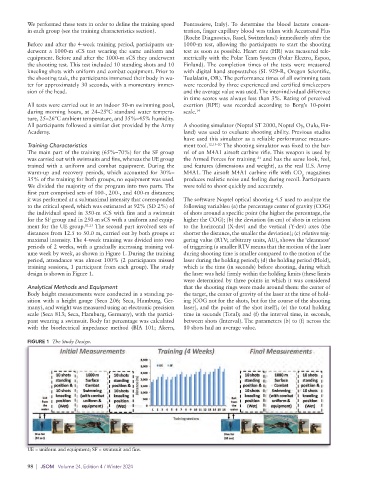
          ume week by week, as shown in Figure 1. During the training   during shooting time is smaller compared to the motion of the
          period, attendance was almost 100% (2 participants missed   laser during the holding period); (d) the holding period (Hold),
          training sessions, 1 participant from each group). The study   which is the time (in seconds) before shooting, during which
          design is shown in Figure 1.                       the laser was held firmly within the holding limits (these limits
                                                             were determined by three points in which it was considered
          Analytical Methods and Equipment                   that the shooting rings were made around them: the center of
          Body height measurements were conducted in a standing po-  the target, the center of gravity of the laser at the time of hold-
          sition with a height gauge (Seca 206; Seca, Hamburg, Ger-  ing [COG not for the shots, but for the course of the shooting
          many), and weight was measured using an electronic precision   laser], and the point of the shot itself); (e) the total holding
          scale (Seca 813; Seca, Hamburg, Germany), with the partici-  time in seconds (Total); and (f) the interval time, in seconds,
          pant wearing a swimsuit. Body fat percentage was calculated   between shots (Interval). The parameters (b) to (f) across the
          with the bioelectrical impedance method (BIA 101;  Akern,   10 shots had an average value.

          FIGURE 1  The Study Design.


          UE = uniform and equipment; SF = swimsuit and fins.

          98  |  JSOM   Volume 24, Edition 4 / Winter 2024

