


Page 105 - JSOM Winter 2024
P. 105
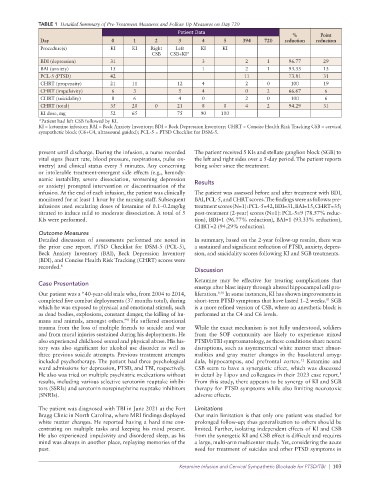
TABLE 1  Detailed Summary of Pre-Treatment Measures and Follow Up Measures on Day 720
                                                           Patient Data
                                                                                                 %        Point
              Day                     0      1      2      3       4      5     394    720    reduction  reduction
              Procedure(s)           KI     KI    Right   Left     KI     KI
                                                   CSB   CSB+KI*
              BDI (depression)       31                            3             2      1      96.77       29
              BAI (anxiety)          15                            1             2      1      93.33       13
              PCL-5 (PTSD)           42                                          11            73.81       31
              CHRT (propensity)      21     11             12      4             2      0       100        19
              CHRT (impulsivity)      6      3             5       4             0      2      66.67       6
              CHRT (suicidality)      8      6             4       0             2      0       100        6
              CHRT (total)           35     20      0      21      8      0      4      2      94.29       31
              KI dose, mg            52     65             75      90    100
              *Patient had left CSB followed by KI.
              KI = ketamine infusion; BAI = Beck Anxiety Inventory; BDI = Beck Depression Inventory; CHRT = Concise Health Risk Tracking CSB = cervical
              sympathetic block (C6+C4, ultrasound guided); PCL-5 = PTSD Checklist for DSM-5.


              present until discharge. During the infusion, a nurse recorded   The patient received 5 KIs and stellate ganglion block (SGB) to
              vital signs (heart rate, blood pressure, respirations, pulse ox-  the left and right sides over a 5-day period. The patient reports
              imetry) and clinical status every 5 minutes. Any concerning   being sober since the treatment.
              or intolerable treatment-emergent side effects (e.g., hemody-
              namic instability, severe dissociation, worsening depression   Results
              or anxiety) prompted intervention or discontinuation of the
              infusion. At the end of each infusion, the patient was clinically   The patient was assessed before and after treatment with BDI,
              monitored for at least 1 hour by the nursing staff. Subsequent   BAI, PCL-5, and CHRT scores. The findings were as follows: pre-
              infusions used escalating doses of ketamine of 0.1–0.2mg/kg   treatment scores (N=1): PCL-5=42, BDI=31, BAI=15, CHRT=35;
              titrated to induce mild to moderate dissociation. A total of 5   post-treatment (2-year) scores (N=1): PCL-5=9 (78.57% reduc-
              KIs were performed.                                tion), BDI=1 (96.77% reduction), BAI=1 (93.33% reduction),
                                                                 CHRT=2 (94.29% reduction).
              Outcome Measures
              Detailed discussion of assessments performed are noted in   In summary, based on the 2-year follow-up results, there was
              the prior case report. PTSD Checklist for DSM-5 (PCL-5),   a sustained and significant reduction of PTSD, anxiety, depres-
              Beck  Anxiety Inventory (BAI), Beck Depression Inventory   sion, and suicidality scores following KI and SGB treatments.
              (BDI), and Concise Health Risk Tracking (CHRT) scores were
              recorded. 8
                                                                 Discussion
                                                                 Ketamine  may be  effective  for treating  complications  that
              Case Presentation
                                                                 emerge after blast injury through altered hippocampal cell pro-
              Our patient was a “40-year-old male who, from 2004 to 2014,   liferation. 9,10  In some instances, KI has shown improvements in
              completed five combat deployments (37 months total), during   short-term PTSD symptoms that have lasted 1–2 weeks.  SGB
                                                                                                            11
              which he was exposed to physical and emotional stimuli, such   is a more refined version of CSB, where an anesthetic block is
              as dead bodies, explosions, constant danger, the killing of hu-  performed at the C4 and C6 levels.
              mans and animals, amongst others.”  He suffered emotional
                                           8
              trauma from the loss of multiple friends to suicide and war   While the exact mechanism is not fully understood, soldiers
              and from moral injuries sustained during his deployments. He   from the SOF community are likely to experience mixed
              also experienced childhood sexual and physical abuse. His his-  PTSD/bTBI symptomatology, as these conditions share neural
              tory was also significant for alcohol use disorder as well as   disruptions, such as asymmetrical white matter tract abnor-
              three previous suicide attempts. Previous treatment attempts   malities and gray matter changes in the basolateral amyg-
                                                                                                   12
              included psychotherapy. The patient had three psychological   dala,  hippocampus,  and  prefrontal  cortex.   Ketamine  and
              ward admissions for depression, PTSD, and TBI, respectively.   CSB seem to have a synergistic effect, which was discussed
              He also was tried on multiple psychiatric medications without   in detail by Lipov and colleagues in their 2023 case report.
                                                                                                                8
              results, including various selective serotonin reuptake inhibi-  From this study, there appears to be synergy of KI and SGB
              tors (SSRIs) and serotonin norepinephrine reuptake inhibitors   therapy for PTSD symptoms while also limiting neurotoxic
              (SNRIs).                                           adverse effects.

              The patient was diagnosed with TBI in June 2021 at the Fort   Limitations
              Bragg Clinic in North Carolina, where MRI findings displayed   Our main limitation is that only one patient was studied for
              white matter changes. He reported having a hard time con-  prolonged follow-up; thus generalization to others should be
              centrating on multiple  tasks and keeping his mind present.   limited. Further, isolating independent effects of KI and CSB
              He also experienced impulsivity and disordered sleep, as his   from the synergetic KI and CSB effect is difficult and requires
              mind was always in another place, replaying memories of the     a large, multi-arm multicenter study. Yet, considering the acute
              past.                                              need for treatment of suicides and other PTSD symptoms in

                                                            Ketamine Infusion and Cervical Sympathetic Blockade for PTSD/TBI  |  103

