


Page 102 - JSOM Winter 2024
P. 102
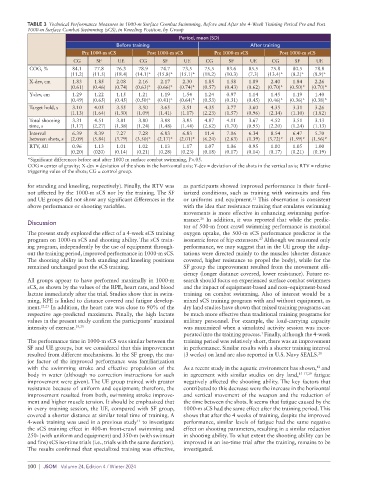
TABLE 3  Technical Performance Measures in 1000-m Surface Combat Swimming, Before and After the 4-Week Training Period Pre and Post
          1000-m Surface Combat Swimming (sCS), in Kneeling Position, by Group
                                                            Period, mean (SD)
                                       Before training                             After training
                            Pre 1000-m sCS       Post 1000-m sCS       Pre 1000-m sCS       Post 1000-m sCS
                         CG      SF     UE     CG     SF     UE     CG      SF     UE     CG     SF     UE
           COG, %        84.1   77.8   76.3   78.9   74.7    73.5   75.5   83.6   85.5   75.8    80.5   78.8
                        (11.2)  (11.5)  (18.4)  (14.1)*  (15.8)*  (15.1)*  (18.2)  (10.3)  (7.3)  (13.4)*  (8.2)*  (8.9)*
           X-dev, cm     1.83   1.85   2.08   2.16   2.17    2.30   1.85   1.58   1.89   2.40    1.84   2.26
                        (0.61)  (0.46)  (0.74)  (0.63)*  (0.66)*  (0.74)*  (0.57)  (0.43)  (0.62)  (0.70)*  (0.50)*  (0.70)*
           Y-dev, cm     1.29   1.22   1.15   1.21   1.19    1.54   1.24   0.97   1.14   1.45    1.19   1.40
                        (0.49)  (0.65)  (0.45)  (0.50)*  (0.41)*  (0.64)*  (0.53)  (0.31)  (0.45)  (0.46)*  (0.36)*  (0.38)*
           Target hold, s  3.10   4.05   3.55   3.50   3.65   3.51   4.35   3.77   3.60   4.35   3.31   3.26
                        (1.13)  (1.64)  (1.30)  (1.09)  (1.41)  (1.17)  (2.23)  (1.57)  (0.96)  (2.14)  (1.10)  (1.82)
           Total shooting   3.31   4.51   3.81   3.80   3.88   3.85   4.87   4.11   3.67   4.52   3.51   3.13
           time, s      (1.17)  (2.27)  (1.38)  (1.24)  (1.48)  (1.44)  (2.62)  (1.70)  (0.95)  (2.20)  (1.24)  (1.13)
           Interval      6.39   8.39   7.27   7.28   6.83    6.83   11.4   7.06   6.34   8.54    6.47   5.70
           between shots, s  (2.09)  (5.84)  (3.79)  (3.50)*  (2.17)*  (2.01)*  (6.24)  (2.63)  (1.39)  (3.72)*  (1.59)*  (1.56)*
           RTV, AU       0.96   1.13   1.01   1.02   1.13    1.17   1.07   1.06   0.95   1.00    1.05   1.00
                        (0.20)  (020)  (0.14)  (0.21)  (0.28)  (0.23)  (0.18)  (0.17)  (0.14)  (0.17)  (0.21)  (0.19)
          *Significant differences before and after 1000 m surface combat swimming, P<.05.
          COG = center of gravity; X-dev = deviation of the shots in the horizontal axis; Y-dev = deviation of the shots in the vertical axis; RTV = relative
          triggering value of the shots; CG = control group.

          for standing and kneeling, respectively). Finally, the RTV was   as participants showed improved performance in their famil-
          not affected by the 1000-m sCS nor by the training. The SF   iarized  conditions,  such  as  training  with  swimsuits  and  fins
          and UE groups did not show any significant differences in the   or uniforms and equipment.  This observation is consistent
                                                                                    11
          above performance or shooting variables.           with the idea that resistance training that emulates swimming
                                                             movements is more effective in enhancing swimming perfor-
                                                             mance.  In addition, it was reported that while the predic-
                                                                  26
          Discussion
                                                             tor of 500-m front crawl swimming performance is maximal
          The present study explored the effect of a 4-week sCS training   oxygen uptake, the 500-m sCS performance predictor is the
                                                                                      27
          program on 1000-m sCS and shooting ability. The sCS train-  isometric force of hip extensors.  Although we measured only
          ing program, independently by the use of equipment through-  performance, we may suggest that in the UE group the adap-
          out the training period, improved performance in 1000-m sCS.   tations were directed mainly to the muscles (shorter distance
          The shooting ability in both standing and kneeling positions   covered, higher resistance to propel the body), while for the
          remained unchanged post the sCS training.          SF group the improvement resulted from the movement effi-
                                                             ciency (longer distance covered, lower resistance). Future re-
          All groups appear to have performed maximally in 1000-m   search should focus on experienced surface combat swimmers
          sCS, as shown by the values of the RPE, heart rate, and blood   and the impact of equipment-based and non–equipment-based
          lactate immediately after the trial. Studies show that in swim-  training on combat swimming. Also of interest would be a
          ming, RPE is linked to distance covered and fatigue develop-  mixed sCS training program with and without equipment, as
          ment. 22,23  In addition, the heart rate was close to 90% of the   dry land studies have shown that mixed training programs can
          respective age-predicted maximum. Finally, the high lactate   be much more effective than traditional training programs for
          values in the present study confirm the participants’ maximal   military personnel. For example, the load-carrying capacity
          intensity of exercise. 24,25                       was maximized when a simulated activity session was incor-
                                                                                      1
                                                             porated into the training process.  Finally, although the 4-week
          The performance time in 1000-m sCS was similar between the   training period was relatively short, there was an improvement
          SF and UE groups, but we considered that this improvement   in performance. Similar results with a shorter training interval
          resulted from different mechanisms. In the SF group, the ma-  (3 weeks) on land are also reported in U.S. Navy SEALS. 28
          jor factor of the improved performance was familiarization
          with the swimming stroke and effective propulsion of the   As a recent study in the aquatic environment has shown,  and
                                                                                                        12
          body in water (although no correction instructions for such   in agreement with similar studies on dry land, 15–17,29  fatigue
          improvement were given). The UE group trained with greater   negatively affected the shooting ability. The key factors that
          resistance because of uniform and equipment; therefore, the   contributed to this decrease were the increase in the horizontal
          improvement resulted from both, swimming stroke improve-  and vertical movement of the weapon and the reduction of
          ment and higher muscle tension. It should be emphasized that   the time between the shots. It seems that fatigue caused by the
          in every training session, the UE, compared with SF group,   1000-m sCS had the same effect after the training period. This
          covered a shorter distance at similar total time of training. A   shows that after the 4 weeks of training, despite the improved
          4-week training was used in a previous study  to investigate   performance, similar levels of fatigue had the same negative
                                              11
          the sCS training effect in 400-m front-crawl swimming and   effect on shooting parameters, resulting in a similar reduction
          250- (with uniform and equipment) and 350-m (with swimsuit   in shooting ability. To what extent the shooting ability can be
          and fins) sCS iso-time trials (i.e., trials with the same duration).   improved in an iso-time trial after the training, remains to be
          The results confirmed that specialized training was effective,   investigated.

          100  |  JSOM   Volume 24, Edition 4 / Winter 2024

