


Page 96 - JSOM Winter 2024
P. 96
Our prospective observational study sought to build upon the   non-latex examination gloves. Participants were allotted a
          existing body of literature related to the use of ultrasound in   maximum of three minutes per tissue model; time began with
          the detection of wooden FBs by describing the accuracy of   placement of the ultrasound probe upon the model. They were
          Special Forces (SF) medics’ ability to identify wooden FBs and   asked to determine, in real time, their sonographic impres-
          potentially identifying a threshold size at which a wooden FB   sion of each tissue model regarding the presence or absence
          can be reliably detected using ultrasound on a previously vali-  of an FB. Once they had completed an assessment of one tis-
          dated tissue simulation model.                     sue model, they were immediately moved to the next blinded
                                                             model until they had assessed all 10 models. The study PI and
                                                             AI recorded the participants impression for each model. All
          Methods
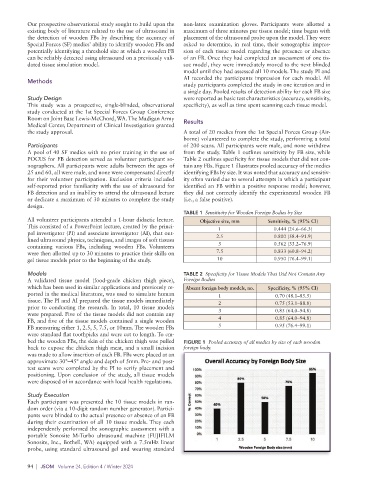
                                                             study participants completed the study in one iteration and in
                                                             a single day. Pooled results of detection ability for each FB size
          Study Design                                       were reported as basic test characteristics (accuracy, sensitivity,
          This  study  was  a  prospective,  single-blinded,  observational   specificity), as well as time spent scanning each tissue model.
          study conducted at the 1st Special Forces Group Conference
          Room on Joint Base Lewis-McChord, WA. The Madigan Army   Results
          Medical Center, Department of Clinical Investigation granted
          the study approval.                                A total of 20 medics from the 1st Special Forces Group (Air-
                                                             borne) volunteered to complete the study, performing a total
          Participants                                       of 200 scans. All participants were male, and none withdrew
          A pool of 40 SF medics with no prior training in the use of   from the study. Table 1 outlines sensitivity by FB size, while
          POCUS for FB detection served as volunteer participant so-  Table 2 outlines specificity for tissue models that did not con-
          nographers. All participants were adults between the ages of   tain any FBs. Figure 1 illustrates pooled accuracy of the medics
          25 and 60, all were male, and none were compensated directly   identifying FBs by size. It was noted that accuracy and sensitiv-
          for their volunteer participation. Exclusion criteria included   ity often varied due to several attempts in which a participant
          self-reported prior familiarity with the use of ultrasound for   identified an FB within a positive response model; however,
          FB detection and an inability to attend the ultrasound lecture   they did not correctly identify the experimental wooden FB
          or dedicate a maximum of 30 minutes to complete the study   (i.e., a false positive).
          design.
                                                             TABLE 1  Sensitivity for Wooden Foreign Bodies by Size
          All volunteer participants attended a 1-hour didactic lecture.   Objective size, mm  Sensitivity, % (95% CI)
          This consisted of a PowerPoint lecture, created by the princi-  1                0.444 (24.6–66.3)
          pal investigator (PI) and associate investigator (AI), that out-
          lined ultrasound physics, techniques, and images of soft tissues   2.5           0.800 (58.4–91.9)
          containing various FBs, including wooden FBs.  Volunteers     5                  0.562 (33.2–76.9)
          were then allotted up to 30 minutes to practice their skills on   7.5            0.833 (60.8–94.2)
          gel tissue models prior to the beginning of the study.        10                 0.950 (76.4–99.1)

          Models                                             TABLE 2  Specificity for Tissue Models That Did Not Contain Any
          A validated tissue model (food-grade chicken thigh piece),   Foreign Bodies
          which has been used in similar applications and previously re-  Absent foreign body models, no.  Specificity, % (95% CI)
          ported in the medical literature, was used to simulate human   1                 0.70 (48.1–85.5)
          tissue. The PI and AI prepared the tissue models immediately   2                 0.75 (53.1–88.8)
          prior to conducting the research. In total, 10 tissue models
          were prepared. Five of the tissue models did not contain any   3                 0.85 (64.0–94.8)
          FB, and five of the tissue models contained a single wooden   4                  0.85 (64.0–94.8)
          FB measuring either 1, 2.5, 5, 7.5, or 10mm. The wooden FBs   5                  0.95 (76.4–99.1)
          were standard flat toothpicks and were cut to length. To em-
          bed the wooden FBs, the skin of the chicken thigh was pulled   FIGURE 1  Pooled accuracy of all medics by size of each wooden
          back to expose the chicken thigh meat, and a small incision   foreign body.
          was made to allow insertion of each FB. FBs were placed at an
          approximate 30°–45° angle and depth of 5mm. Pre- and post-
          test scans were completed by the PI to verify placement and
          positioning. Upon conclusion of the study, all tissue models
          were disposed of in accordance with local health regulations.

          Study Execution
          Each participant was presented the 10 tissue models in ran-
          dom order (via a 10-digit random number generator). Partici-
          pants were blinded to the actual presence or absence of an FB
          during their examination of all 10 tissue models. They each
          independently performed the sonographic assessment with a
          portable Sonosite M-Turbo ultrasound machine (FUJIFILM
          Sonosite, Inc., Bothell, WA) equipped with a 7.5mHz linear
          probe,  using standard  ultrasound  gel  and  wearing  standard

          94  |  JSOM   Volume 24, Edition 4 / Winter 2024

