


Page 34 - JSOM Spring 2023
P. 34
from the Israeli Defence Force (IDF), and one from a local   to hospital. The reported success rate of intubation is therefore
          national Iraqi population. Seven reported whether or not the   likely biased upwards.
          intubation attempts were successful (Table 1).
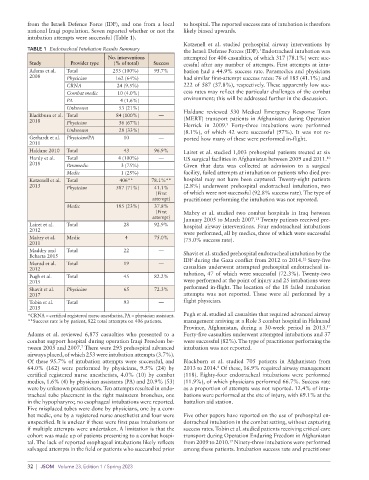
                                                             Katzenell et al. studied prehospital airway interventions by
          TABLE 1  Endotracheal Intubation Results Summary   the Israeli Defense Forces (IDF). Endotracheal intubation was
                                                                                      1
                                    No. interventions        attempted for 406 casualties, of which 317 (78.1%) were suc-
           Study        Provider type  (% of total)  Success  cessful after any number of attempts. First attempts at intu-
           Adams et al.   Total       253 (100%)   95.7%     bation had a 44.9% success rate. Paramedics and physicians
           2008        Physician       162 (64%)             had similar first-attempt success rates: 76 of 185 (41.1%) and
                       CRNA            24 (9.5%)             222 of 587 (37.8%), respectively. These apparently low suc-
                       Combat medic    10 (4.0%)             cess rates may reflect the particular challenges of the combat
                       PA               4 (1.6%)             environment; this will be addressed further in the discussion.
                       Unknown          53 (21%)
           Blackburn et al.   Total    84 (100%)     —       Haldane reviewed 530 Medical Emergency Response  Team
           2018        Physician        56 (67%)             (MERT) transport patients in Afghanistan during Operation
                                                                           9
                                                             Herrick in 2009.  Forty-three intubations were performed
                       Unknown          28 (33%)             (8.1%), of which 42 were successful (97%).  It was not re-
           Gerhardt et al.   Physician/PA  10        —       ported how many of these were performed in-flight.
           2011
           Haldane 2010  Total           43        96.9%     Lairet et al. studied 1,003 prehospital patients treated at six
           Hardy et al.   Total         4 (100%)     —       US surgical facilities in Afghanistan between 2009 and 2011.
                                                                                                            10
           2018        Paramedic         3 (75%)             Given that data was collected at admission to a surgical
                       Medic             1 (25%)             facility, failed attempts at intubation or patients who died pre-
           Katzenell et al.  Total      406**      78.1%**   hospital may not have been captured. Twenty-eight patients
           2013        Physician       587 (71%)   41.1%     (2.8%) underwent prehospital  endotracheal  intubation, two
                                                    (First   of which were not successful (92.8% success rate). The type of
                                                   attempt)  practitioner performing the intubation was not reported.
                       Medic           185 (23%)   37.8%
                                                    (First   Mabry et al. studied two combat hospitals in Iraq between
                                                   attempt)  January 2005 to March 2007.  Twenty patients received pre-
                                                                                     11
           Lairet et al.   Total         28        92.9%     hospital airway interventions. Four endotracheal intubations
           2012                                              were performed, all by medics, three of which were successful
           Mabry et al.   Medic           4        75.0%     (75.0% success rate).
           2011
           Maddry and   Total            22          —       Shavit et al. studied prehospital endotracheal intubation by the
           Bebarta 2015                                      IDF during the Gaza conflict from 2012 to 2014.  Sixty-five
                                                                                                    12
           Murad et al.   Total          19          —
           2012                                              casualties underwent attempted prehospital endotracheal in-
           Pugh et al.   Total           45        82.2%     tubation, 47 of which were successful (72.3%). Twenty-two
           2015                                              were performed at the point of injury and 25 intubations were
           Shavit et al.   Physician     65        72.3%     performed in-flight. The location of the 18 failed intubation
           2017                                              attempts was not reported.  These were all performed by a
           Tobin et al.   Total          93          —       flight physician.
           2015
          *CRNA = certified registered nurse anesthetist, PA = physician assistant.  Pugh et al. studied all casualties that required advanced airway
          **Success rate is by patient, 822 total attempts on 406 patients.  management arriving at a Role 3 combat hospital in Helmand
                                                             Province,  Afghanistan, during a 30-week period in 2013.
                                                                                                            17
          Adams  et  al. reviewed  6,875  casualties  who  presented  to  a   Forty-five casualties underwent attempted intubations and 37
          combat support hospital during operation Iraqi Freedom be-  were successful (82%). The type of practitioner performing the
                            7
          tween 2005 and 2007.  There were 293 prehospital advanced   intubation was not reported.
          airways placed, of which 253 were intubation attempts (3.7%).
          Of these 95.7% of intubation attempts were successful, and   Blackburn et al. studied 705 patients in  Afghanistan from
          64.0% (162) were performed by physicians, 9.5% (24) by   2013 to 2014.  Of these, 16.9% required airway management
                                                                        8
          certified registered nurse anesthetists, 4.0% (10) by combat   (118). Eighty-four endotracheal intubations were performed
          medics, 1.6% (4) by physician assistants (PA) and 20.9% (53)   (11.9%), of which physicians performed 66.7%. Success rate
          were by unknown practitioners. Ten attempts resulted in endo-  as a proportion of attempts was not reported. 12.4% of intu-
          tracheal tube placement in the right mainstem bronchus, one   bations were performed at the site of injury, with 69.1% at the
          in the hypopharynx; no esophageal intubations were reported.   battalion aid station.
          Five misplaced tubes were done by physicians, one by a com-
          bat medic, one by a registered nurse anesthetist and four were   Five other papers have reported on the use of prehospital en-
          unspecified. It is unclear if these were first pass intubations or   dotracheal intubation in the combat setting, without capturing
          if multiple attempts were undertaken. A limitation is that the   success rates. Tobin et al. studied patients receiving critical care
          cohort was made up of patients presenting to a combat hospi-  transport during Operation Enduring Freedom in Afghanistan
          tal. The lack of reported esophageal intubations likely reflects   from 2009 to 2010.  Ninety-three intubations were performed
                                                                            17
          salvaged attempts in the field or patients who succumbed prior   among these patients. Intubation success rate and practitioner
          32  |  JSOM   Volume 23, Edition 1 / Spring 2023

