


Page 36 - JSOM Spring 2023
P. 36
Registry) from 2007 to 2009 to identify all patients who re-  TABLE 3  Supraglottic Airway Results Summary
          ceived prehospital cricothyroidotomy in  Afghanistan and                      No. interventions
              21
          Iraq.  Seventy-two cricothyroidotomies were performed with   Study  Provider type  (% of total)  Success
          49 being successful (68%); 45 were performed by medics, and   Adams et al.   Total  23      91.3%
          27 were performed by physicians or PAs. Of the 45 done by   2008  Medic         14 (61%)
          medics, 28 were successful (62%). Of the 27 done by physi-
          cians/PAs, 21 were successful (77%).                            Physician        5 (22%)
                                                                          Unknown          4 (17%)
          Mabry et al. reported on 20 patients with prehospital airway   Blackburn et al.  Total  5     —
                     21
          interventions.   Three cricothyroidotomies were performed,   2018  Medic         3 (60%)
          all by medics, with two being successful (66%). Pugh et al.     Physician        1 (20%)
          reported on 14 cricothyroidotomies performed  in Helmand        Unknown          1 (20%)
          province Afghanistan; 12 were successful (86%).  Practitioner   Haldane 2010  Total  2      50.0%
                                               22
          training was not reported. Schauer et al. examined the Depart-  Hardy et al.   Total  22      —
          ment of Defense Trauma Registry and the Prehospital Trauma   2018  Medic        14 (64%)
          Registry from 2013 to 2014 in Afghanistan for cricothyroi-      Paramedic        8 (36%)
          dotomies performed by medics using commercially available
          kits. Four were attempted and three were successful (75%). 23  Mabry et al.   Medic  12     91.7%
                                                              2011
                                                              Pugh et al. 2015 Total         6        50.0%
          Blackburn et al. found that of 132 patients that required an
          airway management procedure, 16 cricothyroidotomies were   Schauer, April,   Total  1         —
                                                              Simon, et al.
                        8
          performed (12%).  On five occasions, cricothyroidotomy was   2017
          used as a rescue technique after another airway procedure was   Shavit et al.   Physician  18  88.9%
          attempted. Eight cricothyroidotomies were performed by med-  2017
          ics and eight were performed by physicians.
                                                             success (50%). Mabry et al. studied 20 patients with prehospi-
          Seven studies reported the usage of cricothyroidotomy in the   tal airway interventions.  Eleven Combitubes were placed and
                                                                                11
          combat setting, without reporting success rate. Gerhardt et al.   one LMA. All were by medics, and 11 were successful (92%).
          studied 318 casualties in Iraq, and four cricothyroidotomies   Shavit et al. studied 18 patients who underwent LMA as a
                             14
          were performed (1.3%).  One was performed by a medic and   rescue intervention after failed intubation, 16 were successful
          three were performed by physicians. Haldane et al. studied 530   (89%).  These were performed by a flight physician. Pugh et
                                                                   12
          patients transported by MERT and 13 cricothyroidotomies   al. reported on six supraglottic airways, and three were suc-
                             9
          were performed (2.5%).  Hardy et al. studied 617 patients   cessful (50%).  The training level of the care providers was
                                                                        22
          requiring airway interventions  and 28 cricothyroidotomies   not reported.
          (4.5%) were performed: 15 by medics, 10 by paramedics, and
          three by unspecified providers. Maddry and Bebarta studied   Three remaining studies reported on the use of supraglottic
          1,022 medevac records and 19 cricothyroidotomies were per-  airways, but without specifically reporting success rates. Black-
          formed (1.8%). Murad et al. studied 2,788 Iraqi trauma pa-  burn et al. studied 132 airway procedures; four (3.0%) were
                                                15
          tients and one cricothyroidotomy was performed.  Schauer et   supraglottic airways.  Three were performed by medics, and
                                                                             8
          al. studied the Department of Defense Trauma Registry and   one by a medical officer. Hardy et al. studied 617 airway inter-
          the Prehospital Trauma Registry, for Iraq and Afghanistan for   ventions.  Twenty-two supraglottic airways were performed
                                                                    13
          mass casualty events between 2011 to 2014 and found one cri-  (3.6%), 14 by medics, and eight by paramedics. Schauer et al.
          cothyroidotomy.  Tobin et al. studied critical care transport   studied 2017 patients involved in mass casualty events, and
                       24
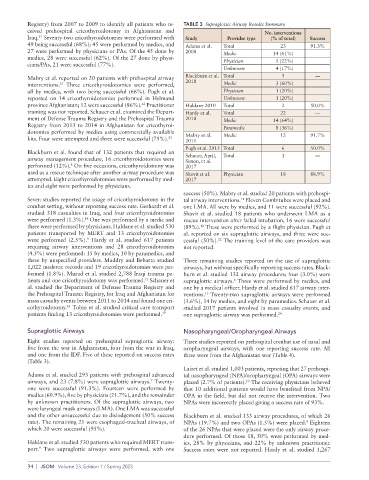
          patients finding 13 cricothyroidotomies were performed. 17  one supraglottic airway was performed. 24
          Supraglottic Airways                               Nasopharyngeal/Oropharyngeal Airways
          Eight  studies  reported  on  prehospital  supraglottic  airway:     Three studies reported on prehospital combat use of nasal and
          five from the war in Afghanistan, four from the war in Iraq,   oropharyngeal airways, with one reporting success rate. All
          and one from the IDF. Five of these reported on success rates   three were from the Afghanistan war (Table 4).
          (Table 3).
                                                             Lairet et al. studied 1,003 patients, reporting that 27 prehospi-
          Adams et al. studied 293 patients with prehospital advanced   tal nasopharyngeal (NPA)/oropharyngeal (OPA) airways were
                                                  7
          airways, and 23 (7.8%) were supraglottic airways.  Twenty-  placed (2.7% of patients).  The receiving physicians believed
                                                                                 10
          one were successful (91.3%). Fourteen were performed by   that 10 additional patients would have benefited from NPA/
          medics (60.9%), five by physicians (21.7%), and the remainder   OPA in the field, but did not receive the intervention. Two
          by unknown practitioners. Of the supraglottic airways, two   NPAs were incorrectly placed giving a success rate of 93%.
          were laryngeal mask airways (LMA). One LMA was successful
          and the other unsuccessful due to dislodgement (50% success   Blackburn et al. studied 133 airway procedures, of which 26
          rate). The remaining 21 were esophageal-tracheal airways, of   NPAs (19.7%) and two OPAs (1.5%) were placed.  Eighteen
                                                                                                     8
          which 20 were successful (95%).                    of the 26 NPAs that were placed were the only airway proce-
                                                             dure performed. Of those 18, 50% were performed by med-
          Haldane et al. studied 530 patients who required MERT trans-  ics, 28% by physicians, and 22% by unknown practitioner.
          port.  Two supraglottic airways were performed, with one  Success rates were not reported. Hardy et al. studied 1,267
              9
          34  |  JSOM   Volume 23, Edition 1 / Spring 2023

