


Page 37 - JSOM Spring 2023
P. 37
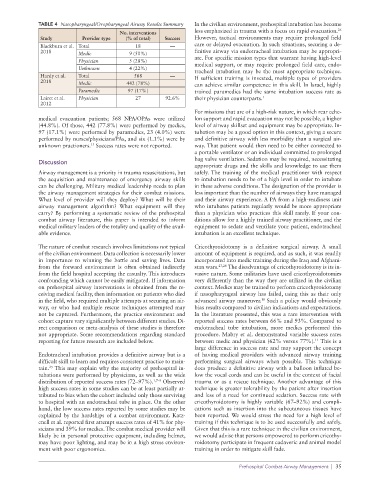
TABLE 4  Nasopharyngeal/Oropharyngeal Airway Results Summary  In the civilian environment, prehospital intubation has become
                                                                                                               26
                                        No. interventions        less emphasized in trauma with a focus on rapid evacuation.
              Study         Provider type  (% of total)  Success  However, tactical environments may require prolonged field
              Blackburn et al.  Total        18          —       care or delayed evacuation. In such situations, securing a de-
              2018         Medic           9 (50%)               finitive airway via endotracheal intubation may be appropri-
                           Physician       5 (28%)               ate. For specific mission types that warrant having high-level
                                                                 medical support, or may require prolonged field care, endo-
                           Unknown         4 (22%)               tracheal intubation may be the most appropriate technique.
              Hardy et al.   Total           568         —       If sufficient training is invested, multiple types of providers
              2018         Medic          442 (78%)              can achieve similar competence in this skill. In Israel, highly
                           Paramedic       97 (17%)              trained paramedics  had the  same intubation success rate  as
              Lairet et al.   Physician      27        92.6%     their physician counterparts. 1
              2012
                                                                 For missions that are of a high-risk nature, in which rear eche-
              medical evacuation patients; 568 NPA/OPAs were utilized   lon support and rapid evacuation may not be possible, a higher
              (44.8%). Of those, 442 (77.8%) were performed by medics,   level of airway skillset and equipment may be appropriate. In-
              97 (17.1%) were performed by paramedics, 23 (4.0%) were   tubation may be a good option in this context, giving a secure
              performed by nurses/physicians/PAs, and six (1.1%) were by   and definitive airway with less morbidity than a surgical air-
              unknown practioners.  Success rates were not reported.  way. That patient would then need to be either connected to
                               13
                                                                 a portable ventilator or an individual committed to prolonged
                                                                 bag valve ventilation. Sedation may be required, necessitating
              Discussion
                                                                 appropriate drugs and the skills and knowledge to use them
              Airway management is a priority in trauma resuscitations, but   safely. The training of the medical  practitioner with respect
              the  acquisition and  maintenance  of emergency  airway skills   to intubation needs to be of a high level in order to intubate
              can be challenging. Military medical leadership needs to plan   in these adverse conditions. The designation of the provider is
              the airway management strategies for their combat missions.   less important than the number of airways they have managed
              What level of provider will they deploy? What will be their   and their airway experience. A PA from a high-readiness unit
              airway  management  algorithm?  What  equipment  will  they   who intubates patients regularly would be more appropriate
              carry? By performing a systematic review of the prehospital   than a physician who practices this skill rarely. If your con-
              combat  airway  literature,  this  paper  is  intended  to  inform   ditions allow for a highly trained airway practitioner, and the
              medical military leaders of the totality and quality of the avail-  equipment to sedate and ventilate your patient, endotracheal
              able evidence.                                     intubation is an excellent technique.

              The nature of combat research involves limitations not typical   Cricothyroidotomy  is  a definitive  surgical  airway.  A  small
              of the civilian environment. Data collection is necessarily lower   amount of equipment is required, and as such, it was readily
              in importance to winning the battle and saving lives. Data   incorporated into medic training during the Iraq and Afghani-
              from the forward environment is often obtained indirectly   stan wars. 27,28  The disadvantage of cricothyroidotomy is its in-
              from the field hospital accepting the casualty. This introduces   vasive nature. Some militaries have used cricothyroidotomies
              confounding which cannot be easily mitigated. If information   very differently than the way they are utilized in the civilian
              on prehospital airway interventions is obtained from the re-  context. Medics may be trained to perform cricothyroidotomy
              ceiving medical facility, then information on patients who died   if nasopharyngeal airway has failed, using this as their only
                                                                                      18
              in the field, who required multiple attempts at securing an air-  advanced airway maneuver.  Such a policy would obviously
              way, or who had multiple rescue techniques attempted may   bias results compared to civilian indications and expectations.
              not be captured. Furthermore, the practice environment and   In the literature presented, this was a rare intervention with
              cohort capture vary significantly between different studies. Di-  reported success rates between 66% and 93%. Compared to
              rect comparison or meta-analysis of these studies is therefore   endotracheal tube intubation, more medics performed this
              not appropriate. Some recommendations regarding standard   procedure. Mabry et al. demonstrated variable success rates
              reporting for future research are included below.  between medic and physician (62% versus 77%).  This is a
                                                                                                        11
                                                                 large difference in success rate and may support the concept
              Endotracheal intubation provides a definitive airway but is a   of having medical providers with advanced airway training
              difficult skill to learn and requires consistent practice to main-  performing surgical airways when possible. This  technique
              tain.  This may explain why the majority of prehospital in-  does produce a definitive airway with a balloon inflated be-
                 25
              tubations were performed by physicians, as well as the wide   low the vocal cords and can be useful in the context of facial
              distribution of reported success rates (72–97%). 1,7–9  Observed   trauma or as a rescue technique. Another advantage of this
              high success rates in some studies can be at least partially at-  technique is greater tolerability by the patient after insertion
              tributed to bias when the cohort included only those surviving   and less of a need for continued sedation. Success rate with
              to hospital with an endotracheal tube in place. On the other   cricothyroidotomy is highly variable (67–92%) and compli-
              hand, the low success rates reported by some studies may be   cations such as insertion into the subcutaneous tissues have
              explained by the hardships of a combat environment. Katz-  been reported. We would stress the need for a high level of
              enell et al. reported first attempt success rates of 41% for phy-  training if this technique is to be used successfully and safely.
              sicians and 39% for medics. The combat medical provider will   Given that this is a rare technique in the civilian environment,
              likely be in personal protective equipment, including helmet,   we would advise that persons empowered to perform cricothy-
              may have poor lighting, and may be in a high stress environ-  roidotomy participate in frequent cadaveric and animal model
              ment with poor ergonomics.                         training in order to mitigate skill fade.

                                                                               Prehospital Combat Airway Management  |  35

