


Page 42 - JSOM Spring 2023
P. 42
CQT students with at least one lower leg injury (20/187 =   TABLE 2  Cause of Musculoskeletal Injuries Among 142 SWCC
          10.7%) was significantly higher than the percentage of SWCC   Operators and 187 CQT Students During a One-Year Period
          Operators with at least one lower leg injury (2/142 = 1.4%;     [Count (Percent)]
          p < 0.001). The percentage of CQT students with at least one   Cause of Injury  SWCC Operators  CQT Students
          knee injury (14/187 = 7.5%) was not significantly different   Climbing       0 (0.0)       2 (2.0)
          than the percentage of SWCC Operators with at least one knee   Compression from Boating  0 (0.0)  1 (1.0)
          injury (9/142 = 6.3%; p = 0.828).                   Crushing                 0 (0.0)       2 (2.0)
                                                              Direct Trauma           5 (13.2)       5 (5.1)
          TABLE 1  Anatomic Sub-Location of Musculoskeletal Injuries
          Among 142 SWCC Operators and 187 CQT Students During a    Fall               3 (7.9)       4 (4.1)
          One-Year Period [Count (Percent)]                   Jump                     1 (2.6)       0 (0.0)
           Anatomic    Anatomic                               Landing                  2 (5.3)       0 (0.0)
           Location   Sub-Location  SWCC Operators CQT Students  Lifting              9 (23.7)       8 (8.2)
           Lower    Hip                0 (0.0)     3 (3.1)    Marching                 1 (2.6)       0 (0.0)
           Extremity  Knee           11 (28.9)   15 (15.3)    Planting                 2 (5.3)       1 (1.0)
                    Ankle              3 (7.9)   11 (11.2)    Pulling                  1 (2.6)       2 (2.0)
                    Thigh              3 (7.9)     9 (9.2)    Running                 6 (15.8)     54 (55.1)
                    Lower leg          2 (5.3)   20 (20.4)    Twist/Turn/Slip (no fall)  2 (5.3)     1 (1.0)
                    Foot and toes      0 (0.0)     7 (7.1)    Whiplash                 0 (0.0)       2 (2.0)
           Upper    Shoulder          8 (21.1)   16 (16.3)    Other                    3 (7.9)     13 (13.3)
           Extremity  Wrist            0 (0.0)     2 (2.0)    Unknown                  3 (7.9)       3 (3.1)
                    Upper arm          1 (2.6)     1 (1.0)    Total                    38            98
                    Hand and fingers   2 (5.3)     5 (5.1)   SWCC = Special Warfare Combatant-Craft Crewman, CQT = Crew-
           Spine    Cervical           0 (0.0)     2 (2.0)   man Qualification Training
                    Lumbopelvic       5 (13.2)     7 (7.1)
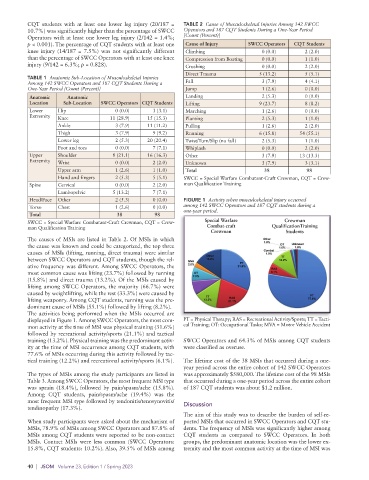
           Head/Face  Other            2 (5.3)     0 (0.0)   FIGURE 1  Activity when musculoskeletal injury occurred
           Torso    Chest              1 (2.6)     0 (0.0)   among 142 SWCC Operators and 187 CQT students during a
                                                             one-year period.
           Total                       38           98
          SWCC = Special Warfare Combatant-Craft Crewman, CQT = Crew-  Special Warfare        Crewman
          man Qualification Training                                 Combat-craft         QualificationTraining
                                                                      Crewman                 Students
          The causes of MSIs are listed in Table 2. Of MSIs in which
          the cause was known and could be categorized, the top three
          causes of MSIs (lifting, running, direct trauma) were similar
          between SWCC Operators and CQT students, though the rel-
          ative frequency was different. Among SWCC Operators, the
          most common cause was lifting (23.7%) followed by running
          (15.8%) and direct trauma (13.2%). Of the MSIs caused by
          lifting among SWCC Operators, the majority (66.7%) were   Combat
                                                                  7.9%
          caused by weightlifting, while the rest (33.3%) were caused by
          lifting weaponry. Among CQT students, running was the pre-
          dominant cause of MSIs (55.1%) followed by lifting (8.2%).
          The activities being performed when the MSIs occurred are
          displayed in Figure 1. Among SWCC Operators, the most com-  PT = Physical Therapy; RAS = Recreational Activity/Sports; TT = Tacti-
          mon activity at the time of MSI was physical training (31.6%)   cal Training; OT: Occupational Tasks; MVA = Motor Vehicle Accident
          followed by recreational activity/sports (21.1%) and tactical
          training (13.2%). Physical training was the predominant activ-  SWCC Operators and 64.3% of MSIs among CQT students
          ity at the time of MSI occurrence among CQT students, with   were classified as overuse.
          77.6% of MSIs occurring during this activity followed by tac-
          tical training (12.2%) and recreational activity/sports (6.1%).  The lifetime cost of the 38 MSIs that occurred during a one-
                                                             year period across the entire cohort of 142 SWCC Operators
          The types of MSIs among the study participants are listed in   was approximately $580,000. The lifetime cost of the 98 MSIs
          Table 3. Among SWCC Operators, the most frequent MSI type   that occurred during a one-year period across the entire cohort
          was sprain (18.4%), followed by pain/spasm/ache (15.8%).   of 187 CQT students was about $1.2 million.
          Among CQT students, pain/spasm/ache (19.4%) was the
          most frequent MSI type followed by tendonitis/tenosynovitis/   Discussion
          tendinopathy (17.3%).
                                                             The aim of this study was to describe the burden of self-re-
          When study participants were asked about the mechanism of   ported MSIs that occurred in SWCC Operators and CQT stu-
          MSIs, 78.9% of MSIs among SWCC Operators and 87.8% of   dents. The frequency of MSIs was significantly higher among
          MSIs among CQT students were reported to be non-contact   CQT  students  as  compared  to  SWCC  Operators.  In  both
          MSIs. Contact MSIs were less common (SWCC Operators:   groups, the predominant anatomic location was the lower ex-
          15.8%, CQT students: 10.2%). Also, 39.5% of MSIs among   tremity and the most common activity at the time of MSI was

          40  |  JSOM   Volume 23, Edition 1 / Spring 2023

