


Page 65 - JSOM Winter 2022
P. 65
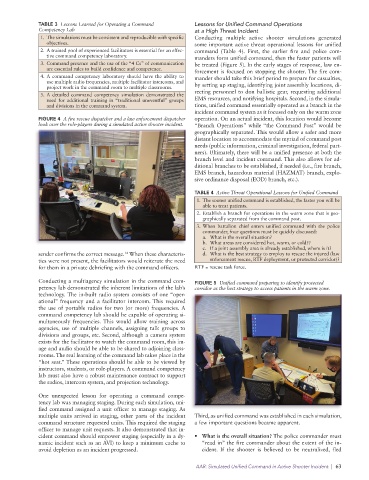
TABLE 3  Lessons Learned for Operating a Command    Lessons for Unified Command Operations
              Competency Lab                                     at a High Threat Incident
              1.  The simulations must be consistent and reproducible with specific   Conducting multiple active shooter simulations generated
                objectives.                                      some important active threat operational lessons for unified
              2.  A trained pool of experienced facilitators is essential for an effec-  command (Table 4). First, the earlier fire and police com-
                tive command competency laboratory.              manders form unified command, then the faster patients will
              3.  Command presence and the use of the “4 Cs” of communication   be treated (Figure 5). In the early stages of response, law en-
                are essential rules to build confidence and competence.  forcement is focused on stopping the shooter. The fire com-
              4.  A command competency laboratory should have the ability to   mander should take this brief period to prepare for casualties,
                use multiple radio frequencies, multiple facilitator intercoms, and   by setting up staging, identifying joint assembly locations, di-
                project work in the command room to multiple classrooms.
              5.  A detailed command competency simulation demonstrated the   recting personnel to don ballistic gear, requesting additional
                need for additional training in “traditional uneventful” groups   EMS resources, and notifying hospitals. Second, in the simula-
                and divisions in the command system.             tions, unified command essentially operated as a branch in the
                                                                 incident command system as it focused only on the warm zone
              FIGURE 4  A fire rescue dispatcher and a law enforcement dispatcher   operation. On an actual incident, this location would become
              look over the role-players during a simulated active shooter incident.  “Branch Operations” while “the Command Post” would be
                                                                 geographically separated. This would allow a safer and more
                                                                 distant location to accommodate the myriad of command post
                                                                 needs (public information, criminal investigation, federal part-
                                                                 ners). Ultimately, there will be a unified presence at both the
                                                                 branch level and incident command. This also allows for ad-
                                                                 ditional branches to be established, if needed (i.e., fire branch,
                                                                 EMS branch, hazardous material (HAZMAT) branch, explo-
                                                                 sive ordinance disposal (EOD) branch, etc.).

                                                                 TABLE 4  Active Threat Operational Lessons for Unified Command
                                                                 1.  The sooner unified command is established, the faster you will be
                                                                   able to treat patients.
                                                                 2.  Establish a branch for operations in the warm zone that is geo-
                                                                   graphically separated from the command post.
                                                                 3.  When battalion chief enters unified command with the police
                                                                   commander, four questions must be quickly discussed:
                                                                   a.  What is the overall situation?
                                                                   b.  What areas are considered hot, warm, or cold??
                                                                   c.  If a joint assembly area is already established, where is it?
                                          14
              sender confirms the correct message.  When these characteris-  d.  What is the best strategy to employ to rescue the injured (law
              tics were not present, the facilitators would reiterate the need   enforcement rescue, RTF deployment, or protected corridor)?
              for them in a private debriefing with the command officers.  RTF = rescue task force.

              Conducting a multiagency simulation in the command com-  FIGURE 5  Unified command preparing to identify protected
              petency lab demonstrated the inherent limitations of the lab’s   corridor as the best strategy to access patients in the warm zone.
              technology. The in-built radio system consists of one “oper-
              ational” frequency  and  a  facilitator  intercom. This  required
              the use of portable radios for two (or more) frequencies. A
              command competency lab should be capable of operating si-
              multaneously frequencies.  This would allow training across
              agencies, use of multiple channels, assigning talk groups to
              divisions and groups, etc. Second, although a camera system
              exists for the facilitator to watch the command room, this im-
              age and audio should be able to be shared to adjoining class-
              rooms. The real learning of the command lab takes place in the
              “hot seat.” These operations should be able to be viewed by
              instructors, students, or role-players. A command competency
              lab must also have a robust maintenance contract to support
              the radios, intercom system, and projection technology.

              One unexpected lesson for operating a command compe-
              tency lab was managing staging. During each simulation, uni-
              fied command assigned a unit officer to manage staging. As
              multiple units arrived in staging, other parts of the incident   Third, as unified command was established in each simulation,
              command structure requested units. This required the staging   a few important questions became apparent.
              officer to manage unit requests. It also demonstrated that in-
              cident command should empower staging (especially in a dy-  •  What is the overall situation? The police commander must
              namic incident such as an AVI) to keep a minimum cache to   “read in” the fire commander about the extent of the in-
              avoid depletion as an incident progressed.           cident. If the shooter is believed to be neutralized, fled

                                                                 AAR: Simulated Unified Command in Active Shooter Incident  |  63

