


Page 68 - JSOM Winter 2022
P. 68
“athletes,” “sleep,” “physical functional performance,” “pain,”   current  narrative  review  focused  on  understanding  whether
          “humans,” “exercise,” and “athletic performance.” Addition-  there is evidence to support the use of FR to enhance physio-
          ally, reference lists of the retrieved articles were assessed for   logical and psychological performance parameters in the SO
          potential inclusion.                               population and to provide postulations as to the mechanisms
                                                             of action of FR therapy.
          Study Selection and Data Extraction
          The inclusion criteria for selecting articles were limited to   The operational tempo for SOs has increased, resulting in
                                                                                                     16
          those published in English and to studies that used FR as an in-  more frequent combat deployments and missions.  To meet
          tervention to improve well-being and performance in healthy   the operational environment’s unique physical, emotional,
          and unhealthy adults and athletes. We combined the initial key   and environmental demands, SOs train rigorously and con-
          terms with “flotation REST.” We performed a final search us-  tinuously. However, this can lead to interconnected health
          ing the following central search terms for all databases: “flota-  problems and degradations in performance. 16,17  For instance,
                                                                      17
          tion REST adults,” “flotation REST athletes,” “flotation REST   Freuh et al.  reported that prolonged exposure to extreme
          sleep,”  “flotation REST physical functional performance,”   environmental conditions and training creates situations in
          “flotation REST pain,” “flotation REST humans,” “flotation   which traditional medical models of healthcare are often inef-
          REST exercise,” and “flotation REST athletic performance.”   fective in treating the interrelated health disorders frequently
          The first two authors (RO, LS) independently searched  pri-  reported in SOs. Comorbid conditions include traumatic brain
          mary and secondary sources, screened titles and abstracts, and   injury, endocrine dysfunction, sleep disturbance, sleep apnea,
          evaluated the full text of published articles potentially relevant   depression, suicide, anger, stress reactivity, chronic joint/back
          to the narrative topic and aims.                   pain, orthopedic issues, worry, rumination, hypervigilance,
                                                             decrements in memory and concentration, and headaches.
                                                                                                            17
                                                             Without precisely timed restoration and recovery periods, the
          Results
                                                             overall performance degradations of SOs will likely progress
          The online database searches produced 39 primary and sec-  to injury and other health-related issues. 16,17
          ondary articles in PubMed and 55 in the Cochrane Library.
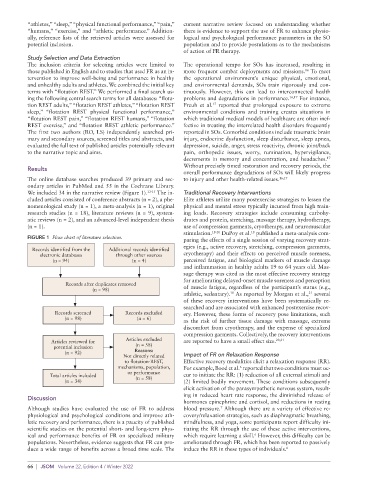
          We included 34 in the narrative review (Figure 1). 13-15  The in-  Traditional Recovery Interventions
          cluded articles consisted of conference abstracts (n = 2), a phe-  Elite athletes utilize many postexercise strategies to lessen the
          nomenological study (n = 1), a meta-analysis (n = 1), original   physical and mental stress typically incurred from high train-
          research studies (n = 18), literature reviews (n = 9), system-  ing loads. Recovery strategies include consuming carbohy-
          atic reviews (n = 2), and an advanced-level independent thesis     drates and protein, stretching, massage therapy, hydrotherapy,
          (n = 1).                                           use of compression garments, cryotherapy, and neuromuscular
                                                                                   18
                                                             stimulation. 18-20  DuPoy et al.  published a meta-analysis com-
          FIGURE 1  Flow chart of literature selection.      paring the effects of a single session of varying recovery strat-
                                                             egies (e.g., active recovery, stretching, compression garments,
            Records identified from the   Additional records identified
              electronic databases     through other sources   cryotherapy) and their effects on perceived muscle soreness,
                  (n = 94)                  (n = 4)          perceived fatigue, and biological markers of muscle damage
                                                             and inflammation in healthy adults 19 to 64 years old. Mas-
                                                             sage therapy was cited as the most effective recovery strategy
                                                             for ameliorating delayed-onset muscle soreness and perception
                      Records after duplicates removed
                               (n = 98)                      of muscle fatigue, regardless of the participant’s status (e.g.,
                                                                            18
                                                             athletic, sedentary).  As reported by Morgan et al.,  several
                                                                                                      21
                                                             of these recovery interventions have been systematically re-
                                                             searched and are associated with enhanced postexercise recov-
                   Records screened       Records excluded   ery. However, these forms of recovery pose limitations, such
                      (n = 98)                (n = 6)        as the risk of further tissue damage with massage, extreme
                                                             discomfort from cryotherapy, and the expense of specialized
                                                             compression garments. Collectively, the recovery interventions
                  Articles reviewed for   Articles excluded   are reported to have a small effect size. 20,21
                   potential inclusion       (n = 58)
                      (n = 92)               Reasons:        Impact of FR on Relaxation Response
                                         Not directly related
                                          to  flotation-REST,   Effective recovery modalities elicit a relaxation response (RR).
                                          mechanisms, population,   For example, Bood et al.  reported that two conditions must oc-
                                                                               6
                                           or performance
                 Total articles included     (n = 58)        cur to initiate the RR: (1) reduction of all external stimuli and
                      (n = 34)                               (2) limited bodily movement. These conditions subsequently
                                                             elicit activation of the parasympathetic nervous system, result-
                                                             ing in reduced heart rate response, the diminished release of
          Discussion
                                                             hormones epinephrine and cortisol, and reductions in resting
                                                                         7
          Although studies have evaluated the use of FR to address   blood pressure.  Although there are a variety of effective re-
          physiological and psychological conditions and improve ath-  covery/relaxation strategies, such as diaphragmatic breathing,
          letic recovery and performance, there is a paucity of published   mindfulness, and yoga, some participants report difficulty ini-
          scientific studies on the potential short- and long-term phys-  tiating the RR through the use of these active interventions,
                                                                                    6
          ical  and  performance  benefits  of  FR  on  specialized  military   which require learning a skill.  However, this difficulty can be
          populations. Nevertheless, evidence suggests that FR can pro-  ameliorated through FR, which has been reported to passively
          duce a wide range of benefits across a broad time scale. The   induce the RR in these types of individuals. 6

          66  |  JSOM   Volume 22, Edition 4 / Winter 2022

