


Page 70 - JSOM Winter 2022
P. 70
FR treatment, and the posttest was administered immediately   FIGURE 2  Postulated synergistic effects of flotation therapy.
          after the FR treatment. Reported objective measures (e.g., ac-  THERMAL    CHEMICAL    MECHANICAL
          curacy, precision) statistically improved (p = .01) after 40 min-  EFFECTS  EFFECTS     EFFECTS
                                                                                       4
          utes of FR. Similar studies are yet to be conducted to assess   Warm Water   MgSO      Whole Body
          the effects of FR on performance in sports in which success   Immersion  (Epsom salt)  Immersion
          depends on bursts of strength or speed, rapidity of reactions,   •  Improved   •  Improved healing   •  Increased blood
          or the ability to make rapid changes of motion or attention.   immunity  time        circulation
          Therefore, additional FR research is warranted in events that   •  Reduced pain  •  Increased mental   •  Increased cell
                                                                               relaxation
                                                                                               oxygenation
                                                              •  Reduced
          emphasize power or speed, such as sprints and field sports. 29  inflammation  •  Increased physical  •  Improved
                                                                               relaxation      cardiovsacular
          The  prospective benefits of  FR as a  performance-enhancing                         functioning
          recovery tool for the Special Forces community are encourag-
          ing. However, FR studies of elite athletes comparable to SOs   are well known. A limited number of researchers have reported
          remain sparse, and most have been performed under labora-  the transdermal absorption of magnesium sulfate through the
          tory conditions rather than in the field. We were able to locate   skin during FR, although many of the studies lacked adequate
          only two published studies on the effects of FR on recovery and   statistical power and had weak experimental designs and lack
                                                    4
          performance in competitive athletes. Driller and Argus  found   of peer review.  One proposed entry point for magnesium sul-
                                                                        5
          small to moderate improvements in mood states and perceived   fate is through the hair follicles, but these represent only 0.1%
          muscle soreness in elite athletes (e.g., basketball, cycling, foot-  to 1% of the total surface area of the skin.  Currently, evidence
                                                                                             5
                                                         7
          ball, rowing, rugby, swimming) exposed to FR. Broderick et al.    is scarce regarding the magnitude of the contribution of mag-
          found small to moderate effects of FR on sleep, physical fatigue,   nesium sulfate effects during an FR session, especially in the
          salivary cortisol levels, perceived muscle soreness, and several   management of pain, improved sleep, anxiety, depression, and
          physical performance measures in a sample of 19 trained male   stress, as well as the precise mechanisms associated with these
                                          7
          athletes (e.g., basketball, football, rugby).  Currently, empirical   improvements. Therefore, exploration is warranted regarding
          evidence is insufficient to fully support the use of FR in elite   the role of magnesium sulfate in FR and its precise mechanism
          military and athletic populations, although a large percentage   of action.
          of elite competitive athletes anecdotally recommend the routine
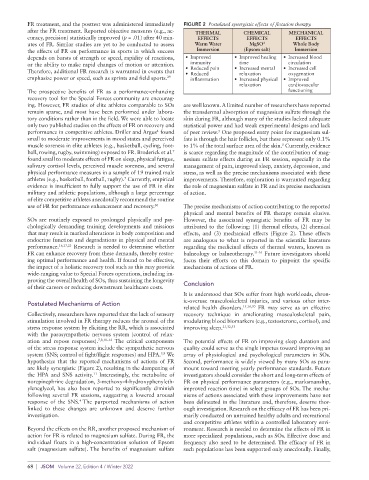
          use of FR for performance enhancement and recovery. 30  The precise mechanisms of action contributing to the reported
                                                             physical and mental benefits of FR therapy remain elusive.
          SOs are routinely exposed to prolonged physically and psy-  However, the associated  synergistic benefits  of FR  may be
          chologically demanding training developments and missions   attributed to the following: (1) thermal effects, (2) chemical
          that may result in marked alterations in body composition and   effects, and (3) mechanical effects (Figure 2).  These effects
          endocrine function and degradations in physical and mental   are analogous to what is reported in the scientific literature
          performance. 16,17,23  Research is needed to determine whether   regarding the medicinal effects of thermal waters, known as
          FR can enhance recovery from these demands, thereby restor-  balneology or balneotherapy. 31-34  Future investigators should
          ing optimal performance and health. If found to be effective,   focus their efforts on this domain to pinpoint the specific
          the impact of a holistic recovery tool such as this may provide   mechanisms of actions of FR.
          wide-ranging value to Special Forces operations, including im-
          proving the overall health of SOs, thus sustaining the longevity   Conclusion
          of their careers or reducing downstream healthcare costs.
                                                             It is understood that SOs suffer from high workloads, chron-
                                                             ic-overuse musculoskeletal injuries, and various other inter-
          Postulated Mechanisms of Action
                                                             related  health  disorders. 15,16,30   FR  may  serve  as  an  effective
          Collectively, researchers have reported that the lack of sensory   recovery technique in ameliorating musculoskeletal pain,
          stimulation involved in FR therapy reduces the arousal of the   modulating blood biomarkers (e.g., testosterone, cortisol), and
          stress response system by eliciting the RR, which is associated   improving sleep. 21,32,33
          with  the parasympathetic  nervous  system  (control  of relax-
          ation and repose responses). 7,8,10–12   The critical components   The potential effects of FR on improving sleep duration and
          of the stress response system include the sympathetic nervous   quality could serve as the single impetus toward improving an
                                                      3,9
          system (SNS; control of fight/flight responses) and HPA.  We   array of physiological and psychological parameters in SOs.
          hypothesize  that  the  reported  mechanisms  of  actions  of  FR   Second, performance is widely viewed by many SOs as para-
          are likely synergistic (Figure 2), resulting in the dampening of   mount toward meeting yearly performance standards. Future
                                11
          the HPA and SNS activity.  Interestingly, the metabolite of   investigators should consider the short and long-term effects of
          norepinephrine degradation, 3-methoxy-4-hydroxyphenyleth-  FR on physical performance parameters (e.g., marksmanship,
          yleneglycol, has also been reported to significantly diminish   improved reaction time) in select groups of SOs. The mecha-
          following several FR sessions, suggesting a lowered arousal   nisms of actions associated with these improvements have not
          response of the SNS. The purported mechanisms of action   been delineated in the literature and, therefore, deserve thor-
                           4
          linked to these changes are unknown and deserve further   ough investigation. Research on the efficacy of FR has been pri-
          investigation.                                     marily conducted on untrained healthy adults and recreational
                                                             and competitive athletes within a controlled laboratory envi-
          Beyond the effects on the RR, another proposed mechanism of   ronment. Research is needed to determine the effects of FR in
          action for FR is related to magnesium sulfate. During FR, the   more specialized populations, such as SOs. Effective dose and
          individual  floats in  a high-concentration  solution of  Epsom   frequency also need to be determined. The efficacy of FR in
          salt (magnesium sulfate). The benefits of magnesium sulfate    such populations has been supported only anecdotally. Finally,

          68  |  JSOM   Volume 22, Edition 4 / Winter 2022

