


Page 64 - JSOM Winter 2022
P. 64
9
          TABLE 1  Key Tenets for Command Officers           intensity.  This helped standardized the jurisdiction’s response
           Law Enforcement Supervisor  Fire and Rescue Command Officer  to an AVI. By providing these simulations (supported by facil-
           •  Acknowledge AVI and   •  Acknowledge AVI and request   itators), the participants left more confident in commanding a
            request additional resources.  additional resources.  response to an AVI.
           •  Monitor deployment of   •  Identify a Staging Location.
            contact teams.       •  Announce need for ballistic PPE   The authors also identified two important observations about
           •  Gains early situational   and TECC kits.       commanding the response to a high threat incident: 1) do not
            awareness.           •  Build up plan and resources for
           •  Declaration of a warm zone.  mass casualties.  hesitate to deploy medical personnel into the warm zone, and
           •  Announces unified                              2) deploy multiple warm zone care strategies (i.e., RTF teams
            command location and                             and protected corridor). First, participants hesitated to request
            requests Fire and Rescue                         unified  command, delaying  entry  of medical  personnel  into
            Command Officer.                                 the warm zone. The command officers were seeking definite
           Unified Command Objectives                        confirmation that one shooter existed and was stopped. Facil-
           •  Establish and announce unified command.        itators pointed out that there will always be uncertainty when
           •  Share information to establish a common operating picture.  contact  teams  report  that  the  shooter  was  apprehended  (or
           •  Determine a joint strategy to access, treat, and extract patients
            (i.e., RTF teams, protected corridor, etc.).     “down”). Reports of a second shooter are common during an
           •  Establish joint assembly area and begin forming joint teams.   AVI. 11,12  According to an FBI 18-year review of active shooter
            Maintain accountability of these teams from formation to   incidents, only 1% of incidents consisted of more than one
            deployment.                                      shooter.  The establishment of a warm zone should be based
                                                                   13
           •  Locate, treat, and remove patients from the warm zone through   on  probability, not  possibility  of  a second  shooter. This  ac-
            effective face-to-face and radio communication between law
            enforcement and fire and rescue.                 knowledgement helps shorten the time to get fire and rescue
           •  Utilize the four “Cs” of communication with and across agencies   personnel (as RTF teams or through a protected corridor) into
            for effective communication.                     the warm zone to treat patients. Role-player provided key in-
           •  Demonstrate command presence.                  formation to the command officers over the radio, such as “the
          AVI = acts of violence, TECC = tactical emergency casualty care, PPE =   down shooter matches the description” and “we do not hear
          personal protective equipment, RTF = rescue task force.  any more gun shots in the building.” Second, one of the AVI
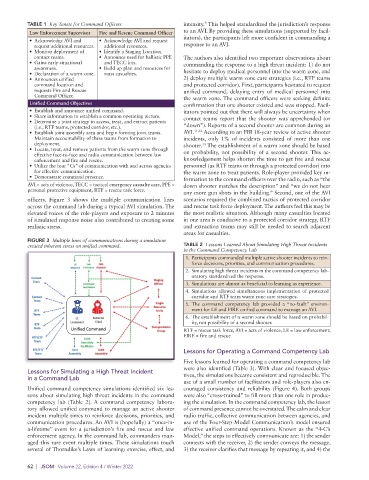
          officers. Figure 3 shows the multiple communication lines   scenarios required the combined tactics of protected corridor
          across the command lab during a typical AVI simulation. The   and rescue task force deployment. The authors feel this may be
          elevated voices of the role-players and exposure to 2 minutes   the most realistic situation. Although many casualties located
          of simulated response noise also contributed to creating some   in one area is conducive to a protected corridor strategy, RTF
          realistic stress.                                  and extraction teams may still be needed to search adjacent
                                                             areas for casualties.
          FIGURE 3  Multiple lines of communications during a simulation
          created inherent stress on unified command.        TABLE 2  Lessons Learned About Simulating High Threat Incidents
                                                             in the Command Competency Lab
                                                              1.  Participants commanded multiple active shooter incidents to rein-
                                                                force decisions, priorities, and communication procedures.
                                                              2.  Simulating high threat incidents in the command competency lab-
                                                                oratory standardized the response.
                                                              3.  Simulations are almost as beneficial to learning as experience.
                                                              4.  Simulations  allowed  simultaneous  implementation  of  protected
                                                                corridor and RTF team warm zone care strategies.
                                                              5.  The command  competency  lab provided a “no-fault” environ-
                                                                ment for LE and FIRE unified command to manage an AVI.
                                                              6.  The establishment of a warm zone should be based on probabil-
                                                                ity, not possibility of a second shooter.
                                                             RTF = rescue task force, AVI = acts of violence, LE = law enforcement;
                                                             FIRE = fire and rescue

                                                             Lessons for Operating a Command Competency Lab
                                                             Five lessons learned for operating a command competency lab
                                                             were also identified (Table 3). With clear and focused objec-
          Lessons for Simulating a High Threat Incident
          in a Command Lab                                   tives, the simulations became consistent and reproducible. The
                                                             use of a small number of facilitators and role-players also en-
          Unified command competency simulations identified six les-  couraged consistency and reliability (Figure 4). Both groups
          sons about simulating high threat incidents in the command   were also “cross-trained” to fill more than one role in produc-
          competency lab (Table 2). A command competency labora-  ing the simulation. In the command competency lab, the lesson
          tory allowed unified command to manage an active shooter   of command presence cannot be overstated. The calm and clear
          incident multiple times to reinforce decisions, priorities, and   radio traffic, collective communication between agencies, and
          communication procedures. An AVI is (hopefully) a “once-in-  use of the Four-Step Model Communication’s model ensured
          a-lifetime” event for a jurisdiction’s fire and rescue and law   effective unified command operations. Known as the “4-C’s
          enforcement agency. In the command lab, commanders man-  Model,” the steps to effectively communicate are: 1) the sender
          aged this rare event multiple times. These simulations touch   connects with the receiver, 2) the sender conveys the message,
          several of Thorndike’s Laws of learning: exercise, effect, and   3) the receiver clarifies that message by repeating it, and 4) the

          62  |  JSOM   Volume 22, Edition 4 / Winter 2022

