


Page 60 - JSOM Winter 2022
P. 60
Results                                            FIGURE 1  Comparison of data collections 1 (heavy), 2 (25-grain,
                                                             50-grain charges), and 3 hockey puck–style (HP).
          Hypothesis 1 was evaluated by recording breach success per
          charge. The success rate of untamped and tamped charges for     Summary of PSI as Measured from Charge
          heavy breaching was 100%, whereas that of the untamped   25                   26 ft from   11 ft from charge
          charges for light breaching applications was 50% and that of   20             charge
          the tamped was 100%. There were two unsuccessful breaches:
          one untamped 25-grain charge (door hung improperly) and   PSI  15
          one untamped 50-grain charge. As previously mentioned, all   10
          charges in this phase used a rubber push, with the explosive
          secured to the push for best effect.                   5
                                                                 0
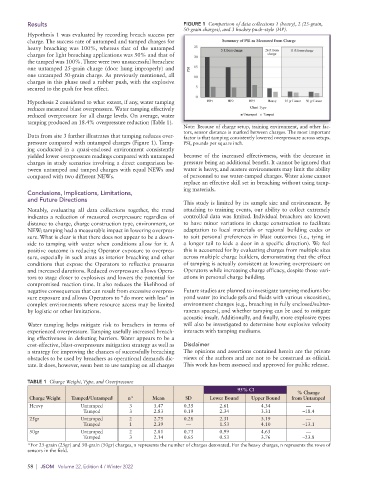
          Hypothesis 2 considered to what extent, if any, water tamping   HP1                  HP2                   HP3                Heavy          25 gr Linear      50 gr Linear
          reduces measured blast overpressure. Water tamping effectively           Chart Type
          reduced overpressure for all charge levels. On average, water          Untamped  Tamped
          tamping produced an 18.4% overpressure reduction (Table 1).
                                                             Note: Because of charge setup, training environment, and other fac-
                                                             tors, sensor distance is marked between charges. The most important
          Data from site 3 further illustrates that tamping reduces over-  factor is that tamping consistently lowered overpressure across setups.
          pressure compared with untamped charges (Figure 1). Tamp-  PSI, pounds per square inch.
          ing  conducted  in  a  quasi-enclosed  environment  consistently
          yielded lower overpressure readings compared with untamped   because of the increased effectiveness, with the decrease in
          charges in study scenarios involving a direct comparison be-  pressure being an additional benefit. It cannot be ignored that
          tween untamped and tamped charges with equal NEWs and   water is heavy, and austere environments may limit the ability
          compared with two different NEWs.                  of personnel to use water-tamped charges. Water alone cannot
                                                             replace an effective skill set in breaching without using tamp-
                                                             ing materials.
          Conclusions, Implications, Limitations,
          and Future Directions
                                                             This study is limited by its sample size and environment. By
          Notably, evaluating all data collections together, the trend   attaching to training events, our ability to collect extremely
          indicates a reduction of measured overpressure regardless of   controlled data was limited. Individual breachers are known
          distance to charge, charge construction type, environment, or   to have minor variations in charge construction to facilitate
          NEW; tamping had a measurable impact in lowering overpres-  adaptation to local materials  or regional building codes or
          sure. What is clear is that there does not appear to be a down-  to suit personal preferences in blast outcomes (i.e., tying in
          side to tamping with water when conditions allow for it. A   a longer tail to kick a door in a specific direction). We feel
          positive outcome is reducing Operator exposure to overpres-  this is accounted for by evaluating charges from multiple sites
          sure, especially in such areas as interior breaching and other   across multiple charge builders, demonstrating that the effect
          conditions that expose the Operators to reflective pressures   of tamping is actually consistent at lowering overpressure on
          and increased durations. Reduced overpressure allows Opera-  Operators while increasing charge efficacy, despite those vari-
          tors to stage closer to explosives and lowers the potential for   ations in personal charge building.
          compromised reaction time. It also reduces the likelihood of
          negative consequences that can result from excessive overpres-  Future studies are planned to investigate tamping mediums be-
          sure exposure and allows Operators to “do more with less” in   yond water (to include gels and fluids with various viscosities),
          complex environments where resource access may be limited   environment changes (e.g., breaching in fully enclosed/subter-
          by logistic or other limitations.                  ranean spaces), and whether tamping can be used to mitigate
                                                             acoustic insult. Additionally, and finally, more explosive types
          Water tamping helps mitigate risk to breachers in terms of   will also be investigated to determine how explosive velocity
          experienced overpressure. Tamping usefully increased breach-  interacts with tamping mediums.
          ing effectiveness in defeating barriers. Water appears to be a
          cost-effective, blast-overpressure mitigation strategy as well as   Disclaimer
          a strategy for improving the chances of successfully breaching   The opinions and assertions contained herein are the private
          obstacles to be used by breachers as operational demands dic-  views of the authors and are not to be construed as official.
          tate. It does, however, seem best to use tamping on all charges   This work has been assessed and approved for public release.

          TABLE 1  Charge Weight, Type, and Overpressure
                                                                               95% CI
                                                                                                  % Change
           Charge Weight  Tamped/Untamped  n*      Mean       SD      Lower Bound  Upper Bound  from Untamped
           Heavy           Untamped        3       3.47      0.35        2.61         4.34           —
                            Tamped         3       2.83      0.19        2.34         3.31          –18.4
           25gr            Untamped        2       2.75      0.28        2.31         3.19           —
                            Tamped         1       2.39       —          1.53         4.10          –13.1
           50gr            Untamped        2       2.81      0.73        0.99         4.63           —
                            Tamped         3       2.14      0.65        0.53         3.76          –23.8
          *For 25-grain (25gr) and 50-grain (50gr) charges, n represents the number of charges detonated. For the heavy charges, n represents the rows of
          sensors in the field.

          58  |  JSOM   Volume 22, Edition 4 / Winter 2022

