


Page 63 - JSOM Winter 2022
P. 63
6.  Effective and ongoing communication between law en-  FIGURE 2  Additional fire and rescue units “respond” from
                forcement and fire commanders.                   separate rooms.
              The simulations were packaged into a unified command
              competency  training  and  simulation  program.  Each  unified
              command competency training with simulations lasted ap-
              proximately 3.5 hours. Each session began with a 45- minute
              lecture reviewing important aspects of responding to an AVI.
              This lecture presented the determination of hot/warm/cold
              zones, casualty triage designations, unified command’s im-
              portance, operations at the  Joint Assembly Area (JAA), the
              makeup  of  joint teams  (rescue  task  force,  extraction),  and
              common language between LCSO and LCFR. This informa-
              tion was consistent with the regional joint response manual. 7

              Following this lecture, students completed four active shooter
              unified command simulations.  AVI simulations were cre-
              ated using SimsUshare Command  Training Center (https://
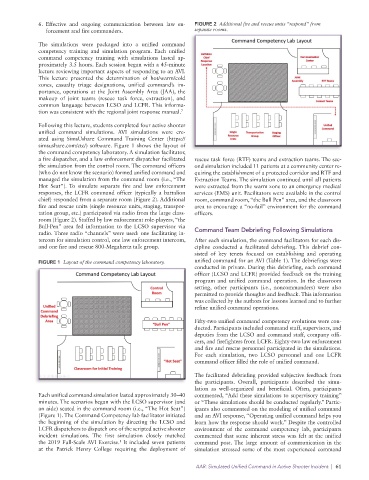
              simsushare.com/ctc/) software. Figure 1 shows the layout of
              the command competency laboratory. A simulation facilitator,
              a fire dispatcher, and a law enforcement dispatcher facilitated   rescue task force (RTF) teams and extraction teams. The sec-
              the simulation from the control room. The command officers   ond simulation included 11 patients at a community center re-
              (who do not know the scenario) formed unified command and   quiring the establishment of a protected corridor and RTF and
              managed the simulation from the command room (i.e., “The   Extraction Teams. The simulation continued until all patients
              Hot Seat”).  To simulate separate fire and law enforcement   were extracted from the warm zone to an emergency medical
              responses, the LCFR command officer (typically a battalion   services (EMS) unit. Facilitators were available in the control
              chief) responded from a separate room (Figure 2). Additional   room, command room, “the Bull Pen” area, and the classroom
              fire and rescue units (single resource units, staging, transpor-  area to encourage a “no-fail” environment for the command
              tation group, etc.) participated via radio from the large class-  officers.
              room (Figure 2). Staffed by law enforcement role-players, “the
              Bull-Pen”  area  fed  information  to  the  LCSO  supervisor  via   Command Team Debriefing Following Simulations
              radio. Three radio “channels” were used: one facilitating in-
              tercom for simulation control, one law enforcement intercom,   After each simulation, the command facilitators for each dis-
              and one fire and rescue 800-Megahertz talk group.  cipline conducted a facilitated debriefing.  This debrief con-
                                                                 sisted of key tenets focused on establishing and operating
              FIGURE 1  Layout of the command competency laboratory.  unified command for an AVI (Table 1). The debriefings were
                                                                 conducted in private. During this debriefing, each command
                                                                 officer (LCSO and LCFR) provided feedback on the training
                                                                 program and unified command operation. In the classroom
                                                                 setting, other participants (i.e., noncommanders) were also
                                                                 permitted to provide thoughts and feedback. This information
                                                                 was collected by the authors for lessons learned and to further
                                                                 refine unified command operations.

                                                                 Fifty-two unified command competency evolutions were con-
                                                                 ducted. Participants included command staff, supervisors, and
                                                                 deputies from the LCSO and command staff, company offi-
                                                                 cers, and firefighters from LCFR. Eighty-two law enforcement
                                                                 and fire and rescue personnel participated in the simulations.
                                                                 For each simulation, two LCSO personnel and one LCFR
                                                                 command officer filled the role of unified command.

                                                                 The facilitated debriefing provided subjective feedback from
                                                                 the participants. Overall, participants described the simu-
                                                                 lation as well-organized and beneficial. Often, participants
              Each unified command simulation lasted approximately 30–40   commented, “Add these simulations to supervisory training”
              minutes. The scenarios began with the LCSO supervisor (and   or “These simulations should be conducted regularly.” Partic-
              an aide) seated in the command room (i.e., “The Hot Seat”)   ipants also commented on the modeling of unified command
              (Figure 1). The Command Competency lab facilitator initiated   and an AVI response, “Operating unified command helps you
              the beginning of the simulation by directing the LCSO and   learn how the response should work.” Despite the controlled
              LCFR dispatchers to dispatch one of the scripted active shooter   environment of the command competency lab, participants
              incident simulations.  The first simulation closely matched   commented that some inherent stress was felt at the unified
                                        1
              the 2019 Full-Scale AVI Exercise.  It included seven patients   command post. The large amount of communication in the
              at the Patrick Henry College  requiring the deployment  of     simulation stressed some of the most experienced command
                                                                 AAR: Simulated Unified Command in Active Shooter Incident  |  61

