


Page 36 - JSOM Winter 2022
P. 36
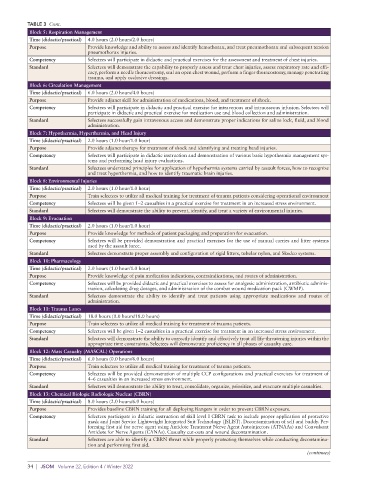
TABLE 3  Cont.
           Block 5: Respiration Management
           Time (didactic/practical)  4.0 hours (2.0 hours/2.0 hours)
           Purpose            Provide knowledge and ability to assess and identify hemothorax, and treat pneumothorax and subsequent tension
                              pneumothorax injuries.
           Competency         Selectees will participate in didactic and practical exercises for the assessment and treatment of chest injuries.
           Standard           Selectees will demonstrate the capability to properly assess and treat chest injuries, assess respiratory rate and effi-
                              cacy, perform a needle thoracostomy, seal an open chest wound, perform a finger thoracostomy, manage penetrating
                              trauma, and apply occlusive dressings.
           Block 6: Circulation Management
           Time (didactic/practical)  6.0 hours (2.0 hours/4.0 hours)
           Purpose            Provide adjunct skill for administration of medications, blood, and treatment of shock.
           Competency         Selectees will participate in didactic and practical exercise for intravenous and intraosseous infusion. Selectees will
                              participate in didactic and practical exercise for medication use and blood collection and administration.
           Standard           Selectees successfully gain intravenous access and demonstrate proper indications for saline lock, fluid, and blood
                              administration.
           Block 7: Hypothermia, Hyperthermia, and Head Injury
           Time (didactic/practical)  2.0 hours (1.0 hour/1.0 hour)
           Purpose            Provide adjunct therapy for treatment of shock and identifying and treating head injuries.
           Competency         Selectees will participate in didactic instruction and demonstration of various basic hypothermia management sys-
                              tems and performing head injury evaluations.
           Standard           Selectees understand principles for application of hypothermia systems carried by assault forces, how to recognize
                              and treat hyperthermia, and how to identify traumatic brain injuries.
           Block 8: Environmental Injuries
           Time (didactic/practical)  2.0 hours (1.0 hour/1.0 hour)
           Purpose            Train selectees to utilize all medical training for treatment of trauma patients considering operational environment
           Competency         Selectees will be given 1–2 casualties in a practical exercise for treatment in an increased stress environment.
           Standard           Selectees will demonstrate the ability to prevent, identify, and treat a variety of environmental injuries.
           Block 9: Evacuation
           Time (didactic/practical)  2.0 hours (1.0 hour/1.0 hour)
           Purpose            Provide knowledge for methods of patient packaging and preparation for evacuation.
           Competency         Selectees will be provided demonstration and practical exercises for the use of manual carries and litter systems
                              used by the assault force.
           Standard           Selectees demonstrate proper assembly and configuration of rigid litters, tubular nylon, and Skedco systems.
           Block 10: Pharmacology
           Time (didactic/practical)  2.0 hours (1.0 hour/1.0 hour)
           Purpose            Provide knowledge of pain medication indications, contraindications, and routes of administration.
           Competency         Selectees will be provided didactic and practical exercises to assess for analgesic administration, antibiotic adminis-
                              tration, calculating drug dosages, and administration of the combat wound medication pack (CWMP).
           Standard           Selectees demonstrate the ability to identify and treat patients using appropriate medications and routes of
                              administration.
           Block 11: Trauma Lanes
           Time (didactic/practical)  18.0 hours (0.0 hours/18.0 hours)
           Purpose            Train selectees to utilize all medical training for treatment of trauma patients.
           Competency         Selectees will be given 1–2 casualties in a practical exercise for treatment in an increased stress environment.
           Standard           Selectees will demonstrate the ability to correctly identify and effectively treat all life-threatening injuries within the
                              appropriate time constraints. Selectees will demonstrate proficiency in all phases of casualty care.
           Block 12: Mass Casualty (MASCAL) Operations
           Time (didactic/practical)  6.0 hours (0.0 hours/6.0 hours)
           Purpose            Train selectees to utilize all medical training for treatment of trauma patients.
           Competency         Selectees will be provided demonstration of multiple CCP configurations and practical exercises for treatment of
                              4–6 casualties in an increased stress environment.
           Standard           Selectees will demonstrate the ability to treat, consolidate, organize, prioritize, and evacuate multiple casualties.
           Block 13: Chemical Biologic Radiologic Nuclear (CBRN)
           Time (didactic/practical)  8.0 hours (2.0 hours/6.0 hours)
           Purpose            Provides baseline CBRN training for all deploying Rangers in order to prevent CBRN exposure.
           Competency         Selectees participate in didactic instruction of skill level I CBRN task to include proper application of protective
                              mask and Joint Service Lightweight Integrated Suit Technology (JSLIST). Decontamination of self and buddy. Per-
                              forming first aid for nerve agent using Antidote Treatment Nerve Agent Autoinjectors (ATNAAs) and Convulsant
                              Antidote for Nerve Agents (CANAs). Casualty cut-outs and wound decontamination.
           Standard           Selectees are able to identify a CBRN threat while properly protecting themselves while conducting decontamina-
                              tion and performing first aid.
                                                                                                     (continues)
          34  |  JSOM   Volume 22, Edition 4 / Winter 2022

