


Page 37 - JSOM Winter 2022
P. 37
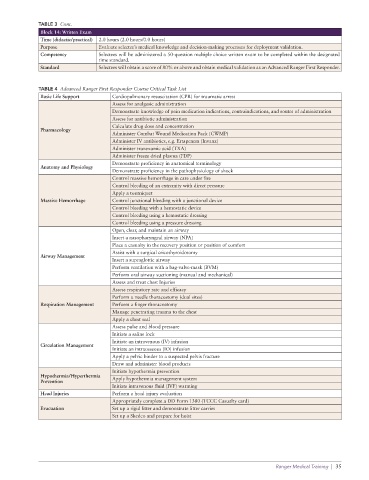
TABLE 3  Cont.
              Block 14: Written Exam
              Time (didactic/practical)  2.0 hours (2.0 hours/0.0 hours)
              Purpose            Evaluate selectee’s medical knowledge and decision-making processes for deployment validation.
              Competency         Selectees will be administered a 50-question multiple choice written exam to be completed within the designated
                                 time standard.
              Standard           Selectees will obtain a score of 80% or above and obtain medical validation as an Advanced Ranger First Responder.


              TABLE 4  Advanced Ranger First Responder Course Critical Task List
              Basic Life Support      Cardiopulmonary resuscitation (CPR) for traumatic arrest
                                      Assess for analgesic administration
                                      Demonstrate knowledge of pain medication indications, contraindications, and routes of administration
                                      Assess for antibiotic administration
                                      Calculate drug dose and concentration
              Pharmacology
                                      Administer Combat Wound Medication Pack (CWMP)
                                      Administer IV antibiotics, e.g. Ertapenem (Invanz)
                                      Administer tranexamic acid (TXA)
                                      Administer freeze dried plasma (FDP)
                                      Demonstrate proficiency in anatomical terminology
              Anatomy and Physiology
                                      Demonstrate proficiency in the pathophysiology of shock
                                      Control massive hemorrhage in care under fire
                                      Control bleeding of an extremity with direct pressure
                                      Apply a tourniquet
              Massive Hemorrhage      Control junctional bleeding with a junctional device
                                      Control bleeding with a hemostatic device
                                      Control bleeding using a hemostatic dressing
                                      Control bleeding using a pressure dressing
                                      Open, clear, and maintain an airway
                                      Insert a nasopharyngeal airway (NPA)
                                      Place a casualty in the recovery position or position of comfort
                                      Assist with a surgical cricothyroidotomy
              Airway Management
                                      Insert a supraglottic airway
                                      Perform ventilation with a bag-valve-mask (BVM)
                                      Perform oral airway suctioning (manual and mechanical)
                                      Assess and treat chest Injuries
                                      Assess respiratory rate and efficacy
                                      Perform a needle thoracostomy (dual sites)
              Respiration Management  Perform a finger thoracostomy
                                      Manage penetrating trauma to the chest
                                      Apply a chest seal
                                      Assess pulse and blood pressure
                                      Initiate a saline lock
                                      Initiate an intravenous (IV) infusion
              Circulation Management
                                      Initiate an intraosseous (IO) infusion
                                      Apply a pelvic binder to a suspected pelvis fracture
                                      Draw and administer blood products
                                      Initiate hypothermia prevention
              Hypothermia/Hyperthermia
              Prevention              Apply hypothermia management system
                                      Initiate intravenous fluid (IVF) warming
              Head Injuries           Perform a head injury evaluation
                                      Appropriately complete a DD Form 1380 (TCCC Casualty card)
              Evacuation              Set up a rigid litter and demonstrate litter carries
                                      Set up a Skedco and prepare for hoist


                                                                                           Ranger Medical Training  |  35

