


Page 33 - JSOM Winter 2022
P. 33
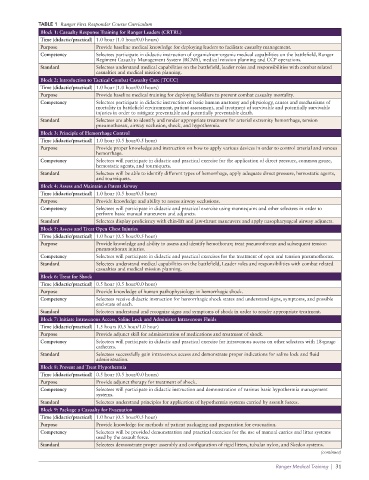
TABLE 1  Ranger First Responder Course Curriculum
              Block 1: Casualty Response Training for Ranger Leaders (CRTRL)
              Time (didactic/practical) 1.0 hour (1.0 hour/0.0 hours)
              Purpose           Provide baseline medical knowledge for deploying leaders to facilitate casualty management.
              Competency        Selectees participate in didactic instruction of organic/non-organic medical capabilities on the battlefield, Ranger
                                Regiment Casualty Management System (RCMS), medical mission planning and CCP operations.
              Standard          Selectees understand medical capabilities on the battlefield, leader roles and responsibilities with combat related
                                casualties and medical mission planning.
              Block 2: Introduction to Tactical Combat Casualty Care (TCCC)
              Time (didactic/practical) 1.0 hour (1.0 hour/0.0 hours)
              Purpose           Provide baseline medical training for deploying Soldiers to prevent combat casualty mortality.
              Competency        Selectees participate in didactic instruction of basic human anatomy and physiology, causes and mechanisms of
                                mortality in battlefield environment, patient assessment, and treatment of survivable and potentially survivable
                                injuries in order to mitigate preventable and potentially preventable death.
              Standard          Selectees are able to identify and render appropriate treatment for arterial extremity hemorrhage, tension
                                pneumothorax, airway occlusion, shock, and hypothermia.
              Block 3: Principle of Hemorrhage Control
              Time (didactic/practical) 1.0 hour (0.5 hour/0.5 hour)
              Purpose           Provide proper knowledge and instruction on how to apply various devices in order to control arterial and venous
                                hemorrhage.
              Competency        Selectees will participate in didactic and practical exercise for the application of direct pressure, common gauze,
                                hemostatic agents, and tourniquets.
              Standard          Selectees will be able to identify different types of hemorrhage, apply adequate direct pressure, hemostatic agents,
                                and tourniquets.
              Block 4: Assess and Maintain a Patent Airway
              Time (didactic/practical) 1.0 hour (0.5 hour/0.5 hour)
              Purpose           Provide knowledge and ability to assess airway occlusions.
              Competency        Selectees will participate in didactic and practical exercise using mannequins and other selectees in order to
                                perform basic manual maneuvers and adjuncts.
              Standard          Selectees display proficiency with chin-lift and jaw-thrust maneuvers and apply nasopharyngeal airway adjuncts.
              Block 5: Assess and Treat Open Chest Injuries
              Time (didactic/practical) 1.0 hour (0.5 hour/0.5 hour)
              Purpose           Provide knowledge and ability to assess and identify hemothorax; treat pneumothorax and subsequent tension
                                pneumothorax injuries.
              Competency        Selectees will participate in didactic and practical exercises for the treatment of open and tension pneumothorax.
              Standard          Selectees understand medical capabilities on the battlefield, Leader roles and responsibilities with combat related
                                casualties and medical mission planning.
              Block 6: Treat for Shock
              Time (didactic/practical) 0.5 hour (0.5 hour/0.0 hour)
              Purpose           Provide knowledge of human pathophysiology in hemorrhagic shock.
              Competency        Selectees receive didactic instruction for hemorrhagic shock states and understand signs, symptoms, and possible
                                end-state of each.
              Standard          Selectees understand and recognize signs and symptoms of shock in order to render appropriate treatment.
              Block 7: Initiate Intravenous Access, Saline Lock and Administer Intravenous Fluids
              Time (didactic/practical) 1.5 hours (0.5 hour/1.0 hour)
              Purpose           Provide adjunct skill for administration of medications and treatment of shock.
              Competency        Selectees will participate in didactic and practical exercise for intravenous access on other selectees with 18-gauge
                                catheters.
              Standard          Selectees successfully gain intravenous access and demonstrate proper indications for saline lock and fluid
                                administration.
              Block 8: Prevent and Treat Hypothermia
              Time (didactic/practical) 0.5 hour (0.5 hour/0.0 hours)
              Purpose           Provide adjunct therapy for treatment of shock.
              Competency        Selectees will participate in didactic instruction and demonstration of various basic hypothermia management
                                systems.
              Standard          Selectees understand principles for application of hypothermia systems carried by assault forces.
              Block 9: Package a Casualty for Evacuation
              Time (didactic/practical) 1.0 hour (0.5 hour/0.5 hour)
              Purpose           Provide knowledge for methods of patient packaging and preparation for evacuation.
              Competency        Selectees will be provided demonstration and practical exercises for the use of manual carries and litter systems
                                used by the assault force.
              Standard          Selectees demonstrate proper assembly and configuration of rigid litters, tubular nylon, and Skedco systems.
                                                                                                          (continues)
                                                                                           Ranger Medical Training  |  31

