


Page 38 - JSOM Winter 2022
P. 38
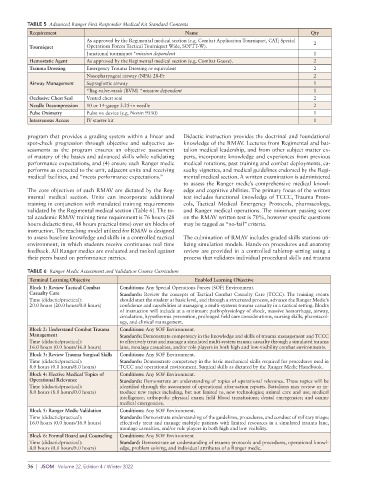
TABLE 5  Advanced Ranger First Responder Medical Kit Standard Contents
           Requirement                                        Name                                     Qty
                             As approved by the Regimental medical section (e.g. Combat Application Tourniquet, CAT; Special   2
           Tourniquet        Operations Forces Tactical Tourniquet Wide, SOFTT-W).
                             Junctional tourniquet *mission dependent                                  1
           Hemostatic Agent  As approved by the Regimental medical section (e.g. Combat Gauze).        2
           Trauma Dressing   Emergency Trauma Dressing or equivalent                                   2
                             Nasopharyngeal airway (NPA) 28-Fr                                         2
           Airway Management  Supraglottic airway                                                      1
                             *Bag-valve-mask (BVM) *mission dependent                                  1
           Occlusive Chest Seal  Vented chest seal                                                     2
           Needle Decompression  10 or 14-gauge 3.25-in needle                                         2
           Pulse Oximetry    Pulse ox device (e.g. Nonin 9550)                                         1
           Intravenous Access  IV starter kit                                                          1

          program that provides a grading system within a linear and   Didactic instruction provides the doctrinal and foundational
          spot-check progression through objective and subjective as-  knowledge of the RMAV. Lectures from Regimental and bat-
          sessments as the program ensures an objective assessment   talion medical leadership, and from other subject matter ex-
          of mastery of the basics and advanced skills while validating   perts, incorporate knowledge and experiences from previous
          performance expectations, and (4) ensure each Ranger medic   medical rotations, past training and combat deployments, ca-
          performs as expected to the unit, adjacent units and receiving   sualty vignettes, and medical guidelines endorsed by the Regi-
          medical facilities, and “meets performance expectations.”  mental medical section. A written examination is administered
                                                             to assess the Ranger medic’s comprehensive medical knowl-
          The core objectives of each RMAV are dictated by the Reg-  edge and cognitive abilities. The primary focus of the written
          imental medical section. Units can incorporate additional   test includes functional knowledge of TCCC, Trauma Proto-
          training in conjunction with mandated training requirements   cols,  Tactical Medical Emergency Protocols, pharmacology,
          validated by the Regimental medical section (Table 6). The to-  and Ranger medical operations. The minimum passing score
          tal academic RMAV training time requirement is 76 hours (28   on the RMAV written test is 70%, however specific questions
          hours didactic time, 48 hours practical time) over six blocks of   may be tagged as “no-fail” criteria.
          instruction. The teaching model utilized for RMAV is designed
          to assess baseline knowledge and skills in a controlled tactical   The culmination of RMAV includes graded skills stations uti-
          environment, in which students receive continuous real time   lizing simulation models. Hands-on procedures and anatomy
          feedback. All Ranger medics are evaluated and ranked against   review are provided in a controlled tabletop setting using a
          their peers based on performance metrics.          process that validates individual procedural skills and trauma

          TABLE 6  Ranger Medic Assessment and Validation Course Curriculum
           Terminal Learning Objective                           Enabled Learning Objective
           Block 1: Review Tactical Combat   Conditions: Any Special Operations Forces (SOF) Environment.
           Casualty Care                Standards: Review the concepts of Tactical Combat Casualty Care (TCCC). The training events
           Time (didactic/practical):   should start the student at basic level, and through a structured process, advance the Ranger Medic’s
           20.0 hours (20.0 hours/0.0 hours)  confidence and capabilities at managing a multi-systems trauma casualty in a tactical setting. Blocks
                                        of instruction will include at a minimum: pathophysiology of shock, massive hemorrhage, airway,
                                        circulation, hypothermia prevention, prolonged field care considerations, nursing skills, pharmacol-
                                        ogy, and clinical management.
           Block 2: Understand Combat Trauma   Conditions: Any SOF Environment.
           Management                   Standards: Demonstrate competency in the knowledge and skills of trauma management and TCCC
           Time (didactic/practical):   to effectively treat and manage a simulated multi-system trauma casualty through a simulated trauma
           16.0 hours (0.0 hours/16.0 hours)  lane, moulage casualties, and/or role players in both high and low-visibility combat environments.
           Block 3: Review Trauma Surgical Skills  Conditions: Any SOF Environment.
           Time (didactic/practical):   Standards: Demonstrate competency in the basic mechanical skills required for procedures used in
           8.0 hours (0.0 hours/8.0 hours)  TCCC and operational environment. Surgical skills as dictated by the Ranger Medic Handbook.
           Block 4: Elective Medical Topics of   Conditions: Any SOF Environment.
           Operational Relevance        Standards: Demonstrate an understanding of topics of operational relevance. These topics will be
           Time (didactic/practical):   identified through the assessment of operational after-action reports. Battalions may review or in-
           8.0 hours (8.0 hours/0.0 hours)  troduce new topics including, but not limited to, new technologies; animal care and use; medical
                                        intelligence; orthopedic physical exam; field blood transfusions; dental emergencies;  and canine
                                        medical emergencies.
           Block 5: Ranger Medic Validation  Conditions: Any SOF Environment.
           Time (didactic/practical):   Standards: Demonstrate understanding of the guidelines, procedures, and conduct of military triage;
           16.0 hours (0.0 hours/16.0 hours)  effectively treat and manage multiple patients with limited resources in a simulated trauma lane,
                                        moulage casualties, and/or role players in both high and low visibility.
           Block 6: Formal Board and Counseling  Conditions: Any SOF Environment
           Time (didactic/practical):   Standard: Demonstrate an understanding of trauma protocols and procedures, operational knowl-
           8.0 hours (0.0 hours/8.0 hours)  edge, problem solving, and individual attributes of a Ranger medic.

          36  |  JSOM   Volume 22, Edition 4 / Winter 2022

