


Page 35 - JSOM Winter 2022
P. 35
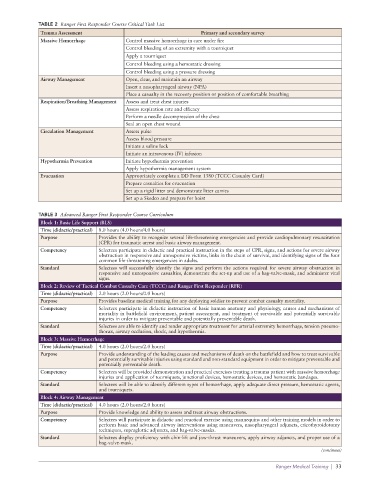
TABLE 2  Ranger First Responder Course Critical Task List
              Trauma Assessment                                    Primary and secondary survey
              Massive Hemorrhage          Control massive hemorrhage in care under fire
                                          Control bleeding of an extremity with a tourniquet
                                          Apply a tourniquet
                                          Control bleeding using a hemostatic dressing
                                          Control bleeding using a pressure dressing
              Airway Management           Open, clear, and maintain an airway
                                          Insert a nasopharyngeal airway (NPA)
                                          Place a casualty in the recovery position or position of comfortable breathing
              Respiration/Breathing Management  Assess and treat chest injuries
                                          Assess respiration rate and efficacy
                                          Perform a needle decompression of the chest
                                          Seal an open chest wound
              Circulation Management      Assess pulse
                                          Assess blood pressure
                                          Initiate a saline lock
                                          Initiate an intravenous (IV) infusion
              Hypothermia Prevention      Initiate hypothermia prevention
                                          Apply hypothermia management system
              Evacuation                  Appropriately complete a DD Form 1380 (TCCC Casualty Card)
                                          Prepare casualties for evacuation
                                          Set up a rigid litter and demonstrate litter carries
                                          Set up a Skedco and prepare for hoist

              TABLE 3  Advanced Ranger First Responder Course Curriculum
              Block 1: Basic Life Support (BLS)
              Time (didactic/practical)  8.0 hours (4.0 hours/4.0 hours)
              Purpose            Provides the ability to recognize several life-threatening emergencies and provide cardiopulmonary resuscitation
                                 (CPR) for traumatic arrest and basic airway management.
              Competency         Selectees participate in didactic and practical instruction in the steps of CPR, signs, and actions for severe airway
                                 obstruction in responsive and unresponsive victims, links in the chain of survival, and identifying signs of the four
                                 common life-threatening emergencies in adults.
              Standard           Selectees  will  successfully  identify  the  signs and  perform  the  actions required for  severe  airway  obstruction  in
                                 responsive and unresponsive casualties, demonstrate the set-up and use of a bag-valve-mask, and administer vital
                                 signs.
              Block 2: Review of Tactical Combat Casualty Care (TCCC) and Ranger First Responder (RFR)
              Time (didactic/practical)  2.0 hours (2.0 hours/0.0 hours)
              Purpose            Provides baseline medical training for any deploying soldier to prevent combat casualty mortality.
              Competency         Selectees participate in didactic instruction of basic human anatomy and physiology, causes and mechanisms of
                                 mortality in battlefield environment, patient assessment, and treatment of survivable and potentially survivable
                                 injuries in order to mitigate preventable and potentially preventable death.
              Standard           Selectees are able to identify and render appropriate treatment for arterial extremity hemorrhage, tension pneumo-
                                 thorax, airway occlusion, shock, and hypothermia.
              Block 3: Massive Hemorrhage
              Time (didactic/practical)  4.0 hours (2.0 hours/2.0 hours)
              Purpose            Provide understanding of the leading causes and mechanisms of death on the battlefield and how to treat survivable
                                 and potentially survivable injuries using standard and non-standard equipment in order to mitigate preventable and
                                 potentially preventable death.
              Competency         Selectees will be provided demonstration and practical exercises treating a trauma patient with massive hemorrhage
                                 injuries and application of tourniquets, junctional devices, hemostatic devices, and hemostatic bandages.
              Standard           Selectees will be able to identify different types of hemorrhage, apply adequate direct pressure, hemostatic agents,
                                 and tourniquets.
              Block 4: Airway Management
              Time (didactic/practical)  4.0 hours (2.0 hours/2.0 hours)
              Purpose            Provide knowledge and ability to assess and treat airway obstructions.
              Competency         Selectees will participate in didactic and practical exercise using mannequins and other training models in order to
                                 perform basic and advanced airway interventions using maneuvers, nasopharyngeal adjuncts, cricothyroidotomy
                                 techniques, supraglottic adjuncts, and bag-valve-masks.
              Standard           Selectees display proficiency with chin-lift and jaw-thrust maneuvers, apply airway adjuncts, and proper use of a
                                 bag-valve-mask.
                                                                                                          (continues)

                                                                                           Ranger Medical Training  |  33

