


Page 31 - JSOM Winter 2022
P. 31
training programs of instruction. Battalion level medical di-  FIGURE 3  Coordinating efforts during Ranger medical training.
              rectors provide oversight and quality control of medical train-
              ing programs, validate training instructors, certify initial and
              sustainment training, and verify current Regimental medical
              guidance. Battalion medical directors also ensure instructors
              are qualified and validated to conduct medical training, track
              and report unit medical training status, and provide input and
              oversight for medical training and casualty response.

              Four programs have been developed to train individual and
              collective tasks to support the Ranger casualty response sys-
              tem: (1) Ranger First Responder (RFR), (2) Advanced Ranger
              First Responder (ARFR), (3) Ranger Medic Assessment and
              Validation (RMAV), and (4) Casualty Response Training for
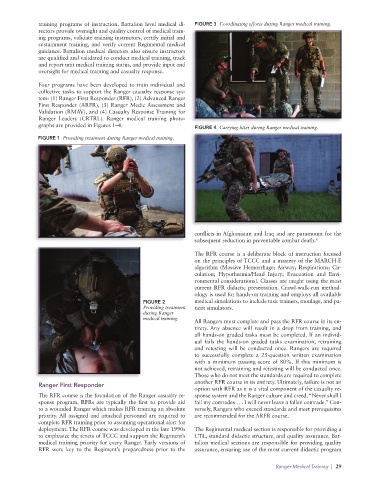
              Ranger Leaders (CRTRL). Ranger medical training photo-
              graphs are provided in Figures 1–4.                FIGURE 4  Carrying litter during Ranger medical training.

             FIGURE 1  Providing treatment during Ranger medical training.


                                                                 conflicts in Afghanistan and Iraq and are paramount for the
                                                                 subsequent reduction in preventable combat death. 6

                                                                 The RFR course is a deliberate block of instruction focused
                                                                 on the principles of TCCC and a mastery of the MARCH-E
                                                                 algorithm (Massive  Hemorrhage; Airway; Respirations;  Cir-
                                                                 culation; Hypothermia/Head Injury; Evacuation and Envi-
                                                                 ronmental considerations). Classes are taught using the most
                                                                 current RFR didactic presentation. Crawl-walk-run method-
                                                                 ology is used for hands-on training and employs all available
                                                FIGURE 2         medical simulations to include task trainers, moulage, and pa-
                                                Providing treatment   tient simulators.
                                                during Ranger
                                                medical training.
                                                                 All Rangers must complete and pass the RFR course in its en-
                                                                 tirety. Any absence will result in a drop from training, and
                                                                 all hands-on graded tasks must be completed. If an individ-
                                                                 ual fails the hands-on graded tasks examination, retraining
                                                                 and retesting will be conducted once. Rangers are required
                                                                 to successfully complete a 25-question written examination
                                                                 with a minimum passing score of 80%. If this minimum is
                                                                 not achieved, retraining and retesting will be conducted once.
                                                                 Those who do not meet the standards are required to complete
              Ranger First Responder                             another RFR course in its entirety. Ultimately, failure is not an
                                                                 option with RFR as it is a vital component of the casualty re-
              The RFR course is the foundation of the Ranger casualty re-  sponse system and the Ranger culture and creed, “Never shall I
              sponse program. RFRs are typically the first to provide aid   fail my comrades . . . I will never leave a fallen comrade.” Con-
              to a wounded Ranger which makes RFR training an absolute   versely, Rangers who exceed standards and meet prerequisites
              priority. All assigned and attached personnel are required to   are recommended for the ARFR course.
              complete RFR training prior to assuming operational alert for
              deployment. The RFR course was developed in the late 1990s   The Regimental medical section is responsible for providing a
              to emphasize the tenets of TCCC and support the Regiment’s   CTL, standard didactic structure, and quality assurance. Bat-
              medical training priority for every Ranger. Early versions of   talion medical sections are responsible for providing quality
              RFR were key to the Regiment’s preparedness prior to the   assurance, ensuring use of the most current didactic program

                                                                                           Ranger Medical Training  |  29

