


Page 34 - JSOM Winter 2022
P. 34
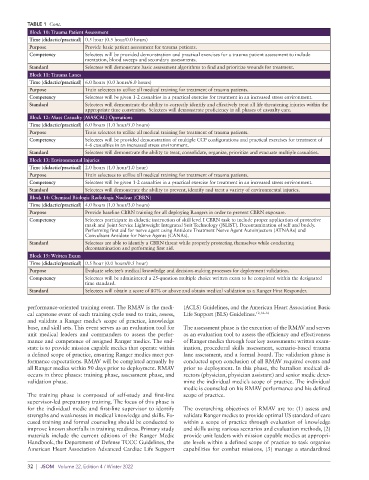
TABLE 1  Cont.
           Block 10: Trauma Patient Assessment
           Time (didactic/practical) 0.5 hour (0.5 hour/0.0 hours)
           Purpose           Provide basic patient assessment for trauma patients.
           Competency        Selectees will be provided demonstration and practical exercises for a trauma patient assessment to include
                             mentation, blood sweeps and secondary assessments.
           Standard          Selectees will demonstrate basic assessment algorithms to find and prioritize wounds for treatment.
           Block 11: Trauma Lanes
           Time (didactic/practical) 6.0 hours (0.0 hours/6.0 hours)
           Purpose           Train selectees to utilize all medical training for treatment of trauma patients.
           Competency        Selectees will be given 1-2 casualties in a practical exercise for treatment in an increased stress environment.
           Standard          Selectees will demonstrate the ability to correctly identify and effectively treat all life threatening injuries within the
                             appropriate time constraints.  Selectees will demonstrate proficiency in all phases of casualty care.
           Block 12: Mass Casualty (MASCAL) Operations
           Time (didactic/practical) 6.0 hours (1.0 hour/5.0 hours)
           Purpose           Train selectees to utilize all medical training for treatment of trauma patients.
           Competency        Selectees will be provided demonstration of multiple CCP configurations and practical exercises for treatment of
                             4-6 casualties in an increased stress environment.
           Standard          Selectees will demonstrate the ability to treat, consolidate, organize, prioritize and evacuate multiple casualties.
           Block 13: Environmental Injuries
           Time (didactic/practical) 2.0 hours (1.0 hour/1.0 hour)
           Purpose           Train selectees to utilize all medical training for treatment of trauma patients.
           Competency        Selectees will be given 1-2 casualties in a practical exercise for treatment in an increased stress environment.
           Standard          Selectees will demonstrate the ability to prevent, identify and treat a variety of environmental injuries.
           Block 14: Chemical Biologic Radiologic Nuclear (CBRN)
           Time (didactic/practical) 4.0 hours (1.0 hour/3.0 hours)
           Purpose           Provide baseline CBRN training for all deploying Rangers in order to prevent CBRN exposure.
           Competency        Selectees participate in didactic instruction of skill level I CBRN task to include proper application of protective
                             mask and Joint Service Lightweight Integrated Suit Technology (JSLIST). Decontamination of self and buddy.
                             Performing first aid for nerve agent using Antidote Treatment Nerve Agent Autoinjectors (ATNAAs) and
                             Convulsant Antidote for Nerve Agents (CANAs).
           Standard          Selectees are able to identify a CBRN threat while properly protecting themselves while conducting
                             decontamination and performing first aid.
           Block 15: Written Exam
           Time (didactic/practical) 0.5 hour (0.0 hours/0.5 hour)
           Purpose           Evaluate selectee’s medical knowledge and decision-making processes for deployment validation.
           Competency        Selectees will be administered a 25-question multiple choice written exam to be completed within the designated
                             time standard.
           Standard          Selectees will obtain a score of 80% or above and obtain medical validation as a Ranger First Responder.

          performance-oriented training event. The RMAV is the medi-  (ACLS) Guidelines, and the American Heart Association Basic
          cal capstone event of each training cycle used to train, assess,   Life Support (BLS) Guidelines. 12,14–16
          and validate a Ranger medic’s scope of practice, knowledge
          base, and skill sets. This event serves as an evaluation tool for   The assessment phase is the execution of the RMAV and serves
          unit medical leaders and commanders to assess the perfor-  as an evaluation tool to assess the efficiency and effectiveness
          mance and competence of assigned Ranger medics. The end-  of Ranger medics through four key assessments: written exam-
          state is to provide mission capable medics that operate within   ination, procedural  skills assessment, scenario-based  trauma
          a defined scope of practice, ensuring Ranger medics meet per-  lane assessment, and a formal board. The validation phase is
          formance expectations. RMAV will be completed annually by   conducted upon conclusion of all RMAV required events and
          all Ranger medics within 90 days prior to deployment. RMAV   prior to deployment. In this phase, the battalion medical di-
          occurs in three phases: training phase, assessment phase, and   rectors (physician, physician assistant) and senior medic deter-
          validation phase.                                  mine the individual medic’s scope of practice. The individual
                                                             medic is counseled on his RMAV performance and his defined
          The training phase is composed of self-study and first-line   scope of practice.
            supervisor-led preparatory training. The focus of this phase is
          for the individual medic and first-line supervisor to identify   The  overarching  objectives  of  RMAV  are  to: (1)  assess  and
          strengths and weaknesses in medical knowledge and skills. Fo-  validate Ranger medics to provide optimal US standard of care
          cused training and formal counseling should be conducted to   within a scope of practice through evaluation of knowledge
          improve known shortfalls in training readiness. Primary study   and skills using various scenarios and evaluation methods, (2)
          materials include the current editions of the Ranger Medic   provide unit leaders with mission capable medics at appropri-

          Handbook, the Department of Defense TCCC Guidelines, the   ate levels within a defined scope of practice to task organize
          American Heart Association Advanced Cardiac Life Support   capabilities for combat missions, (3) manage a standardized
          32  |  JSOM   Volume 22, Edition 4 / Winter 2022

