


Page 19 - JSOM Fall 2022
P. 19
understanding of treatment, and a neurobehavioral symptom boundaries, personal presence, and a steadfast moral code of
inventory measured by the Likert scale. In addition, the sur ethics are qualifiers for this patient population in order to es
vey packet included the PHQ9, PCL5, Satisfaction with Life tablish rapport and engagement in the program. Until assured
Scale, HIT6, Epworth Sleepiness Scale, GAD7, Vestibular of a safe and trusting environment, the PREP population tends
Specific Dizziness Questionnaire, ActivitiesSpecific Balance to not fully engage in their therapies. 7
Confidence Scale (ABC scale), Audit C, and the Mayo Portland
Adaptability Inventory4 Participation Index (M2PI) for goal Nursing Practice
attainment and sustainment assessment. The data was com All staff registered nurses (RNs) must complete specialty train
piled from participants’ responses in the 3 and 8week pro ing and education on TBI, mTBI sequelae, and military culture.
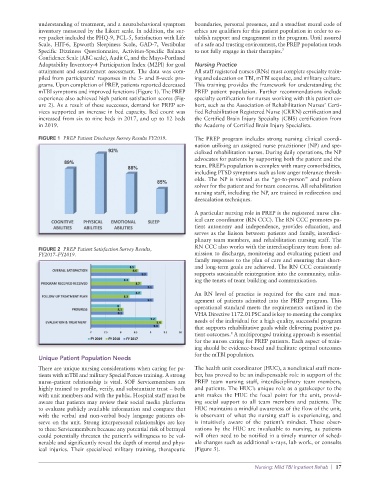
grams. Upon completion of PREP, patients reported decreased This training provides the framework for understanding the
mTBI symptoms and improved functions (Figure 1). The PREP PREP patient population. Further recommendations include
experience also achieved high patient satisfaction scores (Fig specialty certification for nurses working with this patient co
ure 2). As a result of these successes, demand for PREP ser hort, such as the Association of Rehabilitation Nurses’ Certi
vices supported an increase in bed capacity. Bed count was fied Rehabilitation Registered Nurse (CRRN) certification and
increased from six to nine beds in 2017, and up to 12 beds the Certified Brain Injury Specialty (CBIS) certification from
in 2019. the Academy of Certified Brain Injury Specialists.
FIGURE 1 PREP Patient Discharge Survey Results FY2019. The PREP program includes strong nursing clinical coordi
nation utilizing an assigned nurse practitioner (NP) and spe
cialized rehabilitation nurses. During daily operations, the NP
advocates for patients by supporting both the patient and the
team. PREP’s population is complex with many comorbidities,
including PTSD symptoms such as low anger tolerance thresh
olds. The NP is viewed as the “gotoperson” and problem
solver for the patient and for team concerns. All rehabilitation
nursing staff, including the NP, are trained in redirection and
deescalation techniques.
A particular nursing role in PREP is the registered nurse clin
ical care coordinator (RN CCC). The RN CCC promotes pa
tient autonomy and independence, provides education, and
serves as the liaison between patients and family, interdisci
plinary team members, and rehabilitation nursing staff. The
RN CCC also works with the interdisciplinary team from ad
FIGURE 2 PREP Patient Satisfaction Survey Results,
FY2017–FY2019. mission to discharge, monitoring and evaluating patient and
family responses to the plan of care and ensuring that short
and longterm goals are achieved. The RN CCC consistently
supports sustainable reintegration into the community, utiliz
ing the tenets of team building and communication.
An RN level of practice is required for the care and man
agement of patients admitted into the PREP program. This
operational standard meets the requirements outlined in the
VHA Directive 1172.01PSCand is key to meeting the complex
needs of the individual for a high quality, successful program
that supports rehabilitative goals while delivering positive pa
tient outcomes. A multipronged training approach is essential
8
for the nurses caring for PREP patients. Each aspect of train
ing should be evidencebased and facilitate optimal outcomes
for the mTBI population.
Unique Patient Population Needs
There are unique nursing considerations when caring for pa The health unit coordinator (HUC), a nonclinical staff mem
tients with mTBI and military Special Forces training. A strong ber, has proved to be an indispensable role in support of the
nurse–patient relationship is vital. SOF Servicemembers are PREP team nursing staff, interdisciplinary team members,
highly trained to profile, verify, and substantiate trust – both and patients. The HUC’s unique role as a gatekeeper to the
with unit members and with the public. Hospital staff must be unit makes the HUC the focal point for the unit, provid
aware that patients may review their social media platforms ing social support to all team members and patients. The
to evaluate publicly available information and compare that HUC maintains a mindful awareness of the flow of the unit,
with the verbal and nonverbal body language patients ob is observant of what the nursing staff is experiencing, and
serve on the unit. Strong interpersonal relationships are key is intuitively aware of the patient’s mindset. These obser
to these Servicemembers because any potential risk of betrayal vations by the HUC are invaluable to nursing, as patients
could potentially threaten the patient’s willingness to be vul will often need to be notified in a timely manner of sched
nerable and significantly reveal the depth of mental and phys ule changes such as additional xrays, lab work, or consults
ical injuries. Their specialized military training, therapeutic (Figure 3).
Nursing: Mild TBI Inpatient Rehab | 17

