


Page 22 - JSOM Fall 2022
P. 22
protocol (i.e., the walking blood bank), knowing how long Results
before SWB is rendered unusable would be valuable. Unfor
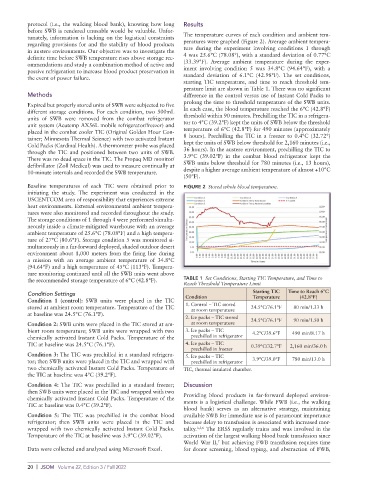
tunately, information is lacking on the logistical constraints The temperature curves of each condition and ambient tem
regarding provisions for and the stability of blood products peratures were graphed (Figure 2). Average ambient tempera
in austere environments. Our objective was to investigate the ture during the experiment involving conditions 1 through
definite time before SWB temperature rises above storage rec 4 was 25.6°C (78.08°), with a standard deviation of 0.77°C
ommendations and study a combination method of active and (33.39°F). Average ambient temperature during the exper
passive refrigeration to increase blood product preservation in iment involving condition 5 was 34.8°C (94.64°F), with a
the event of power failure. standard deviation of 6.1°C (42.98°F). The set conditions,
starting TIC temperature, and time to reach threshold tem
perature limit are shown in Table 1. There was no significant
Methods difference in the control versus use of Instant Cold Packs to
prolong the time to threshold temperature of the SWB units.
Expired but properly stored units of SWB were subjected to five
different storage conditions. For each condition, two 500mL In each case, the blood temperature reached the 6°C (42.8°F)
units of SWB were removed from the combat refrigerator threshold within 90 minutes. Prechilling the TIC in a refrigera
unit system (Acutemp AX56L mobile refrigerator/freezer) and tor to 4°C (39.2°F) kept the units of SWB below the threshold
placed in the combat cooler TIC (Original Golden Hour Con temperature of 6°C (42.8°F) for 490 minutes (approximately
tainer; Minnesota Thermal Science) with two activated Instant 8 hours). Prechilling the TIC in a freezer to 0.4°C (32.72°)
Cold Packs (Cardinal Health). A thermometer probe was placed kept the units of SWB below threshold for 2,160 minutes (i.e.,
through the TIC and positioned between two units of SWB. 36 hours). In the austere environment, prechilling the TIC to
There was no dead space in the TIC. The Propaq MD monitor/ 3.9°C (39.02°F) in the combat blood refrigerator kept the
defibrillator (Zoll Medical) was used to measure continually at SWB units below threshold for 780 minutes (i.e., 13 hours),
10minute intervals and recorded the SWB temperature. despite a higher average ambient temperature of almost +10°C
(50°F).
Baseline temperatures of each TIC were obtained prior to FIGURE 2 Stored whole blood temperature.
initiating the study. The experiment was conducted in the
USCENTCOM area of responsibility that experiences extreme
heat environments. External environmental ambient tempera
tures were also monitored and recorded throughout the study.
The storage conditions of 1 through 4 were performed simulta
neously inside a climatemitigated warehouse with an average
ambient temperature of 25.6°C (78.08°F) and a high tempera
ture of 27°C (80.6°F). Storage condition 5 was monitored si
multaneously in a farforward deployed, shaded outdoor desert
environment about 1,000 meters from the firing line during
a mission with an average ambient temperature of 34.8°C
(94.64°F) and a high temperature of 45°C (113°F). Tempera
ture monitoring continued until all the SWB units went above
the recommended storage temperature of 6°C (42.8°F). TABLE 1 Set Conditions, Starting TIC Temperature, and Time to
Reach Threshold Temperature Limit
Condition Settings Condition Starting TIC Time to Reach 6°C
Temperature
(42.8°F)
Condition 1 (control): SWB units were placed in the TIC
stored at ambient room temperature. Temperature of the TIC 1. Control – TIC stored 24.5°C/76.1°F 80 min/1.33 h
at room temperature
at baseline was 24.5°C (76.1°F).
2. Ice packs – TIC stored 24.5°C/76.1°F 90 min/1.50 h
Condition 2: SWB units were placed in the TIC stored at am at room temperature
bient room temperature; SWB units were wrapped with two 3. Ice packs – TIC 4.2°C/39.6°F 490 min/8.17 h
chemically activated Instant Cold Packs. Temperature of the prechilled in refrigerator
TIC at baseline was 24.5°C (76.1°F). 4. Ice packs – TIC 0.39°C/32.7°F 2,160 min/36.0 h
prechilled in freezer
Condition 3: The TIC was prechilled in a standard refrigera 5. Ice packs – TIC
tor; then SWB units were placed in the TIC and wrapped with prechilled in refrigerator 3.9°C/39.0°F 780 min/13.0 h
two chemically activated Instant Cold Packs. Temperature of TIC, thermal insulated chamber.
the TIC at baseline was 4°C (39.2°F).
Condition 4: The TIC was prechilled in a standard freezer; Discussion
then SWB units were placed in the TIC and wrapped with two
chemically activated Instant Cold Packs. Temperature of the Providing blood products in farforward deployed environ
TIC at baseline was 0.4°C (39.2°F). ments is a logistical challenge. While FWB (i.e., the walking
blood bank) serves as an alternative strategy, maintaining
Condition 5: The TIC was prechilled in the combat blood available SWB for immediate use is of paramount importance
refrigerator; then SWB units were placed in the TIC and because delay to transfusion is associated with increased mor
wrapped with two chemically activated Instant Cold Packs. tality. 3,5,6 The ERSS regularly trains and was involved in the
Temperature of the TIC at baseline was 3.9°C (39.02°F). activation of the largest walking blood bank transfusion since
World War II, but achieving FWB transfusion requires time
7
Data were collected and analyzed using Microsoft Excel. for donor screening, blood typing, and abstraction of FWB,
20 | JSOM Volume 22, Edition 3 / Fall 2022

