


Page 21 - JSOM Fall 2022
P. 21
Whole Blood Storage Temperature Investigation
in Austere Environments
2
1
Cesar Avila, MD *; Samuel Sayson, MD ; Bruce Bennett, MD 3
ABSTRACT
Introduction: Military medical research has affirmed that early Introduction
administration of blood products and timely treatment save
lives. The US Navy’s Expeditionary Resuscitative Surgical Sys The US Navy’s ERSS is a ninemember Special Operations
tem (ERSS) is a Role 2 Light Maneuver team that functions Role 2 Light Maneuver team that functions close to the point
close to the point of injury, administering blood products and of injury, administering blood products and providing dam
providing damagecontrol resuscitation and surgery. However, agecontrol resuscitation and surgery before medical evacua
information is lacking on the logistical constraints regarding tion. Hemorrhage is the leading cause of preventable death
provisions for and the stability of blood products in austere en on the battlefield; between 2001 and 2011, mortality analysis
vironments. Methods: ERSS conducted a study on the United from the Iraq and Afghanistan wars identified 976 potentially
States Central Command (USCENTCOM) area of responsi survivable injuries, of which 91% were related to hemor
1
bility. Expired but properly stored units of stored whole blood rhage. Over the past 20 years, military medical research has
(SWB) were subjected to five different storage conditions, in affirmed that early administration of blood products and
13
cluding combinations of passive and active refrigeration. The timely treatment save lives.
SWB was monitored continuously, including for external am
bient temperatures. The time for the SWB to rise above the To counter the logistical difficulties of maintaining a readily
threshold temperature was recorded. Results: The main out available supply of all physiologic ratios of blood components
come of the study was the time for the SWB to rise above the in farforward deployed settings, fresh whole blood (FWB) and
recommended storage temperature. Average ambient tempera SWB serve as the cornerstone in the treatment of hemorrhage.
ture during the experiment involving conditions 1 through 4 FWB can be kept at room temperature for 24 hours; SWB is
was 25.6°C (78.08°F). Average ambient temperature during kept at 1°C to 6°C for up to 35 days in the anticoagulant
4
the experiment involving condition 5 was 34.8°C (94.64°F). citratephosphatedextroseadenine1. The ERSS maintains
Blood temperature reached the 6°C (42.8°F) threshold within up to 20 units of SWB in theater, using active or passive cool
90 minutes in conditions 1 and 2, which included control and ing measures (i.e., portable combat refrigerators or coolers)
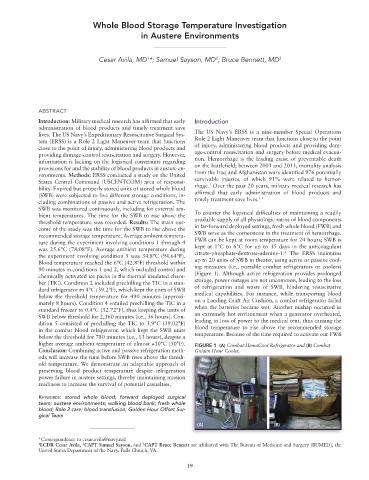
chemically activated ice packs in the thermal insulated cham (Figure 1). Although active refrigeration provides prolonged
ber (TIC). Condition 2 included prechilling the TIC in a stan storage, power outages are not uncommon, leading to the loss
dard refrigerator to 4°C (39.2°F), which kept the units of SWB of refrigeration and waste of SWB, hindering resuscitative
below the threshold temperature for 490 minutes (approxi medical capabilities. For instance, while transporting blood
mately 8 hours). Condition 4 entailed prechilling the TIC in a on a Landing Craft Air Cushion, a combat refrigerator failed
standard freezer to 0.4°C (32.72°F), thus keeping the units of when the batteries became wet. Another mishap occurred in
SWB below threshold for 2,160 minutes (i.e., 36 hours). Con an extremely hot environment when a generator overheated,
dition 5 consisted of prechilling the TIC to 3.9°C (39.02°F) leading to loss of power to the medical tent, thus causing the
in the combat blood refrigerator, which kept the SWB units blood temperature to rise above the recommended storage
below the threshold for 780 minutes (i.e., 13 hours), despite a temperature. Because of the time required to activate our FWB
higher average ambient temperature of almost +10°C (50°F). FIGURE 1 (A) Combat HemaCool Refrigerator and (B) Combat
Conclusion: Combining active and passive refrigeration meth Golden Hour Cooler.
ods will increase the time before SWB rises above the thresh
old temperature. We demonstrate an adaptable approach of
preserving blood product temperature despite refrigeration
power failure in austere settings, thereby maintaining mission
readiness to increase the survival of potential casualties.
Keywords: stored whole blood; forward deployed surgical
team; austere environments; walking blood bank; fresh whole
blood; Role 2 care; blood transfusion; Golden Hour Offset Sur-
gical Team
(A) (B)
*Correspondence to cesar.avila@navy.mil
2
1 LCDR Cesar Avila, CAPT Samuel Sayson, and CAPT Bruce Bennett are affiliated with The Bureau of Medicine and Surgery (BUMED), the
3
United States Department of the Navy, Falls Church, VA.
19

