


Page 15 - JSOM Fall 2022
P. 15
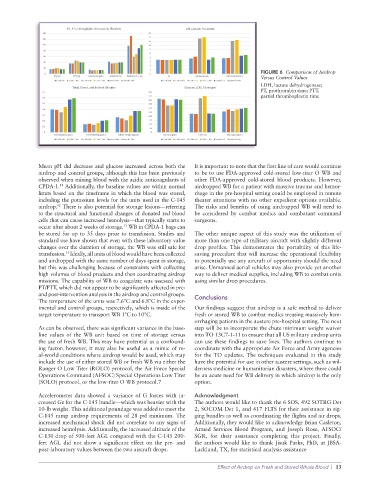
FIGURE 6 Comparison of Airdrop
Versus Control Values
LDH, lactate dehydrogenase;
PT, prothrombin time; PTT,
partial thromboplastin time
Mean pH did decrease and glucose increased across both the It is important to note that the first line of care would continue
airdrop and control groups, although this has been previously to be to use FDAapproved coldstored lowtiter O WB and
observed when mixing blood with the acidic anticoagulants of other FDAapproved coldstored blood products. However,
CPDA1. Additionally, the baseline values are within normal airdropped WB for a patient with massive trauma and hemor
11
limits based on the timeframe in which the blood was stored, rhage in the prehospital setting could be employed in remote
including the potassium levels for the units used in the C145 theater situations with no other expedient options available.
airdrop. There is also potential for storage lesions—referring The risks and benefits of using airdropped WB will need to
12
to the structural and functional changes of donated red blood be considered by combat medics and combatant command
cells that can cause increased hemolysis—that typically starts to surgeons.
occur after about 2 weeks of storage. WB in CPDA1 bags can
13
be stored for up to 35 days prior to transfusion. Studies and The other unique aspect of this study was the utilization of
standard use have shown that even with these laboratory value more than one type of military aircraft with slightly different
changes over the duration of storage, the WB was still safe for drop profiles. This demonstrates the portability of this life
transfusion. Ideally, all units of blood would have been collected saving procedure that will increase the operational flexibility
14
and airdropped with the same number of days spent in storage, to potentially use any aircraft of opportunity should the need
but this was challenging because of constraints with collecting arise. Unmanned aerial vehicles may also provide yet another
high volumes of blood products and then coordinating airdrop way to deliver medical supplies, including WB to combat units
missions. The capability of WB to coagulate was assessed with using similar drop procedures.
PT/PTT, which did not appear to be significantly affected in pre
and postintervention analysis in the airdrop and control groups.
The temperature of the units was 7.6°C and 6.8°C in the exper Conclusions
imental and control groups, respectively, which is inside of the Our findings suggest that airdrop is a safe method to deliver
target temperature to transport WB 1°C to 10°C. fresh or stored WB to combat medics treating massively hem
orrhaging patients in the austere prehospital setting. The next
As can be observed, there was significant variance in the base step will be to incorporate the chute minimum weight waiver
line values of the WB unit based on time of storage versus into TO 13C7111 to ensure that all US military airdrop units
the use of fresh WB. This may have potential as a confound can use these findings to save lives. The authors continue to
ing factor; however, it may also be useful as a mimic of re coordinate with the appropriate Air Force and Army agencies
alworld conditions where airdrop would be used, which may for the TO updates. The techniques evaluated in this study
include the use of either stored WB or fresh WB via either the have the potential for use in other austere settings, such as wil
Ranger O Low Titer (ROLO) protocol, the Air Force Special derness medicine or humanitarian disasters, where there could
Operations Command (AFSOC) Special Operations Low Titer be an acute need for WB delivery in which airdrop is the only
(SOLO) protocol, or the lowtiter O WB protocol.7 option.
Accelerometer data showed a variance of G forces with in Acknowledgment
creased Gz for the C145 bundle—which was heavier with the The authors would like to thank the 6 SOS, 492 SOTRG Det
10lb weight. This additional poundage was added to meet the 2, SOCOM Det 1, and 417 FLTS for their assistance in rig
C145 ramp airdrop requirements of 28 psf minimum. The ging bundles as well as coordinating the flights and air drops.
increased mechanical shock did not correlate to any signs of Additionally, they would like to acknowledge Brian Casleton,
increased hemolysis. Additionally, the increased altitude of the Armed Services Blood Program, and Joseph Rose, AFSOC/
C130 drop of 500feet AGL compared with the C145 200 SGR, for their assistance completing this project. Finally,
feet AGL did not show a significant effect on the pre and the authors would like to thank Jisuk Parks, PhD, at JBSA
postlaboratory values between the two aircraft drops. Lackland, TX, for statistical analysis assistance
Effect of Airdrop on Fresh and Stored Whole Blood | 13

