


Page 12 - JSOM Fall 2022
P. 12
Aviation Advisor training aircraft to assess whether aerial re FIGURE 2 Pre-drop.
supply could potentially serve as a platform to deliver blood
products to combat medics when casualty evacuation was un
available. The study suggested that airdrop can be an effective
and safe method for blood delivery; however, the analysis re
quired increased power to validate its safety. To achieve statis
tical significance and incorporate other operational aircraft,
this project airdropped 24 units of blood from both C145
and C130 aircraft. Finally, additional data were collected us
ing an accelerometer to evaluate the forces acting upon the
blood.
Methods
WB Collection
In compliance with standards set forth by the AABB and
FDA, a total of 48 CPDA1 blood collection sets (Haemon
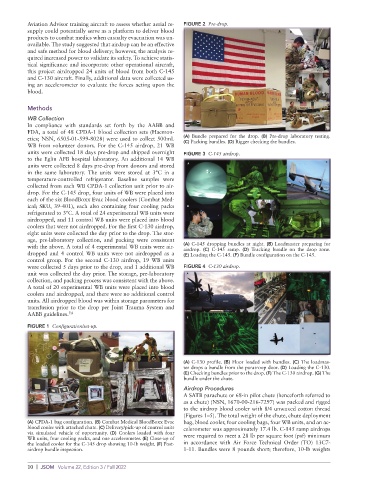
etics; NSN, 6505015998028) were used to collect 500mL (A) Bundle prepared for the drop. (B) Predrop laboratory testing.
(C) Packing bundles. (D) Rigger checking the bundles.
WB from volunteer donors. For the C145 airdrop, 21 WB
units were collected 18 days predrop and shipped overnight FIGURE 3 C-145 airdrop.
to the Eglin AFB hospital laboratory. An additional 14 WB
units were collected 8 days predrop from donors and stored
in the same laboratory. The units were stored at 3°C in a
temperature controlled refrigerator. Baseline samples were
collected from each WB CPDA1 collection unit prior to air
drop. For the C145 drop, four units of WB were placed into
each of the six BloodBoxx Evac blood coolers (Combat Med
ical; SKU, 39401), each also containing four cooling packs
refrigerated to 3°C. A total of 24 experimental WB units were
airdropped, and 11 control WB units were placed into blood
coolers that were not airdropped. For the first C130 airdrop,
eight units were collected the day prior to the drop. The stor
age, prelaboratory collection, and packing were consistent
with the above. A total of 4 experimental WB units were air (A) C145 dropping bundles at night. (B) Loadmaster preparing for
airdrop. (C) C145 ramp. (D) Tracking bundle on the drop zone.
dropped and 4 control WB units were not airdropped as a (E) Loading the C145. (F) Bundle configuration on the C145.
control group. For the second C130 airdrop, 19 WB units
were collected 5 days prior to the drop, and 1 additional WB FIGURE 4 C-130 airdrop.
unit was collected the day prior. The storage, prelaboratory
collection, and packing process was consistent with the above.
A total of 20 experimental WB units were placed into blood
coolers and airdropped, and there were no additional control
units. All airdropped blood was within storage parameters for
transfusion prior to the drop per Joint Trauma System and
AABB guidelines. 7,8
FIGURE 1 Configuration/set-up.
(A) C130 profile. (B) Floor loaded with bundles. (C) The loadmas
ter drops a bundle from the paratroop door. (D) Loading the C130.
(E) Checking bundles prior to the drop. (F) The C130 airdrop. (G) The
bundle under the chute.
Airdrop Procedures
A SATB parachute or 68in pilot chute (henceforth referred to
as a chute) (NSN, 1670002167297) was packed and rigged
to the airdrop blood cooler with 8/4 unwaxed cotton thread
(Figures 1–5). The total weight of the chute, chute deployment
(A) CPDA1 bag configuration. (B) Combat Medical BloodBoxx Evac bag, blood cooler, four cooling bags, four WB units, and an ac
blood cooler with attached chute. (C) Delivery/pickup of control units celerometer was approximately 17.4 lb. C145 ramp airdrops
via simulated vehicle of opportunity. (D) Coolers loaded with four were required to meet a 28 lb per square foot (psf) minimum
WB units, four cooling packs, and one accelerometer. (E) Closeup of
the loaded cooler for the C145 drop showing 10lb weight. (F) Post in accordance with Air Force Technical Order (TO) 13C7
airdrop bundle inspection. 111. Bundles were 8 pounds short; therefore, 10lb weights
10 | JSOM Volume 22, Edition 3 / Fall 2022

