


Page 9 - JSOM Fall 2022
P. 9
Workload of Swedish Special Forces Operators Experienced willingness to be trained in pointofcare ultrasound (POCUS).
During Stressful Simulation Training: A Pilot Study: Stress MNs are interested in learning POCUS and say it would be
week was included during training of Special Forces Oper beneficial for the patient. Available scientific data tend to val
ators in Sweden to test their ability and limits for handling idate their ability after a brief training course to perform reli
stress in different unknown situations and environments at a able, targeted US examinations in the field.
military training facility in Sweden. The authors used the Na
tional Aeronautics and Space Administration Task Load Index Implications of Neurological Directed-Energy Weapons for
(NASATLX), a validated, subjective, and multidimensional Military Medicine (Editorial) provides a basic background
assessment tool. on the increasing threat of neuroweapons and then focuses
specifically on the neurological implications of potential di
Walking Quadriplegic: Cervical Myelopathy in an Ambulat- rected energy weapon employment, such as those seen from
ing Combat Support Soldier describes the case of a 27year Havana, for military medical practitioners. The authors pro
old male Soldier who presented with acute to subacute vague pose a comprehensive strategy, like that of chemical warfare or
radicular complaints, which were atypical for and out of other weapons of mass destruction, to improve our defense of
proportion to the imaging findings. Imaging demonstrated medical repercussions of this warfare.
compressive cervical myelopathy at the levels of C3/C4 and
C4/C5. This case highlights the difficulty of identifying this
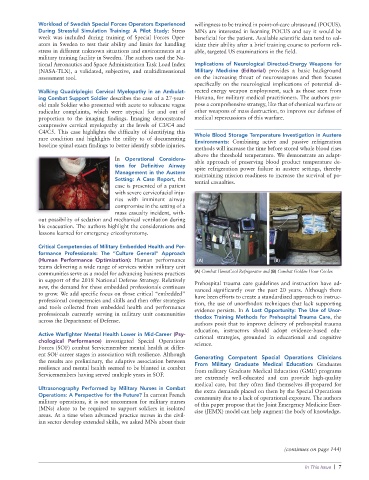
rare condition and highlights the utility to of documenting Whole Blood Storage Temperature Investigation in Austere
Environments: Combining active and passive refrigeration
baseline spinal exam findings to better identify subtle injuries.
methods will increase the time before stored whole blood rises
above the threshold temperature. We demonstrate an adapt
In Operational Considera- able approach of preserving blood product temperature de
tion for Definitive Airway spite refrigeration power failure in austere settings, thereby
Management in the Austere maintaining mission readiness to increase the survival of po
Setting: A Case Report, the tential casualties.
case is presented of a patient
with severe cervicofacial inju
ries with imminent airway
compromise in the setting of a
mass casualty incident, with
out possibility of sedation and mechanical ventilation during
his evacuation. The authors highlight the considerations and
lessons learned for emergency cricothyrotomy.
Critical Competencies of Military Embedded Health and Per-
formance Professionals: The “Culture General” Approach
(Human Performance Optimization): Human performance (A) (B)
teams delivering a wide range of services within military unit
communities serve as a model for advancing business practices (A) Combat HemaCool Refrigerator and (B) Combat Golden Hour Cooler.
in support of the 2018 National Defense Strategy. Relatively Prehospital trauma care guidelines and instruction have ad
new, the demand for these embedded professionals continues vanced significantly over the past 20 years. Although there
to grow. We add specific focus on those critical “embedded” have been efforts to create a standardized approach to instruc
professional competencies and skills and then offer strategies tion, the use of unorthodox techniques that lack supporting
and tools collected from embedded health and performance
professionals currently serving in military unit communities evidence persists. In A Lost Opportunity: The Use of Unor-
thodox Training Methods for Prehospital Trauma Care, the
across the Department of Defense.
authors posit that to improve delivery of prehospital trauma
education, instructors should adopt evidencebased edu
Active Warfighter Mental Health Lower in Mid-Career (Psy- cational strategies, grounded in educational and cognitive
chological Performance) investigated Special Operations science.
Forces (SOF) combat Servicemember mental health at differ
ent SOF career stages in association with resilience. Although
the results are preliminary, the adaptive association between Generating Competent Special Operations Clinicians
From Military Graduate Medical Education: Graduates
resilience and mental health seemed to be blunted in combat from military Graduate Medical Education (GME) programs
Servicemembers having served multiple years in SOF.
are extremely welleducated and can provide highquality
medical care, but they often find themselves illprepared for
Ultrasonography Performed by Military Nurses in Combat the extra demands placed on them by the Special Operations
Operations: A Perspective for the Future? In current French community due to a lack of operational exposure. The authors
military operations, it is not uncommon for military nurses of this paper propose that the Joint Emergency Medicine Exer
(MNs) alone to be required to support soldiers in isolated cise (JEMX) model can help augment the body of knowledge.
areas. At a time when advanced practice nurses in the civil
ian sector develop extended skills, we asked MNs about their
(continues on page 144)
In This Issue | 7

