


Page 57 - JSOM Winter 2021
P. 57
from a curriculum-based approach for ultrasound training as   at the Navy Trauma Training Center, Los Angeles County and
              demonstrated in recent studies on teaching single ultrasound   University of California. He serves as a subject matter expert
              applications to military medics. 6–11  Although these trainings   for deployment teams, attends field courses at the Naval Expe-
              were successful, none taught multiple ultrasound techniques   ditionary Medical Training Institute in Camp Pendleton, CA,
              in one course.                                     and has multiple years of experience in using ultrasound in
                                                                 austere environments and trauma management. The course
              Our team developed and implemented a comprehensive, mul-  was based on a flipped classroom model with the total course
              timodal course for Special Operations combat and tactical   time of 43 hours, which was divided into an online component
              medics in ultrasound-guided assessments that included assess-  and live lectures/reviews followed by hands-on training. Live
              ments of the heart, lung, and abdomen. It also consisted of the   instruction also included instructor-led discussions where mil-
              placement of venous catheters and provision of focused re-  itary operational case-based scenarios were discussed to teach
              gional anesthesia. The program combined online coursework   medics how to interpret ultrasound findings and make correct
              and live didactic sessions, including instructor-led lectures   diagnoses/medical decisions. The different ultrasound appli-
              and case-based discussions. It also included hands-on prac-  cations taught in the course included abdominal ultrasound,
              tice sessions on ultrasound simulators, task trainers, and live   lung ultrasound, rapid ultrasound for shock and hypotension
              models with integrated feedback. Our hypothesis was that a   (RUSH), transthoracic echocardiography (TTE), and ultra-
              5-day training course for Special Operations combat and tac-  sound-guided regional anesthesia and vascular access. The ef-
              tical medics would improve their level of knowledge, manual   fectiveness of the course was evaluated utilizing the following
              skills, and workflow understanding of various applications of   criteria adopted to reinforce the three components of profi-
              ultrasound.                                        ciency in ultrasound: knowledge, manual skills, and workflow
                                                                 understanding. 12
              Methods
                                                                 1.  For knowledge assessment, participants completed a pre-
              Study Design                                         and post-course exam, which included questions to assess
              Our team conducted a feasibility study on ultrasound training   learners’ ability to make correct diagnoses based on ultra-
              for Special Operations combat medics and Special Operations   sound findings.
              tactical medics after receiving institutional review board ap-  2.  For manual skills, experts evaluated participants’ manual
              proval for exempt status, with a waiver of documentation of   skills throughout the course via a global rating scale. This
              informed consent by the Committee on Clinical Investigations   scale asked experts to evaluate skills in terms of image find-
              at Beth Israel Deaconess Medical Center (BIDMC). A total of   ing, image optimization, image acquisition speed, final im-
              nine medics in two groups participated in the study after be-  age quality, and global assessment. In addition, participants
              ing recruited as a convenience sample by one of the authors   reported their perceived comfort with ultrasound applica-
              (DNL), who completed an Adult Cardiothoracic Anesthesia   tions before and after the course.
              fellowship at BIDMC and regularly trains military medics.   3.  To evaluate the ability to perform ultrasound techniques
              Eight participants provided demographic data on their prior   using the  appropriate practical  steps (workflow  under-
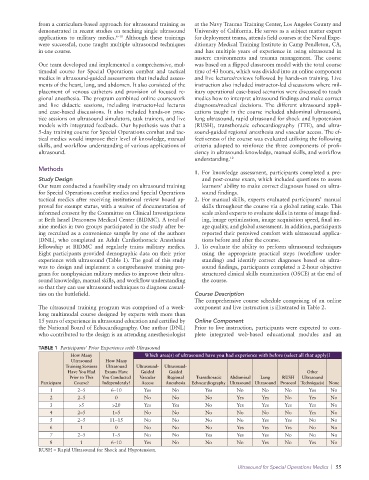
              experience with ultrasound (Table 1). The goal of this study   standing) and identify correct diagnoses based on ultra-
              was to design and implement a comprehensive training pro-  sound findings, participants completed a 2-hour objective
              gram for nonphysician military medics to improve their ultra-  structured clinical skills examination (OSCE) at the end of
              sound knowledge, manual skills, and workflow understanding   the course.
              so that they can use ultrasound techniques to diagnose casual-
              ties on the battlefield.                           Course Description
                                                                 The comprehensive course schedule comprising of an online
              The ultrasound training program was comprised of a week-  component and live instruction is illustrated in Table 2.
              long multimodal course designed by experts with more than
              15 years of experience in ultrasound education and certified by   Online Component
              the National Board of Echocardiography. One author (DNL)   Prior to live instruction, participants were expected to com-
              who contributed to the design is an attending anesthesiologist   plete  integrated  web-based  educational  modules  and  an
              TABLE 1  Participants’ Prior Experience with Ultrasound
                        How Many                Which area(s) of ultrasound have you had experience with before (select all that apply)?
                        Ultrasound   How Many
                      Training Sessions   Ultrasound   Ultrasound-  Ultrasound-
                       Have You Had   Exams Have   Guided   Guided                                   Other
                        Prior to This   You Conducted   Vascular   Regional   Transthoracic   Abdominal   Lung    RUSH   Ultrasound
              Participant  Course?  Independently?  Access  Anesthesia  Echocardiography Ultrasound Ultrasound  Protocol  Technique(s)  None
                 1        2–5        6–10       Yes      No         Yes       No       No     No      Yes    No
                 2        2–5          0        No       No         No        Yes      Yes    No      Yes    No
                 3         >5         >20       Yes      Yes        No        Yes      Yes    Yes     Yes    No
                 4        2–5         1–5       No       No         No        No       No     No      Yes    No
                 5        2–5        11–15      No       No         No        No       Yes    Yes     No     No
                 6         1           0        No       No         No        Yes      Yes    Yes     No     No
                 7        2–5         1–5       No       No         Yes       Yes      Yes    No      No     No
                 8         1         6–10       Yes      No         No        No       Yes    No      Yes    No
              RUSH = Rapid Ultrasound for Shock and Hypotension.

                                                                               Ultrasound for Special Operations Medics  |  55

