


Page 60 - JSOM Winter 2021
P. 60
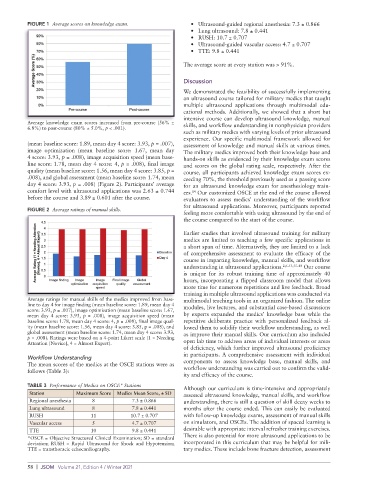
FIGURE 1  Average scores on knowledge exam.          •  Ultrasound-guided regional anesthesia: 7.3 ± 0.866
                                                               •  Lung ultrasound: 7.8 ± 0.441
                                                               •  RUSH: 10.7 ± 0.707
                                                               •  Ultrasound-guided vascular access: 4.7 ± 0.707
                                                               •  TTE: 9.8 ± 0.441
                                                             The average score at every station was > 91%.


                                                             Discussion
                                                             We demonstrated the feasibility of successfully implementing
                                                             an ultrasound course tailored for military medics that taught
                                                             multiple ultrasound applications through multimodal edu-
                                                             cational methods. Additionally, we showed that a short but
                                                             intensive course can develop ultrasound knowledge, manual
          Average knowledge exam scores increased from pre-course (56% ±   skills, and workflow understanding in nonphysician providers
          6.8%) to post-course (80% ± 5.0%, p < .001).
                                                             such as military medics with varying levels of prior ultrasound
                                                             experience. Our specific multimodal framework allowed for
          (mean baseline score: 1.89, mean day 4 score: 3.93, p = .007),   assessment of knowledge and manual skills at various times.
          image optimization (mean baseline score: 1.67, mean day     The military medics improved both their knowledge base and
          4 score: 3.93, p = .008), image acquisition speed (mean base-  hands-on skills as evidenced by their knowledge exam scores
          line score: 1.78, mean day 4 score: 4, p = .008), final image   and scores on the global rating scale, respectively. After the
          quality (mean baseline score: 1.56, mean day 4 score: 3.85, p =   course, all participants achieved knowledge exam scores ex-
          .008), and global assessment (mean baseline score: 1.74, mean   ceeding 70%, the threshold previously used as a passing score
          day 4 score: 3.93, p = .008) (Figure 2). Participants’ average   for an ultrasound knowledge exam for anesthesiology train-
          comfort level with ultrasound applications was 2.63 ± 0.744   ees.  Our customized OSCE at the end of the course allowed
                                                                14
          before the course and 3.89 ± 0.601 after the course.  evaluators to assess medics’ understanding of the workflow
                                                             for ultrasound applications. Moreover, participants reported
          FIGURE 2  Average ratings of manual skills.
                                                             feeling more comfortable with using ultrasound by the end of
                                                             the course compared to the start of the course.

                                                             Earlier studies that involved ultrasound training for military
                                                             medics are limited to teaching a few specific applications in
                                                             a short span of time. Alternatively, they are limited to a lack
                                                             of comprehensive assessment to evaluate the efficacy of the
                                                             course in imparting knowledge, manual skills, and workflow
                                                             understanding in ultrasound applications. 2,6–11,15–18  Our course
                                                             is unique for its robust training time of approximately 40
                                                             hours, incorporating a flipped classroom model that allows
                                                             more time for numerous repetitions and live feedback. Broad
                                                             training in multiple ultrasound applications was conducted via
          Average ratings for manual skills of the medics improved from base-  multimodal teaching tools in an organized fashion. The online
          line to day 4 for image finding (mean baseline score: 1.89, mean day 4   modules, live lectures, and substantial case-based discussions
          score: 3.93, p = .007), image optimization (mean baseline score: 1.67,
          mean day 4 score: 3.93,  p = .008), image acquisition speed (mean   by experts expanded the medics’ knowledge base while the
          baseline score: 1.78, mean day 4 score: 4, p = .008), final image qual-  repetitive deliberate practice with personalized feedback al-
          ity (mean baseline score: 1.56, mean day 4 score: 3.85, p = .008), and   lowed them to solidify their workflow understanding, as well
          global assessment (mean baseline score: 1.74, mean day 4 score: 3.93,   as improve their manual skills. Our curriculum also included
          p = .008). Ratings were based on a 4-point Likert scale (1 = Needing
          Attention [Novice], 4 = Almost Expert).            open lab time to address areas of individual interests or areas
                                                             of deficiency, which further improved ultrasound proficiency
                                                             in participants. A comprehensive assessment with individual
          Workflow Understanding
          The mean scores of the medics at the OSCE stations were as   components to assess knowledge base, manual skills, and
          follows (Table 3):                                 workflow understanding was carried out to confirm the valid-
                                                             ity and efficacy of the course.
          TABLE 3  Performance of Medics on OSCE* Stations   Although our curriculum is time-intensive and appropriately
           Station        Maximum Score  Medics Mean Score, ± SD  assessed ultrasound knowledge, manual skills, and workflow
           Regional anesthesia  8           7.3 ± 0.866      understanding, there is still a question of skill decay weeks to
           Lung ultrasound     8            7.8 ± 0.441      months after the course ended. This can easily be evaluated
           RUSH                11           10.7 ± 0.707     with follow-up knowledge exams, assessment of manual skills
           Vascular access     5            4.7 ± 0.707      on simulators, and OSCEs. The addition of spaced learning is
           TTE                 10           9.8 ± 0.441      desirable with appropriate interval refresher training exercises.
          *OSCE = Objective Structured Clinical Examination; SD = standard   There is also potential for more ultrasound applications to be
          deviation; RUSH = Rapid Ultrasound for Shock and Hypotension;    incorporated in this curriculum that may be helpful for mili-
          TTE = transthoracic echocardiography.              tary medics. These include bone fracture detection, assessment


          58  |  JSOM   Volume 21, Edition 4 / Winter 2021

