


Page 26 - JSOM Winter 2021
P. 26
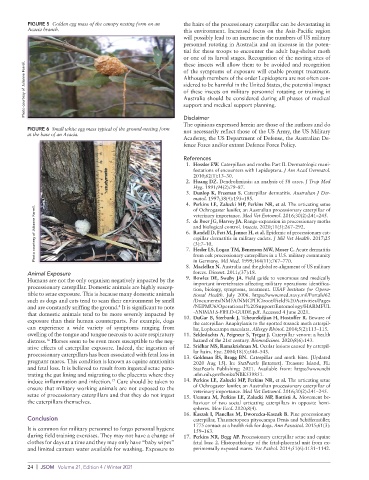
FIGURE 5  Golden egg mass of the canopy nesting form on an   the hairs of the processionary caterpillar can be devastating in
          Acacia branch.                                     this environment. Increased focus on the Asia-Pacific region
                                                             will possibly lead to an increase in the numbers of US military
                                                             personnel rotating in Australia and an increase in the poten-
                                                             tial for these troops to encounter the adult bag-shelter moth
                                                             or one of its larval stages. Recognition of the nesting sites of
         Photo courtesy of Julianne Farrell.                 Although members of the order Lepidoptera are not often con-
                                                             these insects will allow them to be avoided and recognition
                                                             of the symptoms of exposure will enable prompt treatment.

                                                             sidered to be harmful in the United States, the potential impact
                                                             of these insects on military personnel rotating or training in
                                                             Australia should be considered during all phases of medical
                                                             support and medical support planning.

                                                             Disclaimer
                                                             The opinions expressed herein are those of the authors and do
          FIGURE 6  Small white egg mass typical of the ground-nesting form   not necessarily reflect those of the US Army, the US Military
          at the base of an Acacia.
                                                             Academy, the US Department of Defense, the Australian De-
                                                             fence Force and/or extant Defence Force Policy.

                                                             References
                                                              1.  Hossler EW. Caterpillars and moths: Part II. Dermatologic mani-
                                                                festations of encounters with Lepidoptera. J Am Acad Dermatol.
                                                                2010;62(1):13–30.
                                                              2.  Huang DZ. Dendrolimiasis: an analysis of 58 cases. J Trop Med
                                                                Hyg. 1991;94(2):79–87.
                                                              3.  Dunlop K, Freeman S. Caterpillar dermatitis. Australian J Der-
                                                                matol. 1997;38(4):193–195.
                                                              4.  Perkins LE, Zalucki MP, Perkins NR, et al. The urticating setae
            Photo courtesy of Julianne Farrell.               5.  de Boer JG, Harvey JA. Range-expansion in processionary moths
                                                                of Ochrogaster lunifer, an Australian processionary caterpillar of
                                                                veterinary importance. Med Vet Entomol. 2016;30(2):241–245.
                                                                and biological control. Insects. 2020;11(5):267–292.
                                                              6.  Randell D, Fett M, Jenner H, et al. Epidemic of processionary cat-
                                                                erpillar dermatitis in military cadets. J Mil Vet Health. 2017;25
                                                                (3):7–10.
                                                              7.  Hesler LS, Logan TM, Benenson MW, Moser C. Acute dermatitis
                                                                from oak processionary caterpillars in a U.S. military community
                                                                in Germany. Mil Med. 1999;164(11):767–770.
                                                              8.  Maclellan N. Australia and the global re-alignment of US military
          Animal Exposure                                       forces. Dissent. 2011;(37):18.
          Humans are not the only organism negatively impacted by the   9.  Bowles DE, Swaby JA. Field guide to venomous and medically
          processionary caterpillar. Domestic animals are highly suscep-  important invertebrates affecting military operations: identifica-
                                                                tion, biology, symptoms, treatment. USAF Institute for Opera-
          tible to setae exposure. This is because many domestic animals   tional Health. July 2006.  https://www.med.navy.mil/Portals/62
          such as dogs and cats tend to scan their environment by smell   /Documents/NMFA/NMCPHC/root/Field%20Activities/Pages
                                        4
          and are constantly sniffing the ground.  It is significant to note   /NEPMU6/Operational%20Support/Entomology/HARMFUL
          that domestic animals tend to be more severely impacted by   -ANIMALS-FIELD-GUIDE.pdf. Accessed 4 June 2021.
          exposure than their human counterparts. For example, dogs   10.  DuGar B, Sterbank J, Tcheurekdjian H, Hostoffer R. Beware of
                                                                the caterpillar: Anaphylaxis to the spotted tussock moth caterpil-
          can experience a wide variety of symptoms ranging from   lar, Lophocampa maculata. Allergy Rhinol. 2014;5(2):113–115.
          swelling of the tongue and tongue necrosis to acute respiratory   11.  Seldeslachts A, Peigneur S, Tytgat J. Caterpillar venom: a health
          distress.  Horses seem to be even more susceptible to the neg-  hazard of the 21st century. Biomedicines. 2020;8(6):143.
                16
          ative effects of caterpillar exposure. Indeed, the ingestion of   12.  Sridhar MS, Ramakrishnan M. Ocular lesions caused by caterpil-
                                                                lar hairs. Eye. 2004;18(5):540–543.
          processionary caterpillars has been associated with fetal loss in   13.  Goldman BS, Bragg BN. Caterpillar and moth bites. [Updated
          pregnant mares. This condition is known as equine amnionitis   2020 Aug 15]. In:  StatPearls  [Internet]. Treasure Island, FL:
          and fetal loss. It is believed to result from ingested setae pene-  StatPearls Publishing; 2021. Available from:  https://www.ncbi
          trating the gut lining and migrating to the placenta where they   .nlm.nih.gov/books/NBK539851.
                                     17
          induce inflammation and infection.  Care should be taken to   14.  Perkins LE, Zalucki MP, Perkins NR, et al. The urticating setae
          ensure that military working animals are not exposed to the   of Ochrogaster lunifer, an Australian processionary caterpillar of
                                                                veterinary importance. Med Vet Entomol. 2016;30(2):241–245.
          setae of processionary caterpillars and that they do not ingest   15.  Uemura M, Perkins LE, Zalucki MP, Battisti A. Movement be-
          the caterpillars themselves.                          haviour of two social urticating caterpillars in opposite hemi-
                                                                spheres. Mov Ecol. 2020;8(4).
                                                             16.  Kaszak I, Planellas M, Dworecka-Kaszak B. Pine processionary
          Conclusion                                            caterpillar, Thaumetopoea pityocampa Denis and Schiffermüller,
                                                                1775 contact as a health risk for dogs. Ann Parasitol. 2015;61(3):
          It is common for military personnel to forgo personal hygiene   159–163.
          during field training exercises. They may not have a change of   17.  Perkins NR, Begg AP. Processionary caterpillar setae and equine
          clothes for days at a time and they may only have “baby wipes”   fetal loss: 2. Histopathology of the fetal-placental unit from ex-
          and limited canteen water available for washing. Exposure to   perimentally exposed mares. Vet Pathol. 2014;51(6):1131–1142.


          24  |  JSOM   Volume 21, Edition 4 / Winter 2021

