


Page 23 - JSOM Winter 2021
P. 23
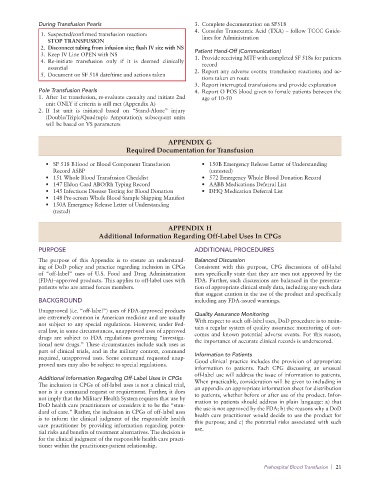
During Transfusion Pearls                          3.  Complete documentation on SF518
                                                                 4.  Consider Tranexamic Acid (TXA) – follow TCCC Guide-
              1.  Suspected/confirmed transfusion reaction:
                 STOP TRANSFUSION                                  lines for Administration
              2.  Disconnect tubing from infusion site; flush IV site with NS
              3.  Keep IV Line OPEN with NS                      Patient Hand-Off (Communication)
              4.  Re-initiate transfusion only if it is deemed clinically   1.  Provide receiving MTF with completed SF 518s for patients
                 essential                                         record
              5.  Document on SF 518 date/time and actions taken  2.  Report any adverse events; transfusion reactions; and ac-
                                                                   tions taken en route
                                                                 3.  Report interrupted transfusions and provide explanation
              Pole Transfusion Pearls                            4.  Report O POS blood given to female patients between the
              1.  After 1st transfusion, re-evaluate casualty and initiate 2nd   age of 10-50
                unit ONLY if criteria is still met (Appendix A)
              2.  If 1st unit is initiated based on “Stand-Alone” injury
                ( Double/Triple/Quadruple Amputation); subsequent units
                will be based on VS parameters

                                                        APPENDIX G
                                          Required Documentation for Transfusion

                •  SF 518 B1lood or Blood Component Transfusion    •  150B Emergency Release Letter of Understanding
                  Record ASBP                                        (untested)
                •  151 Whole Blood Transfusion Checklist           •  572 Emergency Whole Blood Donation Record
                •  147 Eldon Card ABO/Rh Typing Record             •  AABB Medications Deferral List
                •  145 Infectious Disease Testing for Blood Donation  •  DHQ Medication Deferral List
                •  148 Pre-screen Whole Blood Sample Shipping Manifest
                •  150A Emergency Release Letter of Understanding
                  (tested)


                                                        APPENDIX H
                                 Additional Information Regarding Off-Label Uses In CPGs
              PURPOSE                                            ADDITIONAL PROCEDURES
              The purpose of this Appendix is to ensure an understand-  Balanced Discussion
              ing of DoD policy and practice regarding inclusion in CPGs   Consistent with this purpose, CPG discussions of off-label
              of “off-label” uses of U.S. Food and Drug Administration   uses specifically state that they are uses not approved by the
              (FDA)–approved products. This applies to off-label uses with   FDA. Further, such discussions are balanced in the presenta-
              patients who are armed forces members.             tion of appropriate clinical study data, including any such data
                                                                 that suggest caution in the use of the product and specifically
              BACKGROUND                                         including any FDA-issued warnings.
              Unapproved (i.e. “off-label”) uses of FDA-approved products
              are extremely common in American medicine and are usually   Quality Assurance Monitoring
              not subject to any special regulations. However, under Fed-  With respect to such off-label uses, DoD procedure is to main-
              eral law, in some circumstances, unapproved uses of approved   tain a regular system of quality assurance monitoring of out-
              drugs are subject to FDA regulations governing “investiga-  comes and known potential adverse events. For this reason,
              tional new drugs.” These circumstances include such uses as   the importance of accurate clinical records is underscored.
              part of clinical trials, and in the military context, command
              required, unapproved uses. Some command requested unap-  Information to Patients
              proved uses may also be subject to special regulations.   Good clinical practice includes the provision of appropriate
                                                                 information to patients. Each CPG discussing an unusual
                                                                 off-label use will address the issue of information to patients.
              Additional Information Regarding Off-Label Uses in CPGs
              The inclusion in CPGs of off-label uses is not a clinical trial,   When practicable, consideration will be given to including in
              nor is it a command request or requirement. Further, it does   an appendix an appropriate information sheet for distribution
              not imply that the Military Health System requires that use by   to patients, whether before or after use of the product. Infor-
              DoD health care practitioners or considers it to be the “stan-  mation to patients should address in plain language: a) that
              dard of care.” Rather, the inclusion in CPGs of off-label uses   the use is not approved by the FDA; b) the reasons why a DoD
              is to inform the clinical judgment of the responsible health   health care practitioner would decide to use the product for
              care practitioner by providing information regarding poten-  this purpose; and c) the potential risks associated with such
              tial risks and benefits of treatment alternatives. The decision is   use.
              for the clinical judgment of the responsible health care practi-
              tioner within the practitioner-patient relationship.


                                                                                       Prehospital Blood Transfusion  |  21

