


Page 24 - JSOM Winter 2021
P. 24
An Introduction to the Processionary Caterpillar,

                 An Underrecognized Threat to US Military Personnel in Australia


                                                                               2
                                                             1
                                       Michael A. Washington *; Julianne Farrell ;
                                                            3
                                            Julianne Meany ; Weng Chow    4


          ABSTRACT
          Processionary caterpillars are well-described threats to human   (Ochrogaster lunifer). This caterpillar is the larval form of the
          and animal health. They are found throughout Central Asia,   Bag-shelter moth that is ubiquitous in the coastal and inland
          Northern Africa, and Southern Europe. However, US military   regions of Australia, where it tends to nest in the canopies or
          personnel may not be familiar with the threat that these organ-  at the base of Acacia and Eucalyptus trees (Figure 1).  The
                                                                                                         4
          isms pose in Australia. The larval form of the bag-shelter moth   ground-nesting form is more common in coastal areas while
          (Ochrogaster lunifer) is a processionary caterpillar that has   the canopy-nesting form is more common in inland regions.
          been found throughout inland and coastal Australia. These or-  However, there are areas between coastal and inland regions
          ganisms are habitually associated with Acacia and Eucalyptus   where both forms have been noted.
          trees and they tend to form long chains known as “proces-
          sions” as they travel between nesting and pupating sites. They
          are covered with numerous hairs that can detach, become air-
          borne, and cause potentially life-threatening inflammatory re-
          actions and ocular trauma in susceptible personnel. They can
          also cause severe inflammatory reactions in military working
          animals. It is important that military and preventive medical
          personnel  become  aware of  the presence  of  processionary
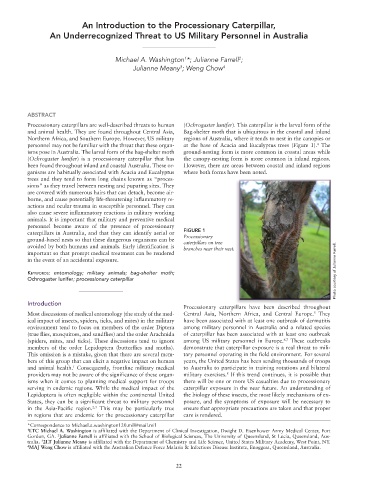
          caterpillars in Australia, and that they can identify aerial or   FIGURE 1
          ground-based nests so that these dangerous organisms can be   Processionary
          avoided by both humans and animals. Early identification is   caterpillars on tree
                                                             branches near their nest.
          important so that prompt medical treatment can be rendered
          in the event of an accidental exposure.
          Keywords:  entomology; military animals; bag-shelter moth;                                           Photo courtesy of Julianne Farrell.
          Ochro gaster lunifer; processionary caterpillar


          Introduction
                                                             Processionary caterpillars have been described throughout
          Most discussions of medical entomology (the study of the med-  Central Asia, Northern Africa, and Central Europe.  They
                                                                                                        5
          ical impact of insects, spiders, ticks, and mites) in the military   have been associated with at least one outbreak of dermatitis
          environment tend to focus on members of the order Diptera   among military personnel in Australia and a related species
          (true flies, mosquitoes, and sandflies) and the order Arachnida   of caterpillar has been associated with at least one outbreak
          (spiders, mites, and ticks). These discussions tend to ignore   among  US  military  personnel  in  Europe.   These  outbreaks
                                                                                              6,7
          members of the order Lepidoptera (butterflies and moths).   demonstrate that caterpillar exposure is a real threat to mili-
          This omission is a mistake, given that there are several mem-  tary personnel operating in the field environment. For several
          bers of this group that can elicit a negative impact on human   years, the United States has been sending thousands of troops
          and animal health.  Consequently, frontline military medical   to Australia to participate in training rotations and bilateral
                         1
          providers may not be aware of the significance of these organ-  military exercises.  If this trend continues, it is possible that
                                                                           8
          isms when it comes to planning medical support for troops   there will be one or more US casualties due to processionary
          serving in endemic regions. While the medical impact of the   caterpillar exposure in the near future. An understanding of
          Lepidoptera is often negligible within the continental United   the biology of these insects, the most likely mechanisms of ex-
          States, they can be a significant threat to military personnel   posure, and the symptoms of exposure will be necessary to
          in the Asia-Pacific region.  This may be particularly true   ensure that appropriate precautions are taken and that proper
                               2,3
          in regions that are endemic for the processionary caterpillar   care is rendered.
          *Correspondence to Michael.a.washington120.mil@mail.mil
          1 LTC Michael A. Washington is affiliated with the Department of Clinical Investigation, Dwight D. Eisenhower Army Medical Center, Fort
          Gordon, GA.  Julianne Farrell is affiliated with the School of Biological Sciences, The University of Queensland, St Lucia, Queensland, Aus-
                    2
          tralia.  2LT Julianne Meany is affiliated with the Department of Chemistry and Life Science, United States Military Academy, West Point, NY.
               3
          4 MAJ Weng Chow is affiliated with the Australian Defence Force Malaria & Infectious Disease Institute, Enoggera, Queensland, Australia.
                                                           22
                                                           22
                                                           22

