


Page 25 - JSOM Winter 2021
P. 25
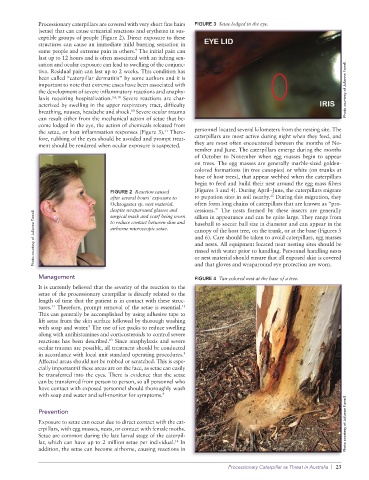
Processionary caterpillars are covered with very short fine hairs   FIGURE 3  Setae lodged in the eye.
              (setae) that can cause urticarial reactions and erythema in sus-
              ceptible groups of people (Figure 2). Direct exposure to these
              structures can cause an immediate mild burning sensation in
              some people and extreme pain in others.  The initial pain can
                                             9
              last up to 12 hours and is often associated with an itching sen-
              sation and ocular exposure can lead to swelling of the conjunc-
              tiva. Residual pain can last up to 2 weeks. This condition has
              been called “caterpillar dermatitis” by some authors and it is
              important to note that extreme cases have been associated with
              the development of severe inflammatory reactions and anaphy-                                        Photo courtesy of Julianne Farrell.
              laxis requiring hospitalization. 3,6,10  Severe reactions are char-
              acterized by swelling in the upper respiratory tract, difficulty
                                            10
              breathing, nausea, headache and shock.  Severe ocular trauma
              can result either from the mechanical action of setae that be-
              come lodged in the eye, the action of chemicals released from
                                                       11
              the setae, or host inflammation responses (Figure 3).  There-  personnel located several kilometers from the nesting site. The
              fore, rubbing of the eyes should be avoided and prompt treat-  caterpillars are most active during night when they feed, and
              ment should be rendered when ocular exposure is suspected.  they are most often encountered between the months of No-
                                                                 vember and June. The caterpillars emerge during the months
                                                                 of October to November when egg masses begin to appear
                                                                 on trees. The egg masses are generally marble-sized golden-
                                                                 colored formations (in tree canopies) or white (on trunks at
                                                                 base of host trees), that appear webbed when the caterpillars
                                                                 begin to feed and build their nest around the egg mass fibers
                                     FIGURE 2  Reaction caused   (Figures 3 and 4). During April–June, the caterpillars migrate
                                                                                         15
                                     after several hours’ exposure to   to pupation sites in soil nearby.  During this migration, they
                                     Ochrogaster sp. nest material,   often form long chains of caterpillars that are known as “pro-
                                     despite wraparound glasses and   cessions.” The nests formed by these insects are generally
            Photo courtesy of Julianne Farrell.  airborne microscopic setae.  canopy of the host tree, on the trunk, or at the base (Figures 5
                                     surgical mask and scarf being worn
                                                                 silken in appearance and can be quite large. They range from
                                     to reduce contact between skin and
                                                                 baseball to soccer ball size in diameter and can appear in the
                                                                 and 6). Care should be taken to avoid caterpillars, egg masses
                                                                 and nests. All equipment located near nesting sites should be
                                                                 rinsed with water prior to handling. Personnel handling nests
                                                                 or nest material should ensure that all exposed skin is covered


              Management                                         and that gloves and wraparound eye protection are worn.
                                                                 FIGURE 4  Tan-colored nest at the base of a tree.
              It is currently believed that the severity of the reaction to the
              setae of the processionary caterpillar is directly related to the
              length of time that the patient is in contact with these struc-
              tures.  Therefore, prompt removal of the setae is essential.
                                                            12
                  11
              This can generally be accomplished by using adhesive tape to
              lift setae from the skin surface followed by thorough washing
              with soap and water.  The use of ice packs to reduce swelling
                              9
              along with antihistamines and corticosteroids to control severe
              reactions has been described.  Since anaphylaxis and severe
                                     13
              ocular trauma are possible, all treatment should be conducted
                                                             9
              in accordance with local unit standard operating procedures.
              Affected areas should not be rubbed or scratched. This is espe-
              cially important if these areas are on the face, as setae can easily
              be transferred into the eyes. There is evidence that the setae
              can be transferred from person to person, so all personnel who
              have contact with exposed personnel should thoroughly wash
              with soap and water and self-monitor for symptoms. 9

              Prevention
              Exposure to setae can occur due to direct contact with the cat-                                     Photo courtesy of Julianne Farrell.
              erpillars, with egg masses, nests, or contact with female moths.
              Setae are common during the late larval stage of the caterpil-
                                                          14
              lar, which can have up to 2 million setae per individual.  In
              addition, the setae can become airborne, causing reactions in
                                                                            Processionary Caterpillar as Threat in Australia  |  23

