


Page 18 - JSOM Winter 2021
P. 18
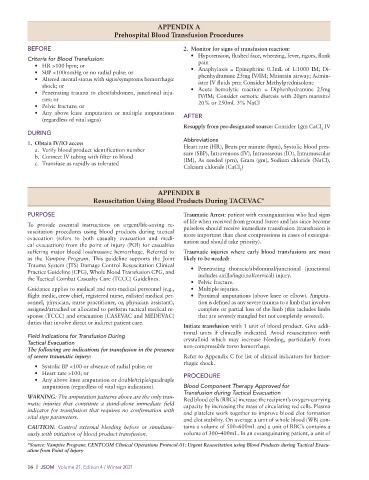
APPENDIX A
                                      Prehospital Blood Transfusion Procedures
          BEFORE                                             2.  Monitor for signs of transfusion reaction:
                                                               •  Hypotension, flushed face, wheezing, fever, rigors, flank
          Criteria for Blood Transfusion:                         pain
            •  HR >100 bpm; or                                 •  Anaphylaxis = Epinephrine 0.3mL of 1:1000 IM; Di-
            •  SBP <100mmHg or no radial pulse; or                phenhydramine 25mg IV/IM; Maintain airway; Admin-
            •  Altered mental status with signs/symptoms hemorrhagic   ister IV fluids prn; Consider Methylprednisolone
               shock; or                                       •  Acute hemolytic reaction = Diphenhydramine 25mg
            •  Penetrating trauma to chest/abdomen, junctional inju-  IV/IM; Consider osmotic diuresis with 20gm mannitol
               ries; or                                           20% or 250mL 3% NaCl
            •  Pelvic fracture; or
            •  Any above knee amputation or multiple amputations
               (regardless of vital signs)                   AFTER
                                                             Resupply from pre-designated source: Consider 1gm CaCl  IV
                                                                                                          2
          DURING
                                                             Abbreviations
          1.  Obtain IV/IO access
            a.  Verify blood product identification number   Heart rate (HR), Beats per minute (bpm), Systolic blood pres-
            b.  Connect IV tubing with filter to blood       sure (SBP), Intravenous (IV), Intraosseous (IO), Intramuscular
            c.  Transfuse as rapidly as tolerated            (IM), As needed (prn), Gram (gm), Sodium chloride (NaCl),
                                                             Calcium chloride (CaCl )
                                                                               2


                                                     APPENDIX B
                               Resuscitation Using Blood Products During TACEVAC*

          PURPOSE                                            Traumatic Arrest: patient with exsanguination who had signs
                                                             of life when received from ground forces and has since become
          To  provide  essential  instructions  on  urgent/life-saving  re-
          suscitation procedures using blood products during tactical   pulseless should receive immediate transfusion (transfusion is
          evacuation (refers to both casualty evacuation and medi-  more important than chest compressions in cases of exsangui-
          cal evacuation) from the point of injury (POI) for casualties   nation and should take priority).
          suffering major blood loss/massive hemorrhage. Referred to   Traumatic injuries where early blood transfusions are most
          as the  Vampire Program.  This guideline supports the Joint   likely to be needed:
          Trauma System (JTS) Damage Control Resuscitation Clinical
          Practice Guideline (CPG), Whole Blood Transfusion CPG, and   •  Penetrating thoracic/abdominal/junctional (junctional
          the Tactical Combat Casualty Care (TCCC) Guidelines.    includes axilla/inguinal/cervical) injury.
                                                               •  Pelvic fracture.
          Guidance applies to medical and non-medical personnel (e.g.,   •  Multiple injuries.
          flight medic, crew chief, registered nurse, enlisted medical per-  •  Proximal amputations (above knee or elbow). Amputa-
          sonnel, physician, nurse practitioner, or, physician assistant),   tion is defined as any severe trauma to a limb that involves
          assigned/attached or allocated to perform tactical medical re-  complete or partial loss of the limb (this includes limbs
          sponse (TCCC) and evacuation (CASEVAC and MEDEVAC)      that are severely mangled but not completely severed).
          duties that involve direct or indirect patient care.
                                                             Initiate transfusion with 1 unit of blood product. Give addi-
                                                             tional units if clinically indicated. Avoid resuscitation with
          Field Indications for Transfusion During           crystalloid which may increase bleeding, particularly from
          Tactical Evacuation                                non-compressible torso hemorrhage.
          The following are indications for transfusion in the presence
          of severe traumatic injury:                        Refer to Appendix C for list of clinical indicators for hemor-
                                                             rhagic shock.
            •  Systolic BP <100 or absence of radial pulse; or
            •  Heart rate >100; or
            •  Any above knee amputation or double/triple/quadruple   PROCEDURE
               amputation (regardless of vital sign indication).   Blood Component Therapy Approved for
                                                             Transfusion during Tactical Evacuation
          WARNING: The amputation patterns above are the only trau-  Red blood cells (RBCs) increase the recipient’s oxygen-carrying
          matic injuries that constitute a stand-alone immediate field   capacity by increasing the mass of circulating red cells. Plasma
          indicator for transfusion that requires no confirmation with   and platelets work together to improve blood clot formation
          vital sign parameters.
                                                             and clot stability. On average a unit of whole blood (WB) con-
          CAUTION: Control external bleeding before or simultane-  tains a volume of 500–600mL and a unit of RBC’s contains a
          ously with initiation of blood product transfusion.   volume of 300–400mL. In an exsanguinating patient, a unit of
          *Source: Vampire Program: CENTCOM Clinical Operations Protocol-01: Urgent Resuscitation using Blood Products during Tactical Evacu-
          ation from Point of Injury


          16  |  JSOM   Volume 21, Edition 4 / Winter 2021

