


Page 14 - JSOM Winter 2021
P. 14
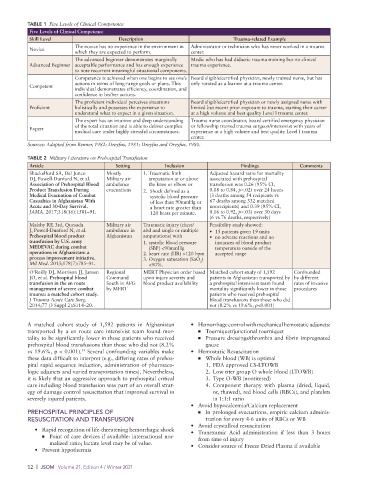
TABLE 1  Five Levels of Clinical Competence
           Five Levels of Clinical Competence
           Skill Level                  Description                          Trauma-related Example
                         The novice has no experience in the environment in   Administrator or technician who has never worked in a trauma
           Novice
                         which they are expected to perform.   center.
                         The advanced beginner demonstrates marginally   Medic who has had didactic trauma training but no clinical
           Advanced Beginner acceptable performance and has enough experience   trauma experience.
                         to note recurrent meaningful situational components.
                         Competence is achieved when one begins to see one’s  Board eligible/certified physician, newly trained nurse, but has
                         actions in terms of long-range goals or plans. This   only rotated as a learner at a trauma center.
           Competent
                         individual demonstrates efficiency, coordination, and
                         confidence in his/her actions.
                         The proficient individual perceives situations   Board eligible/certified physician or newly assigned nurse with
           Proficient    holistically and possesses the experience to   limited but recent prior exposure to trauma, starting their career
                         understand what to expect in a given situation.   at a high volume and best quality Level I trauma center.
                         The expert has an intuitive and deep understanding   Trauma nurse coordinator, board certified emergency physician
                         of the total situation and is able to deliver complex   or fellowship trained trauma surgeon/intensivist with years of
           Expert
                         medical care under highly stressful circumstances.   experience at a high volume and best quality Level I trauma
                                                               center.
          Sources: Adapted from Benner, 1982; Dreyfus, 1981; Dreyfus and Dreyfus, 1980.

          TABLE 2  Military Literature on Prehospital Transfusion
           Article                     Setting         Inclusion                Findings           Comments
           Shackelford SA, Del Junco   Mostly   1.  Traumatic limb    Adjusted hazard ratio for mortality
           DJ, Powell-Dunford N, et al.   Military air   amputation at or above   associated with prehospital
           Association of Prehospital Blood   ambulance   the knee or elbow or  transfusion was 0.26 (95% CI,
           Product Transfusion During   evacuations  2.   Shock defined as a   0.08 to 0.84, p=.02) over 24 hours
           Medical Evacuation of Combat           systolic blood pressure   (3 deaths among 54 recipients vs
           Casualties in Afghanistan With         of less than 90mmHg or   67 deaths among 332 matched
           Acute and 30-Day Survival.             a heart rate greater than   nonrecipients) and 0.39 (95% CI,
           JAMA. 2017;318(16):1581–91.            120 beats per minute.  0.16 to 0.92, p=.03) over 30 days
                                                                      (6 vs 76 deaths, respectively)
           Malsby RF, 3rd, Quesada   Military air   Traumatic injury (chest/  Feasibility study showed:
           J, Powell-Dunford N, et al.   ambulance in   abd and single or multiple   •  15 patients given 19 units
           Prehospital blood product   Afghanistan  amputations) with  •  no adverse reactions and no
           transfusion by U.S. army             1.  systolic blood pressure   instances of blood product
           MEDEVAC during combat                  (SBP) <90mmHg        temperature outside of the
           operations in Afghanistan: a         2.  heart rate (HR) >120 bpm  accepted range
           process improvement initiative.      3.  Oxygen saturation (SaO )
           Mil Med. 2013;178(7):785–91.           <90%.           2
           O’Reilly DJ, Morrison JJ, Jansen   Regional   MERT Physician order based  Matched cohort study of 1,592   Confounded
           JO, et al. Prehospital blood   Command   upon injury severity and   patients in Afghanistan transported by  by different
           transfusion in the en route   South in AFG   blood product availability  a prehospital intensivist team found   rates of invasive
           management of severe combat   by MERT                      mortality significantly lower in those   procedures
           trauma: a matched cohort study.                            patients who received prehospital
           J Trauma Acute Care Surg.                                  blood transfusions than those who did
           2014;77 (3 Suppl 2):S114–20.                               not (8.2% vs 19.6%, p<0.001)


          A matched  cohort study of 1,592 patients in Afghanistan   •  Hemorrhage control with mechanical hemostatic adjuncts:
          transported by a en route care intensivist team found mor-  ■   Tourniquet/junctional tourniquet
          tality to be significantly lower in those patients who received   ■   Pressure dressings/thrombin and fibrin impregnated
          prehospital blood transfusions than those who did not (8.2%   gauze
          vs 19.6%, p < 0.001).  Several confounding variables make   •  Hemostatic Resuscitation
                            19
          these data difficult to interpret (e.g., differing rates of prehos-  ■   Whole blood (WB) is optimal
          pital rapid sequence induction, administration of pharmaco-  1.  FDA approved CS-LTOWB
          logic adjuncts and varied transportation times). Nevertheless,   2.  Low titer group O whole blood (LTOWB)
          it is likely that an aggressive approach to prehospital critical   3.  Type O-WB (nontitered)
          care including blood transfusion was part of an overall strat-  4.  Component therapy with plasma (dried, liquid,
          egy of damage control resuscitation that improved survival in   or, thawed), red blood cells (RBCs), and platelets
          severely injured patients.                                   in 1:1:1 ratio
                                                               •  Avoid hypocalcemia/Calcium replacement
          PREHOSPITAL PRINCIPLES OF                               ■   In prolonged evacuations, empiric calcium adminis-
          RESUSCITATION AND TRANSFUSION                             tration for every 4-6 units of RBCs or WB
                                                               •  Avoid crystalloid resuscitation
            •  Rapid recognition of life-threatening hemorrhagic shock   •  Tranexamic  Acid administration if less than  3 hours
               ■   Point of care devices if available: international nor-  from time of injury
                 malized ratio; lactate level may be of value.   •  Consider source of Freeze Dried Plasma if available
            •  Prevent hypothermia


          12  |  JSOM   Volume 21, Edition 4 / Winter 2021

