


Page 10 - JSOM Winter 2021
P. 10
FEATURE ARTICLES                                   purpose of Asymmetrical Loading Patterns in Military Person-
                                                             nel With a History of Self-Reported Low Back Pain was to
          Joint Trauma System Clinical Practice Guideline: Acute Cor-
          onary Syndrome (ACS) 14 May 2021 provides guidance on   determine if servicemembers with chronic low back pain have
          best management for ACS patients in the deployed and re-  reduced lower extremity performance, and if they use alternate
          source-constrained environment.                    strategies to complete a functional performance task as com-
                                                             pared to healthy servicemembers.
          Joint Trauma System Clinical Practice Guideline (JTS CPG):
          Prehospital Blood Transfusion 30 October 2020 provides a
          brief summary of the scientific literature for prehospital blood
          use, with an emphasis on the en route care environment. Up-
          dates include the importance of calcium administration to
          counteract the deleterious effects of hypocalcemia, minimal to
          no use of crystalloid, and stresses the importance of involved
          and educated en route care medical directors alongside at a
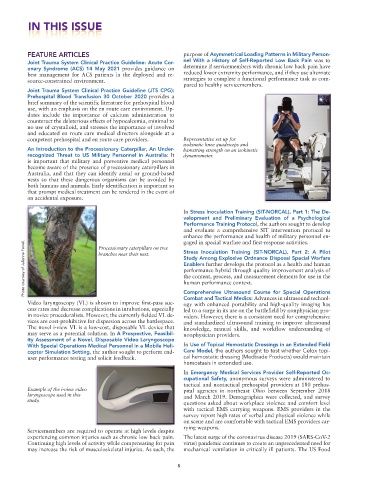
          competent prehospital and en route care providers.  Representative set up for
                                                             isokinetic knee quadriceps and
          An Introduction to the Processionary Caterpillar, An Under-  hamstring strength on an isokinetic
          recognized Threat  to US Military Personnel in  Australia: It   dynamometer.
          is important that military and preventive medical personnel
          become aware of the presence of processionary caterpillars in
          Australia, and that they can identify aerial or ground-based
          nests so that these dangerous organisms can be avoided by
          both humans and animals. Early identification is important so
          that prompt medical treatment can be rendered in the event of
          an accidental exposure.

                                                             In Stress Inoculation Training (SIT-NORCAL), Part 1: The De-
                                                             velopment and Preliminary Evaluation of a Psychological
                                                             Performance Training Protocol, the authors sought to develop
                                                             and evaluate a comprehensive SIT intervention protocol to
                                                             enhance the performance and health of military personnel en-
                                                             gaged in special warfare and first-response activities.
         Photo courtesy of Julianne Farrell.  branches near their nest.  Stress Inoculation Training (SIT-NORCAL), Part 2: A Pilot
                                 Processionary caterpillars on tree
                                                             Study Among Explosive Ordnance Disposal Special Warfare
                                                             Enablers further develops the protocol as a health and human
                                                             performance hybrid through quality improvement analysis of
                                                             the content, process, and measurement elements for use in the
                                                             human performance context.

                                                             Combat and Tactical Medics: Advances in ultrasound technol-
          Video laryngoscopy (VL) is shown to improve first-pass suc-  Comprehensive Ultrasound Course for Special Operations
                                                             ogy with enhanced portability and high-quality imaging has
          cess rates and decrease complications in intubations, especially   led to a surge in its use on the battlefield by nonphysician pro-
          in novice proceduralists. However, the currently fielded VL de-  viders. However, there is a consistent need for comprehensive
          vices are cost-prohibitive for dispersion across the battlespace.   and standardized ultrasound training to improve ultrasound
          The novel i-view VL is a low-cost, disposable VL device that   knowledge,  manual  skills,  and  workflow  understanding  of
          may serve as a potential solution. In A Prospective, Feasibil-  nonphysician providers.
          ity Assessment of a Novel, Disposable Video Laryngoscope
          With Special Operations Medical Personnel in a Mobile Heli-  In Use of Topical Hemostatic Dressings in an Extended Field
          copter Simulation Setting, the author sought to perform end-  Care Model, the authors sought to test whether Celox topi-
          user performance testing and solicit feedback.     cal hemostatic dressing (Medtrade Products) would maintain
                                                             hemostasis in extended use.

                                                             In Emergency Medical Services Provider Self-Reported Oc-
                                                             cupational Safety, anonymous surveys were administered to
                                                             tactical and nontactical prehospital providers at 180 prehos-
          Example of the i-view video                        pital agencies  in  northeast Ohio  between  September  2018
          laryngoscope used in this                          and March 2019. Demographics were collected, and survey
          study.                                             questions asked about workplace violence and comfort level
                                                             with tactical EMS carrying weapons. EMS providers in the
                                                             survey report high rates of verbal and physical violence while
                                                             on scene and are comfortable with tactical EMS providers car-
                                                             rying weapons.
          Servicemembers are required to operate at high levels despite
          experiencing common injuries such as chronic low back pain.   The latest surge of the coronavirus disease 2019 (SARS-CoV-2
          Continuing high levels of activity while compensating for pain   virus) pandemic continues to create an unprecedented need for
          may increase the risk of musculoskeletal injuries. As such, the   mechanical ventilation in critically ill patients. The US Food

                                                           8

