


Page 32 - JSOM Fall 2021
P. 32
Limb Tourniquet Holding Location

                               Model Results Fail to Translate to Human Results


                                                          1
                                    Piper Wall, DVM, PhD *; Charisse Buising, PhD 2


          ABSTRACT
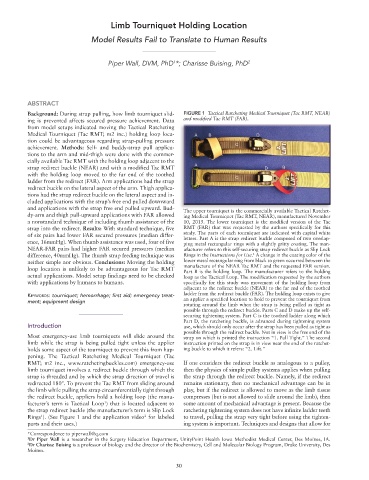
          Background: During strap pulling, how limb tourniquet slid-  FIGURE 1  Tactical Ratcheting Medical Tourniquet (Tac RMT, NEAR)
          ing is prevented affects secured pressure achievement. Data   and modified Tac RMT (FAR).
          from model setups indicated moving the Tactical Ratcheting
          Medical Tourniquet (Tac RMT; m2 inc.) holding loop loca-
          tion could be advantageous regarding strap-pulling pressure
          achievement.  Methods: Self- and buddy-strap pull applica-
          tions to the arm and mid-thigh were done with the commer-
          cially available Tac RMT with the holding loop adjacent to the
          strap redirect buckle (NEAR) and with a modified Tac RMT
          with the holding loop moved to the far end of the toothed
          ladder from the redirect (FAR). Arm applications had the strap
          redirect buckle on the lateral aspect of the arm. Thigh applica-
          tions had the strap redirect buckle on the lateral aspect and in-
          cluded applications with the strap’s free end pulled downward
          and applications with the strap free end pulled upward. Bud-  The upper tourniquet is the commercially available Tactical Ratchet-
          dy-arm and thigh pull-upward applications with FAR allowed   ing Medical Tourniquet (Tac RMT, NEAR), manufactured November
          a nonstandard technique of including thumb assistance of the   10, 2015. The lower tourniquet is the modified version of the Tac
          strap into the redirect. Results: With standard technique, five   RMT (FAR) that was requested by the authors specifically for this
          of six pairs had lower FAR secured pressures (median differ-  study. The parts of each tourniquet are indicated with capital white
          ence, 16mmHg). When thumb assistance was used, four of five   letters. Part A is the strap redirect buckle composed of two overlap-
                                                             ping metal rectangular rings with a slightly gritty coating. The man-
          NEAR-FAR pairs had higher FAR secured pressures (median   ufacturer refers to this self-securing strap redirect buckle as Slip Lock
                                                                                    1
          difference, 40mmHg). The thumb strap feeding technique was   Rings in the Instructions for Use.  A change in the coating color of the
          neither simple nor obvious. Conclusions: Moving the holding   lower metal rectangular ring from black to green occurred between the
          loop location is unlikely to be advantageous for Tac RMT   manufacture of the NEAR Tac RMT and the requested FAR version.
                                                             Part B is the holding loop. The manufacturer refers to the holding
          actual applications. Model setup findings need to be checked   loop as the Tactical Loop. The modification requested by the authors
          with applications by humans to humans.             specifically for this study was movement of the holding loop from
                                                             adjacent to the redirect buckle (NEAR) to the far end of the toothed
          Keywords: tourniquet; hemorrhage; first aid; emergency treat-  ladder from the redirect buckle (FAR). The holding loop exists to give
          ment; equipment design                             an applier a specified location to hold to prevent the tourniquet from
                                                             rotating around the limb when the strap is being pulled as tight as
                                                             possible through the redirect buckle. Parts C and D make up the self-
                                                             securing tightening system. Part C is the toothed ladder along which
                                                             Part D, the ratcheting buckle, is advanced during tightening system
          Introduction                                       use, which should only occur after the strap has been pulled as tight as
                                                             possible through the redirect buckle. Not in view is the free end of the
          Most emergency-use limb tourniquets will slide around the   strap on which is printed the instruction “1. Pull Tight.” The second
          limb while the strap is being pulled tight unless the applier   instruction printed on the strap is in view near the end of the ratchet-
          holds some aspect of the tourniquet to prevent this from hap-  ing buckle to which it refers: “2. Lift.”
          pening. The Tactical Ratcheting Medical Tourniquet (Tac
          RMT; m2 inc.,  www.ratchetingbuckles.com) emergency-use   If one considers the redirect buckle as analogous to a pulley,
          limb tourniquet involves a redirect buckle through which the   then the physics of simple pulley systems applies when pulling
          strap is threaded and by which the strap direction of travel is   the strap through the redirect buckle. Namely, if the redirect
          redirected 180°. To prevent the Tac RMT from sliding around   remains stationary, then no mechanical advantage can be in
          the limb while pulling the strap circumferentially tight through   play, but if the redirect is allowed to move as the limb tissue
          the redirect buckle, appliers hold a holding loop (the manu-  compresses (but is not allowed to slide around the limb), then
                                   1
          facturer’s term is Tactical Loop ) that is located adjacent to   some amount of mechanical advantage is present. Because the
          the strap redirect buckle (the manufacturer’s term is Slip Lock   ratcheting tightening system does not have infinite ladder teeth
              1
          Rings ). (See Figure 1 and the application video  for labeled   to travel, pulling the strap very tight before using the tighten-
                                                2
          parts and their uses.)                             ing system is important. Techniques and designs that allow for
          *Correspondence to piperwall@q.com
          1 Dr  Piper  Wall  is  a researcher  in  the  Surgery  Education  Department,  UnityPoint  Health  Iowa  Methodist  Medical  Center,  Des  Moines,  IA.
          2 Dr Charisse Buising is a professor of biology and the director of the Biochemistry, Cell and Molecular Biology Program, Drake University, Des
          Moines.
                                                           30
                                                           30

