


Page 28 - JSOM Fall 2021
P. 28
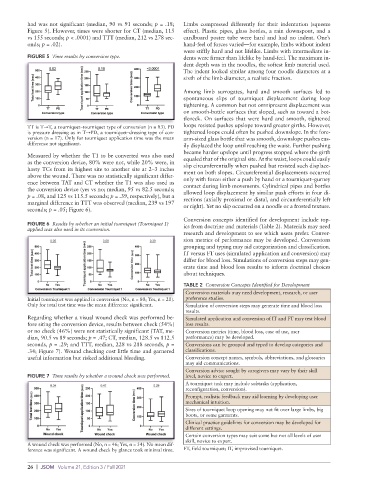
had was not significant (median, 90 vs 91 seconds; p = .18;   Limbs compressed differently for their indentation (squeeze
          Figure 5). However, times were shorter for CT (median, 115   effect). Plastic pipes, glass bottles, a rain downspout, and a
          vs 155 seconds; p < .0001) and TTT (median, 212 vs 278 sec-  cardboard poster tube were hard and had no indent. One’s
          onds; p = .02).                                    hand-feel of forces varied—for example, limbs without indent
                                                             were stiffly hard and not lifelike. Limbs with intermediate in-
          FIGURE 5  Time results by conversion type.         dents were firmer than lifelike by hand-feel. The maximum in-
                                                             dent depth was in the noodles, the softest limb material used.
                                                             The indent looked similar among four noodle diameters at a
                                                             sixth of the limb diameter, a realistic fraction.

                                                             Among limb surrogates, hard and smooth  surfaces led to
                                                             spontaneous  slips  of  tourniquet  displacement  during  loop
                                                             tightening. A common but not omnipresent displacement was
                                                             on smooth-bottle surfaces that sloped, such as toward a bot-
                                                             tleneck. On surfaces that were hard and smooth, tightened
          TT is T→T, a tourniquet–tourniquet type of conversion (n = 83). PD   loops resisted pushes upslope toward greater girths. However,
          is pressure dressing as in T→PD, a tourniquet–dressing type of con-  tightened loops could often be pushed downslope. In the fore-
          version (n = 17). Only for tourniquet application time was the mean   arm-sized glass bottle that was smooth, downslope pushes eas-
          difference not significant.                        ily displaced the loop until reaching the waist. Further pushing
                                                             became harder upslope until progress stopped where the girth
          Measured by whether the T1 to be converted was also used
          as the conversion device, 80% were not, while 20% were, in   equaled that of the original site. At the waist, loops could easily
          hasty TCs from its highest site to another site at 2–3 inches   slip circumferentially when pushed but resisted such displace-
          above the wound. There was no statistically significant differ-  ment on both slopes. Circumferential displacements occurred
          ence between TAT and CT whether the T1 was also used as   only with force: either a push by hand or a tourniquet–gurney
          the conversion device (yes vs no; median, 95 vs 82.5 seconds;   contact during limb movements. Cylindrical pipes and bottles
          p = .08, and 125 vs 115.5 seconds; p = .39, respectively), but a   allowed loop displacement by similar push efforts in four di-
          marginal difference in TTT was observed (median, 239 vs 197   rections (axially proximal or distal, and circumferentially left
          seconds; p = .05; Figure 6).                       or right). Yet no slip occurred on a noodle or a frosted texture.
                                                             Conversion concepts identified for development include top-
          FIGURE 6  Results by whether an initial tourniquet (Tourniquet 1)   ics from doctrine and materials (Table 2). Materials may need
          applied was also used in its conversion.
                                                             research and development to see which users prefer. Conver-
                                                             sion metrics of performance may be developed. Conversions
                                                             grouping and typing may aid categorization and classification.
                                                             IT versus FT uses (simulated application and conversion) may
                                                             differ for blood loss. Simulations of conversion steps may gen-
                                                             erate time and blood loss results to inform doctrinal choices
                                                             about techniques.

                                                             TABLE 2  Conversion Concepts Identified for Development
                                                              Conversion materials may need development, research, or user
          Initial tourniquet was applied in conversion (No, n = 80; Yes, n = 20).   preference studies.
          Only for total test time was the mean difference significant.  Simulation of conversion steps may generate time and blood loss
                                                              results.
          Regarding whether a visual wound check was performed be-  Simulated application and conversion of IT and FT may test blood
          fore siting the conversion device, results between check (54%)   loss results.
          or no check (46%) were not statistically significant (TAT, me-  Conversion metrics (time, blood loss, ease of use, user
          dian, 90.5 vs 89 seconds; p = .47; CT, median, 128.5 vs 112.5   performance) may be developed.
          seconds, p = .29; and TTT, median, 228 vs 218 seconds, p =   Conversions can be grouped and typed to develop categories and
          .34; Figure 7). Wound checking cost little time and garnered   classifications.
          useful information but risked additional bleeding.  Conversion concept names, symbols, abbreviations, and glossaries
                                                              may aid communications.
                                                              Conversion advice sought by caregivers may vary by their skill
          FIGURE 7  Time results by whether a wound check was performed.  level, novice to expert.
                                                              A tourniquet task may include subtasks (application,
                                                              reconfiguration, conversion).
                                                              Prompt, realistic feedback may aid learning by developing user
                                                              mechanical intuition.
                                                              Sizes of tourniquet loop opening may not fit over large limbs, big
                                                              boots, or some garments.
                                                              Clinical practice guidelines for conversion may be developed for
                                                              different settings.
                                                              Certain conversion types may suit some but not all levels of user
                                                              skill, novice to expert.
          A wound check was performed (No, n = 46; Yes, n = 54). No mean dif-
          ference was significant. A wound check by glance took minimal time.  FT, field tourniquet; IT, improvised tourniquet.


          26  |  JSOM   Volume 21, Edition 3 / Fall 2021

