


Page 29 - JSOM Fall 2021
P. 29
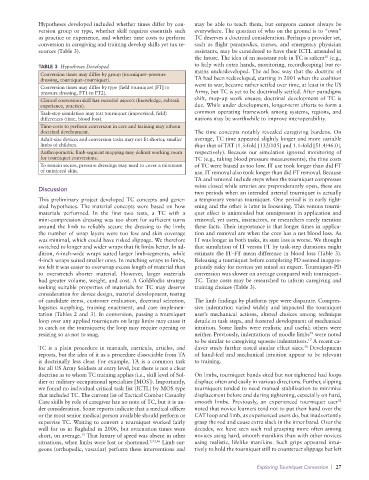
Hypotheses developed included whether times differ by con-  may be able to teach them, but surgeons cannot always be
              version group or type, whether skill requires essentials such   everywhere. The question of who on the ground is to “own”
              as practice or experience, and whether time costs to perform   TC deserves a doctrinal consideration. Perhaps a provider set,
              conversion in caregiving and training develop skills yet tax re-  such as flight paramedics, nurses, and emergency physician
              sources (Table 3).                                 assistants, may be considered to have their ICTL amended in
                                                                 the future. The idea of an assistant role in TC is salient  (e.g.,
                                                                                                           20
              TABLE 3  Hypotheses Developed                      to help with extra hands, monitoring, recordkeeping) but re-
              Conversion times may differ by group (tourniquet–pressure   mains underdeveloped. The ad hoc way that the doctrine of
              dressing, tourniquet–tourniquet).                  TA had been redeveloped, starting in 2001 when the coalition
              Conversion times may differ by type (field tourniquet [FT] to   went to war, became rather settled over time, at least in the US
              pressure dressing, FT1 to FT2).                    Army, but TC is yet to be doctrinally settled. After paradigms
              Clinical conversion skill has essential aspects (knowledge, subtask   shift, mop-up work ensues; doctrinal development of TC is
              experience, practice).                             due. While under development, longer-term efforts to form a
              Task-step simulation may test tourniquet (improvised, field)   common operating framework among systems, regions, and
              differences (time, blood loss).                    nations may be worthwhile to improve interoperability.
              Time-costs to perform conversion in care and training may inform
              doctrinal development.                             The  time  concepts  notably revealed  caregiving burdens.  On
              Adult-size devices and conversion tasks may not fit shorter, smaller   average, TC time appeared slightly longer and more variable
              limbs of children.                                 than that of TAT (1.3-fold [132/105] and 1.1-fold [51.4/46.0],
              Anthropometric limb-segment mapping may delimit working room   respectively). Because our simulation ignored monitoring of
              for tourniquet conversions.                        TC (e.g., taking blood pressure measurements), the time costs
              To remain secure, pressure dressings may need to cover a minimum   of TC were biased as too low. IT use took longer than did FT
              of uninjured skin.                                 use. IT removal also took longer than did FT removal. Because
                                                                 TA and removal include steps when the tourniquet compresses
                                                                 veins closed while arteries are preponderantly open, these are
              Discussion
                                                                 two periods when an intended arterial tourniquet is actually
              This preliminary project developed TC concepts and gener-  a temporary venous tourniquet. One period is in early tight-
              ated hypotheses. The material concepts were based on how   ening and the other is later in loosening. This venous tourni-
              materials performed. In the first two tests, a TC with a   quet effect is unintended but omnipresent in application and
              mini-compression dressing was too short for sufficient turns   removal, yet users, instructors, or researchers rarely mention
              around the limb to reliably secure the dressing to the limb;   these facts. Their importance is that longer times in applica-
              the number of wrap layers were too few and skin coverage   tion and removal are when the core has a net blood loss. As
              was minimal, which could have risked slippage. We therefore   IT was longer in both tasks, its sum loss is worse. We thought
              switched to longer and wider wraps that fit limbs better. In ad-  that simulation of IT versus FT by task-step durations might
              dition, 6-inch-wide wraps suited larger limb-segments, while   estimate the IT–FT mean difference in blood loss (Table 3).
              4-inch wraps suited smaller ones. In matching wraps to limbs,   Releasing a tourniquet before completing PD seemed inappro-
              we felt it was easier to overwrap excess length of material than   priately risky for novices yet suited an expert. Tourniquet–PD
              to overstretch shorter material. However, larger materials   conversion was slower on average compared with tourniquet–
              had greater volume, weight, and cost. A Goldilocks strategy   TC. Time costs may be researched to inform caregiving and
              seeking suitable properties of materials for TC may deserve   training choices (Table 3).
              consideration for device design, materiel development, testing
              of candidate items, customer evaluation, doctrinal selection,   The limb findings by platform type were disparate. Compres-
              logistics supplying, training enactment, and care implemen-  sive indentation varied widely and impacted the tourniquet
              tation (Tables 2 and 3). In conversion, passing a tourniquet   user’s mechanical actions, altered choices among technique
              loop over any applied tourniquets on large limbs may cause it   details in task steps, and fostered development of mechanical
              to catch on the tourniquets; the loop may require opening or   intuition.  Some  limbs  were  realistic  and  useful;  others  were
                                                                                                      49
              resizing so as not to snag.                        neither. Previously, indentations of noodle limbs  were noted
                                                                 to be similar to caregiving squeeze indentations.  A recent ca-
                                                                                                      17
                                                                                                    50
              TC is a plain procedure in manuals, curricula, articles, and   daver study further noted similar effect sizes.  Development
              reports, but the idea of it as a procedure dissociable from TA   of hand-feel and mechanical intuition appear to be relevant
              is doctrinally less clear. For example, TA is a common task   to training.
              for all US Army Soldiers at entry level, but there is not a clear
              doctrine as to whom TC training applies (i.e., skill level of Sol-  On limbs, tourniquet bands sited but not tightened had loops
              dier or military occupational specialties [MOS]). Importantly,   displace often and easily in various directions. Further, slipping
              we found no individual critical task list (ICTL) by MOS type   tourniquets tended to need manual stabilization to minimize
              that included TC. The current list of Tactical Combat Casualty   displacement before and during tightening, especially on hard,
              Care skills by role of caregiver has no note of TC, but it is un-  smooth  limbs. Previously, an experienced  tourniquet  user
                                                                                                               32
              der consideration. Some reports indicate that a medical officer   noted that novice learners tend not to put their hand over the
              or the most senior medical person available should perform or   CAT loop and limb, as experienced users do, but inadvertently
              supervise TC. Waiting to convert a tourniquet worked fairly   grasp the rod and cause extra slack in the inner band. Over the
              well for us in Baghdad in 2006, but evacuation times were   decades, we have seen such rod grasping more often among
                            15
              short, on average.  That luxury of speed was absent in other   novices using hard, smooth manikins than with other novices
              situations, when limbs were lost or shortened. 7,33,36  Limb sur-  using realistic, lifelike manikins. Such grips appeared intui-
              geons (orthopedic, vascular) perform these interventions and   tively to hold the tourniquet still to counteract slippage but left

                                                                                     Exploring Tourniquet Conversion  |  27

