


Page 26 - JSOM Fall 2021
P. 26
of assessment. The US Army Institute of Surgical Research   glass bottles were used in forearm, calf, and thigh sizes. The
          regulatory office determined that this project was not research   two larger bottles were cylindrical; the largest was frosted.
          involving human subjects.                          The forearm-sized bottle had a waist to grasp. The aluminum
                                                             downspout had a calf-foot shape. Limbs rested on a simulated
          One person performed the tests; the first author is a clini-  gurney (two footlockers stacked on a flatbed cart).
          cian-scientist familiar with tourniquets and TC. Testing took
          place in 2020 over a period of 105 days. Usually, one test was   The setting of the clinical situation differed between TA and
          conducted per day.                                 TC. The TA was field care that either was under gunfire or was
                                                             not (i.e., tactical field care or first aid). The TC was emergency
          A test comprised tourniquet application (TA) followed by TC.   care, such as at a dressing station. Materials were used as in
          Testing was not controlled. The test order varied for materials   actual care conditions, except that they were reused. EMT re-
          (e.g., tourniquet models, dressings), steps (e.g., TC task types,   use was on-label. The CAT was single-use; its reuse was off-
          wound check), and assessments (e.g., methods and metrics).   label. No material had instructions for TC, but an EMT maker
          We conducted 100 tests. The test number set the TC type, the   had provided TC advice. 28
          tourniquet type, the site of the tourniquet to be converted, the
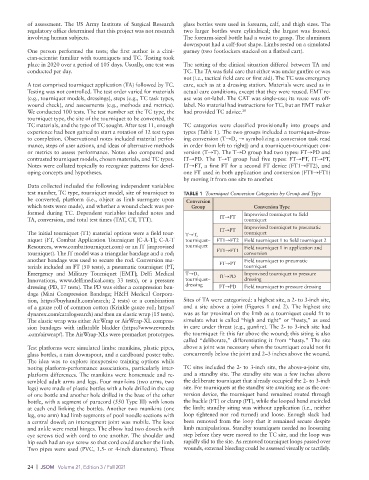
          TC materials, and the type of TC sought. After test 11, enough   TC categories were classified provisionally into groups and
          experience had been gained to start a rotation of 12 test types   types (Table 1). The two groups included a tourniquet–dress-
          to completion. Observational notes included material perfor-  ing conversion (T→D, → symbolizing a conversion task read
          mance, steps of user actions, and ideas of alternative methods   in order from left to right]) and a tourniquet–tourniquet con-
          or metrics to assess performance. Notes also compared and   version (T→T). The T→D group had two types: FT→PD and
          contrasted tourniquet models, chosen materials, and TC types.   IT→PD. The T→T group had five types: FT→PT, IT→PT,
          Notes were collated topically to recognize patterns for devel-  IT→FT, a first FT for a second FT device (FT1→FT2), and
          oping concepts and hypotheses.                     one FT used in both application and conversion (FT1→FT1)
                                                             by moving it from one site to another.
          Data collected included the following independent variables:
          test number, TC type, tourniquet model, site of tourniquet to   TABLE 1  Tourniquet Conversion Categories by Group and Type
          be converted, platform (i.e., object as limb surrogate upon   Conversion
          which tests were made), and whether a wound check was per-  Group         Conversion Type
          formed during TC. Dependent variables included notes and               Improvised tourniquet to field
          TA, conversion, and total test times (TAT, CT, TTT).           IT→FT   tourniquet
                                                                                 Improvised tourniquet to pneumatic
                                                                         IT→PT
          The initial tourniquet (T1) material options were a field tour-  T→T,   tourniquet
          niquet  (FT,  Combat  Application  Tourniquet  [C-A-T];  C-A-T   tourniquet–  FT1→FT2  Field tourniquet 1 to field tourniquet 2
          Resources, www.combattourniquet.com) or an IT (improvised   tourniquet   Field tourniquet 1 in application and
          tourniquet). The IT model was a triangular bandage and a rod;   FT1→FT1   conversion
          another bandage was used to secure the rod. Conversion ma-             Field tourniquet to pneumatic
          terials included an FT (50 tests), a pneumatic tourniquet (PT,   FT→PT   tourniquet
          Emergency and Military Tourniquet [EMT]; Delfi Medical   T→D,   IT→PD   Improvised tourniquet to pressure
          Innovations,  www.delfimedical.com; 33 tests), or a pressure   tourniquet–  dressing
          dressing (PD, 17 tests). The PD was either a compression ban-  dressing   FT→PD   Field tourniquet to pressure dressing
          dage (Mini Compression Bandage; H&H Medical Corpora-
          tion, https://buyhandh.com/search; 2 tests) or a combination   Sites of TA were categorized: a highest site, a 2- to 3-inch site,
          of a gauze roll of common cotton (Krinkle gauze roll; https://  and a site above a joint (Figures 1 and 2). The highest site
          dynarex.com/catalogsearch) and then an elastic wrap (15 tests).   was as far proximal on the limb as a tourniquet could fit to
          The elastic wrap was either AirWrap or AirWrap-XL compres-  simulate what is called “high and tight” or “hasty,” as used
          sion bandages with inflatable bladder (https://www.revmedx   in care under threat (e.g., gunfire). The 2- to 3-inch site had
          .com/airwrap/). The AirWrap-XLs were premarket prototypes.  the tourniquet fit this far above the wound; this siting is also
                                                             called “deliberate,” differentiating it from “hasty.” The site
          Test platforms were simulated limbs: manikins, plastic pipes,   above a joint was necessary when the tourniquet could not fit
          glass bottles, a rain downspout, and a cardboard poster tube.   concurrently below the joint and 2–3 inches above the wound.
          The idea was to explore inexpensive training options while
          noting platform-performance associations, particularly inter-  TC sites included the 2- to 3-inch site, the above-a-joint site,
          platform differences. The manikins were homemade and re-  and a standby site. The standby site was a few inches above
          sembled adult arms and legs. Four manikins (two arms, two   the deliberate tourniquet that already occupied the 2- to 3-inch
          legs) were made of plastic bottles with a hole drilled in the cap   site. For tourniquets at the standby site awaiting use as the con-
          of one bottle and another hole drilled in the base of the other   version device, the tourniquet band remained routed through
          bottle, with a segment of paracord (550 Type III) with knots   the buckle (FT) or clamp (PT), while the looped band encircled
          at each end linking the bottles. Another two manikins (one   the limb; standby siting was without application (i.e., neither
          leg, one arm) had limb segments of pool noodle sections with   loop tightened nor rod turned) and loose. Enough slack had
          a central dowel; an intersegment joint was mobile. The knee   been removed from the loop that it remained secure despite
          and ankle were metal hinges. The elbow had two dowels with   limb manipulations. Standby tourniquets needed no loosening
          eye screws tied with cord to one another. The shoulder and   step before they were moved to the TC site, and the loop was
          hip each had an eye screw so that cord could anchor the limb.   rapidly slid to the site. As removed tourniquet loops passed over
          Two pipes were used (PVC, 1.5- or 4-inch diameters). Three   wounds, external bleeding could be assessed visually or tactilely.


          24  |  JSOM   Volume 21, Edition 3 / Fall 2021

