


Page 34 - JSOM Fall 2021
P. 34
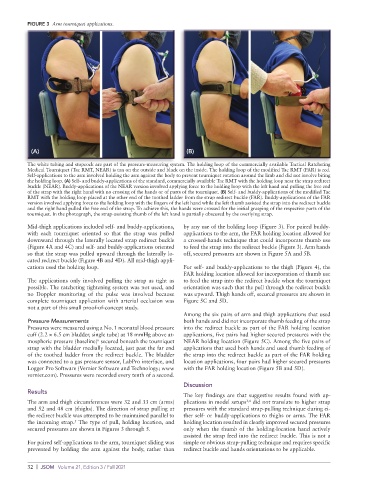
FIGURE 3  Arm tourniquet applications.


           (A)                                                (B)

          The white tubing and stopcock are part of the pressure-measuring system. The holding loop of the commercially available Tactical Ratcheting
          Medical Tourniquet (Tac RMT, NEAR) is tan on the outside and black on the inside. The holding loop of the modified Tac RMT (FAR) is red.
          Self-applications to the arm involved holding the arm against the body to prevent tourniquet rotation around the limb and did not involve biting
          the holding loop. (A) Self- and buddy-applications of the standard, commercially available Tac RMT with the holding loop near the strap redirect
          buckle (NEAR). Buddy-applications of the NEAR version involved applying force to the holding loop with the left hand and pulling the free end
          of the strap with the right hand with no crossing of the hands or of parts of the tourniquet. (B) Self- and buddy-applications of the modified Tac
          RMT with the holding loop placed at the other end of the toothed ladder from the strap redirect buckle (FAR). Buddy-applications of the FAR
          version involved applying force to the holding loop with the fingers of the left hand while the left thumb assisted the strap into the redirect buckle
          and the right hand pulled the free end of the strap. To achieve this, the hands were crossed for the initial grasping of the respective parts of the
          tourniquet. In the photograph, the strap-assisting thumb of the left hand is partially obscured by the overlying strap.

          Mid-thigh applications included self- and buddy-applications,   by any use of the holding loop (Figure 3). For paired buddy-
          with  each tourniquet oriented  so  that  the  strap was  pulled   applications to the arm, the FAR holding location allowed for
          downward through the laterally located strap redirect buckle   a crossed-hands technique that could incorporate thumb use
          (Figure 4A and 4C) and self- and buddy-applications oriented   to feed the strap into the redirect buckle (Figure 3). Arm hands
          so that the strap was pulled upward through the laterally lo-  off, secured pressures are shown in Figure 5A and 5B.
          cated redirect buckle (Figure 4B and 4D). All mid-thigh appli-
          cations used the holding loop.                     For self- and buddy-applications to the thigh (Figure 4), the
                                                             FAR holding location allowed for incorporation of thumb use
          The applications only involved pulling the strap as tight as   to feed the strap into the redirect buckle when the tourniquet
          possible. The ratcheting tightening system was not used, and   orientation was such that the pull through the redirect buckle
          no Doppler monitoring of the pulse was involved because   was upward. Thigh hands off, secured pressures are shown in
          complete tourniquet application with arterial occlusion was   Figure 5C and 5D.
          not a part of this small proof-of-concept study.
                                                             Among the six pairs of arm and thigh applications that used
          Pressure Measurements                              both hands and did not incorporate thumb feeding of the strap
          Pressures were measured using a No. 1 neonatal blood pressure   into the redirect buckle as part of the FAR holding location
          cuff (2.2 × 6.5 cm bladder, single tube) at 18 mmHg above at-  applications, five pairs had higher secured pressures with the
          mospheric pressure (baseline)  secured beneath the tourniquet   NEAR holding location (Figure 5C). Among the five pairs of
                                 6
          strap with the bladder medially located, just past the far end   applications that used both hands and used thumb feeding of
          of the toothed ladder from the redirect buckle. The bladder   the strap into the redirect buckle as part of the FAR holding
          was connected to a gas pressure sensor, LabPro interface, and   location applications, four pairs had higher secured pressures
          Logger Pro Software (Vernier Software and Technology; www   with the FAR holding location (Figure 5B and 5D).
          vernier.com). Pressures were recorded every tenth of a second.
                                                             Discussion
          Results
                                                             The key findings are that suggestive results found with ap-
          The arm and thigh circumferences were 32 and 33 cm (arms)   plications in model setups  did not translate to higher strap
                                                                                  3,4
          and 52 and 48 cm (thighs). The direction of strap pulling at   pressures with the standard strap-pulling technique during ei-
          the redirect buckle was attempted to be maintained parallel to   ther self- or buddy-applications to thighs or arms. The FAR
          the incoming strap.  The type of pull, holding location, and   holding location resulted in clearly improved secured pressures
                         5
          secured pressures are shown in Figures 3 through 5.  only when the thumb of the holding-location hand actively
                                                             assisted the strap feed into the redirect buckle. This is not a
          For paired self-applications to the arm, tourniquet sliding was   simple or obvious strap-pulling technique and requires specific
          prevented by holding the arm against the body, rather than   redirect buckle and hands orientations to be applicable.


          32  |  JSOM   Volume 21, Edition 3 / Fall 2021

