


Page 39 - JSOM Fall 2021
P. 39
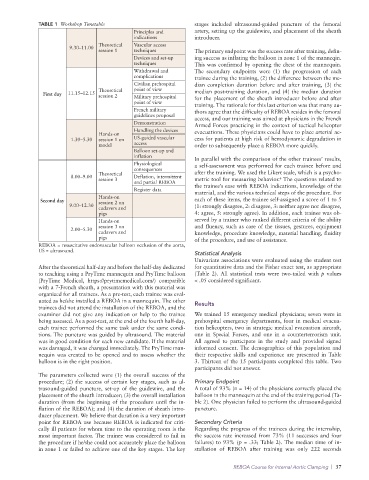
TABLE 1  Workshop Timetable                        stages included ultrasound-guided puncture of the femoral
                                             Principles and      artery, setting up the guidewire, and placement of the sheath
                                             indications         introducer.
                                 Theoretical   Vascular access
                        9.30–11.00
                                 session 1   techniques          The primary endpoint was the success rate after training, defin-
                                             Devices and set-up   ing success as inflating the balloon in zone 1 of the manneqin.
                                             techniques          This was confirmed by opening the chest of the mannequin.
                                             Withdrawal and      The secondary endpoints were (1) the progression of each
                                             complications       trainee during the training, (2) the difference between the me-
                                             Civilian prehospital   dian completion duration before and after training, (3) the
                                 Theoretical   point of view     median post-training duration, and (4) the median duration
               First day  11.15–12.15  session 2  Military prehospital   for the placement of the sheath introducer before and after
                                             point of view       training. The rationale for this last criterion was that many au-
                                             French military     thors agree that the difficulty of REBOA resides in the femoral
                                             guidelines proposal  access, and our training was aimed at physicians in the French
                                             Demonstration       Armed Forces practicing in the context of tactical helicopter
                                             Handling the devices  evacuations. These physicians could have to place arterial ac-
                                 Hands-on
                        1.30–5.30  session 1 on   US-guided vascular   cess for patients at high risk of hemodynamic degradation in
                                 model       access              order to subsequently place a REBOA more quickly.
                                             Balloon set-up and
                                             inflation           In parallel with the comparison of the other trainees’ results,
                                             Physiological       a self-assessment was performed for each trainee before and
                                             consequences
                                 Theoretical                     after the training. We used the Likert scale, which is a psycho-
                        8.00–9.00            Deflation, intermittent                        6
                                 session 3                       metric tool for measuring behavior.  The questions related to
                                             and partial REBOA   the trainee’s ease with REBOA indications, knowledge of the
                                             Register data       material, and the various technical steps of the procedure. For
                                 Hands-on
              Second day         session 2 on                    each of these items, the trainee self-assigned a score of 1 to 5
                        9.00–12.30                               (1: strongly disagree, 2: disagree, 3: neither agree nor disagree,
                                 cadavers and
                                 pigs                            4: agree, 5: strongly agree). In addition, each trainee was ob-
                                 Hands-on                        served by a trainer who ranked different criteria of the ability
                                 session 3 on                    and fluency, such as care of the tissues, gestures, equipment
                        2.00–5.30
                                 cadavers and                    knowledge, procedure knowledge, material handling, fluidity
                                 pigs                            of the procedure, and use of assistance.
              REBOA = resuscitative endovascular balloon occlusion of the aorta,
              US = ultrasound.
                                                                 Statistical Analysis
                                                                 Univariate associations were evaluated using the student test
              After the theoretical half-day and before the half-day dedicated   for quantitative data and the Fisher exact test, as appropriate
              to teaching using a PryTime mannequin and PryTime balloon   (Table 2). All statistical tests were two-tailed with  p values
              (PryTime Medical,  https://prytimemedical.com/) compatible   < .05 considered significant.
              with a 7-French sheath, a presentation with this material was
              organized for all trainees. As a pre-test, each trainee was eval-
              uated as he/she installed a REBOA in a mannequin. The other
              trainees did not attend the installation of the  REBOA, and the   Results
              examiner did not give any indication or help to the trainee   We trained 15 emergency medical physicians; seven were in
              being assessed. As a post-test, at the end of the fourth half-day,   prehospital emergency departments, four in medical evacua-
              each trainee performed the same task under the same condi-  tion helicopters, two in strategic medical evacuation aircraft,
              tions. The puncture was guided by ultrasound. The material   one in Special Forces, and one in a counterterrorism unit.
              was in good condition for each new candidate. If the material   All agreed to participate in the study and provided signed
              was damaged, it was changed immediately. The PryTime man-  informed consent. The demographics of this population and
              nequin was created to be opened and to assess whether the   their respective skills and experience are presented in Table
              balloon is in the right position.                  3. Thirteen of the 15 participants completed this table. Two
                                                                 participants did not answer.
              The parameters collected were (1) the overall success of the
              procedure; (2) the success of certain key stages, such as ul-  Primary Endpoint
              trasound-guided puncture, set-up of the guidewire, and the   A total of 93% (n = 14) of the physicians correctly placed the
              placement of the sheath introducer; (3) the overall installation   balloon in the mannequin at the end of the training period (Ta-
              duration (from the beginning of the procedure until the in-  ble 2). One physician failed to perform the ultrasound-guided
              flation of the REBOA); and (4) the duration of sheath intro-  puncture.
              ducer placement. We believe that duration is a very important
              point for REBOA use because REBOA is indicated for criti-  Secondary Criteria
              cally ill patients for whom time to the operating room is the   Regarding the progress of the trainees during the internship,
              most important factor. The trainee was considered to fail in   the success rate increased from 73% (11 successes and four
              the procedure if he/she could not accurately place the balloon   failures) to 93% (p = .33; Table 2). The median time of in-
              in zone 1 or failed to achieve one of the key stages. The key   stallation of REBOA after training was only 222 seconds

                                                                             REBOA Course for Internal Aortic Clamping  |  37

