


Page 40 - JSOM Fall 2021
P. 40
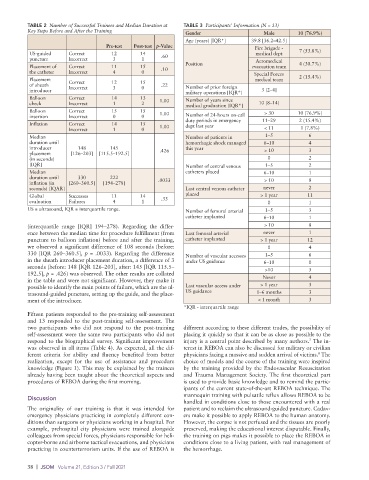
TABLE 2  Number of Successful Trainees and Median Duration at   TABLE 3  Participants’ Information (N = 13)
          Key Steps Before and After the Training             Gender                   Male       10 (76.9%)
                                                              Age (years) [IQR*]   39.8 [36.2–42.5]
                                    Pre-test  Post-test p-Value                     Fire brigade -
           US-guided   Correct       12        14                                    medical dept   7 (53.8%)
           puncture    Incorrect      3        1      .60                            Aeromedical
           Placement of    Correct   11        15     .10     Position             evacuation team  4 (30.7%)
           the catheter  Incorrect    4        0                                    Special Forces
           Placement   Correct       12        15                                   medical team   2 (15.4%)
           of sheath   Incorrect      3        0      .22     Number of prior foreign
           introducer                                         military operations [IQR*]  3 [2–4]
           Balloon     Correct       14        13    1.00     Number of years since
           check       Incorrect      1        2              medical graduation [IQR*]  10 [8–14]
           Balloon     Correct       15        15                                      > 30       10 (76.9%)
           insertion   Incorrect      0        0     1.00     Number of 24-hours on-call
           Inflation   Correct       14        15             duty periods in emergency   11–29    2 (15.4%)
                                                              dept last year
                       Incorrect      1        0     1.00                              < 11        1 (7.8%)
           Median                                             Number of patients in     1–5           6
           duration until                                     hemorrhagic shock managed   6–10        4
           introducer     148        145                      this year                > 10           3
           placement    [126–203]  [115.5–192.5]     .426
           (in seconds)                                                                  0            2
           [IQR]                                              Number of central venous   1–5          2
           Median                                             catheters placed         6–10           1
           duration until   330      222             .0033                             > 10           8
           inflation (in   [260–360.5]  [194–278]
           seconds) [IQAR]                                    Last central venous catheter   never    2
           Global      Successes     11        14     .33     placed                  > 1 year       11
           evaluation  Failures       4        1                                         0            1
          US = ultrasound, IQR = interquartile range.         Number of femoral arterial   1–5        3
                                                              catheter implanted       6–10           1
          (interquartile range [IQR] 194–278). Regarding the differ-                   > 10           8
          ence between the median time for procedure fulfillment (from   Last femoral arterial   never  1
          puncture to balloon inflation) before and after the training,   catheter implanted  > 1 year  12
          we observed a significant difference of 108 seconds (before:                   0            4
          330 [IQR 260–360.5], p = .0033). Regarding the difference   Number of vascular accesses   1–5  6
          in the sheath introducer placement duration, a difference of 3   under US guidance  6–10    0
          seconds (before: 148 [IQR 126–203], after: 145 [IQR 115.5–                    >10           3
          192.5], p = .426) was observed. The other results are collated
          in the table and were not significant. However, they make it                 Never          4
          possible to identify the main points of failure, which are the ul-  Last vascular access under   > 1 year  3
          trasound-guided puncture, setting up the guide, and the place-  US guidance  1–6 months     3
          ment of the introducer.                                                    < 1 month        3
                                                             *IQR - interquartile range
          Fifteen patients responded to the pre-training self-assessment
          and 13 responded to the post-training self-assessment. The
          two participants who did not respond to the post-training   different according to these different trades, the possibility of
          self-assessment were the same two participants who did not   placing it quickly so that it can be as close as possible to the
                                                                                                      7
          respond to the biographical survey. Significant improvement   injury is a central point described by many authors.  The in-
          was observed in all items (Table 4). As expected, all the dif-  terest in REBOA can also be discussed for military or civilian
          ferent  criteria  for  ability  and  fluency  benefited  from  better   physicians facing a massive and sudden arrival of victims.  The
                                                                                                         8
          realization, except for the use of assistance and procedure   choice of models and the course of the training were inspired
          knowledge (Figure 1). This may be explained by the trainees   by the training provided by the Endovascular Resuscitation
          already having been taught about the theoretical aspects and   and Trauma Management Society. The first theoretical part
          procedures of REBOA during the first morning.      is used to provide basic knowledge and to remind the partic-
                                                             ipants of the current state-of-the-art REBOA technique. The
                                                             mannequin training with pulsatile reflux allows REBOA to be
          Discussion
                                                             handled in conditions close to those encountered with a real
          The originality of our training is that it was intended for   patient and to reclaim the ultrasound-guided puncture. Cadav-
          emergency physicians practicing in completely different con-  ers make it possible to apply REBOA to the human anatomy.
          ditions than surgeons or physicians working in a hospital. For   However, the corpse is not perfused and the tissues are poorly
          example,  prehospital  city  physicians  were  trained  alongside   preserved, making the educational interest disputable. Finally,
          colleagues from special forces, physicians responsible for heli-  the training on pigs makes it possible to place the REBOA in
          copter-borne and airborne tactical evacuations, and physicians   conditions close to a living patient, with real management of
          practicing in counterterrorism units. If the use of REBOA is   the hemorrhage.


          38  |  JSOM   Volume 21, Edition 3 / Fall 2021

