


Page 35 - JSOM Fall 2021
P. 35
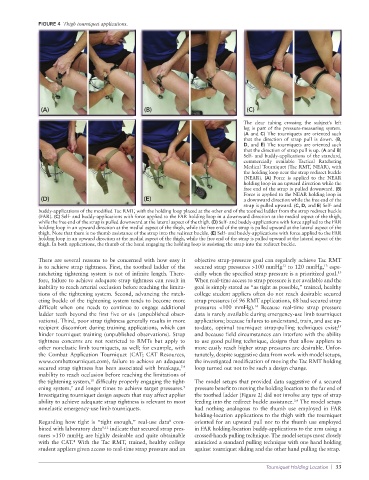
FIGURE 4  Thigh tourniquet applications.


              (A)                               (B)                               (C)
                                                                                 The clear tubing crossing the subject’s left
                                                                                 leg is part of the pressure-measuring system.
                                                                                 (A and C) The tourniquets are oriented such
                                                                                 that the direction of strap pull is down. (B,
                                                                                 D, and E) The tourniquets are oriented such
                                                                                 that the direction of strap pull is up. (A and B)
                                                                                 Self- and buddy-applications of the standard,
                                                                                 commercially available Tactical Ratcheting
                                                                                 Medical Tourniquet (Tac RMT, NEAR), with
                                                                                 the holding loop near the strap redirect buckle
                                                                                 (NEAR).  (A) Force is applied to the NEAR
                                                                                 holding loop in an upward direction while the
                                                                                 free end of the strap is pulled downward. (B)
                                                                                 Force is applied to the NEAR holding loop in
              (D)                               (E)                              a downward direction while the free end of the
                                                                                 strap is pulled upward. (C, D, and E) Self- and
              buddy-applications of the modified Tac RMT, with the holding loop placed at the other end of the toothed ladder from the strap redirect buckle
              (FAR). (C) Self- and buddy-applications with force applied to the FAR holding loop in a downward direction at the medial aspect of the thigh,
              while the free end of the strap is pulled downward at the lateral aspect of the thigh. (D) Self- and buddy-applications with force applied to the FAR
              holding loop in an upward direction at the medial aspect of the thigh, while the free end of the strap is pulled upward at the lateral aspect of the
              thigh. Note that there is no thumb assistance of the strap into the redirect buckle. (E) Self- and buddy-applications with force applied to the FAR
              holding loop in an upward direction at the medial aspect of the thigh, while the free end of the strap is pulled upward at the lateral aspect of the
              thigh. In both applications, the thumb of the hand engaging the holding loop is assisting the strap into the redirect buckle.

              There are several reasons to be concerned with how easy it   objective strap-pressure goal can regularly achieve Tac RMT
                                                                                                           13
                                                                                             12
              is to achieve strap tightness. First, the toothed ladder of the   secured strap pressures >100 mmHg  to 120 mmHg,  espe-
                                                                                                               13
              ratcheting tightening system is not of infinite length. There-  cially when the specified strap pressure is a prioritized goal.
              fore, failure to achieve adequate strap tightness can result in   When real-time access to strap pressure is not available and the
              inability to reach arterial occlusion before reaching the limita-  goal is simply stated as “as tight as possible,” trained, healthy
              tions of the tightening system. Second, advancing the ratch-  college student appliers often do not reach desirable secured
              eting buckle of the tightening system tends to become more   strap pressures (of 96 RMT applications, 68 had secured strap
              difficult when one needs to continue to engage additional   pressures <100 mmHg).  Because real-time strap pressure
                                                                                    14
              ladder teeth beyond the first five or six (unpublished obser-  data is rarely available during emergency-use limb tourniquet
              vations). Third, poor strap tightness generally results in more   applications; because failures to understand, train, and use up-
              recipient discomfort during training applications, which can   to-date, optimal tourniquet strap-pulling techniques exist;
                                                                                                               15
              hinder tourniquet training (unpublished observations). Strap   and because field circumstances can interfere with the ability
              tightness concerns are not restricted to RMTs but apply to   to use good pulling technique, designs that allow appliers to
              other nonelastic limb tourniquets, as well; for example, with   more easily reach higher strap pressures are desirable. Unfor-
              the  Combat  Application  Tourniquet  (CAT;  CAT  Resources,   tunately, despite suggestive data from work with model setups,
              www.combattourniquet.com), failure to achieve an adequate   the investigated modification of moving the Tac RMT holding
              secured strap tightness has been associated with breakage,    loop turned out not to be such a design change.
                                                            7-9
              inability to reach occlusion before reaching the limitations of
                               10
              the tightening system,  difficulty properly engaging the tight-  The model setups that provided data suggestive of a secured
              ening system,  and longer times to achieve target pressures.    pressure benefit to moving the holding location to the far end of
                                                             9
                        7
              Investigating tourniquet design aspects that may affect applier   the toothed ladder (Figure 2) did not involve any type of strap
              ability to achieve adequate strap tightness is relevant to most   feeding into the redirect buckle assistance.  The model setups
                                                                                                 3,4
              nonelastic emergency-use limb tourniquets.         had nothing analogous to the thumb use employed in FAR
                                                                 holding-location applications to the thigh with the tourniquet
              Regarding how tight is “tight enough,” real-use data  com-  oriented for an upward pull nor to the thumb use employed
                                                        8
              bined with laboratory data 9,11  indicate that secured strap pres-  in FAR holding-location buddy-applications to the arm using a
              sures >150 mmHg are highly desirable and quite obtainable   crossed-hands pulling technique. The model setups most closely
              with  the  CAT.   With  the  Tac  RMT,  trained,  healthy  college   mimicked a standard pulling technique with one hand holding
                         4
              student appliers given access to real-time strap pressure and an   against tourniquet sliding and the other hand pulling the strap.
                                                                                        Tourniquet Holding Location  |  33

