


Page 33 - JSOM Fall 2021
P. 33
mechanical advantage gain in the strap-pulling process should   the strap redirect buckle (NEAR; Figure 1). This nonmodified
              aid appliers in achieving maximum strap tightness.  Tac RMT had been requested for and used in prior studies and
                                                                 also had many practice uses.
              Data from model setups involving weight hanging as the
              tourniquet strap-pulling force (Figure 2) indicated that mov-  The other tourniquet was a Tac RMT modified so that the
              ing the holding location from adjacent to the strap redirect   holding loop location was secured to the tourniquet at the far
              buckle to the other end of the toothed ladder from the redirect   end of the toothed ladder from the redirect buckle (FAR; Fig-
              allowed the redirect to move with underlying ballistic gel or   ure  1).  The  FAR  modification  was  made  by  m2  inc.  at the
                                 3
              thigh- tissue compression,  and provided a strap-pulling bene-  request of the authors (January 15, 2020, manufacturing date)
              fit regarding achieved strap tightness (rolled yoga mats thigh   and is not a commercially available tourniquet.
              model): 45 mmHg and 58 mmHg pressure improvements for
              the same applied strap-pulling force. 4            The authors were the recipients, self-appliers, and buddy-
                                                                 appliers. Each Tac RMT was self- and buddy-applied on skin
              The purpose of this small proof-of-concept study was to deter-  to the dominant arm (Figure 3) and mid-thigh (Figure 4) of
              mine whether the results observed with the model setups (Figure   the sitting recipient. Each recipient did her best to maintain
              2) would translate to a strap-pulling benefit in human self- or   relaxed muscles in the limb segment receiving the tourniquet.
              buddy-applications on arms and thighs. The hypothesis was
              that applications with the far version of the holding loop (i.e.,   Self-arm applications did not use the holding loop but instead
              holding location at the other end of the toothed ladder from the   trapped the tourniquet with the arm against the body to pre-
              strap redirect buckle, FAR) would have higher secured pressures   vent the tourniquet from sliding around the arm (Figure 3).
              than applications with the near version of the holding loop (i.e.,   This technique allows one to pull the free end of the strap
              holding location adjacent to the redirect buckle, NEAR).  across the chest in a direction parallel to the strap entering
                                                                                                                5
                                                                 the redirect buckle, which allows optimal strap-pulling force.
                                                                 This technique does not use the holding loop. This tech-
              Methods
                                                                 nique involves some arm muscle use that is not necessary in
              The Drake University Institutional Review Board approved     buddy-arm applications.
              this prospective study. The two tourniquets were requested
              from and donated by m2 inc.                        Buddy-arm applications used the holding loop. With the
                                                                 NEAR holding loop location, buddy-arm applications did not
              One tourniquet was a nonmodified, commercially  available   involve applier arm crossing (Figure 3). With the FAR holding
              Tac RMT (November 10, 2015, manufacturing date) with the   loop location, buddy-arm applications involved arm crossing
              holding loop location secured to the tourniquet adjacent to   (Figure 3).
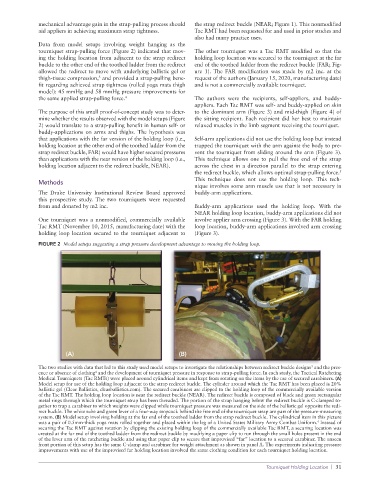
              FIGURE 2  Model setups suggesting a strap pressure development advantage to moving the holding loop.


                       (A)                                  (B)
              The two studies with data that led to this study used model setups to investigate the relationships between redirect buckle designs  and the pres-
                                                                                                       3
              ence or absence of clothing  and the development of tourniquet pressure in response to strap-pulling force. In each study, the Tactical Ratcheting
                                4
              Medical Tourniquets (Tac RMTs) were placed around cylindrical items and kept from rotating on the items by the use of secured carabiners. (A)
              Model setup for use of the holding loop adjacent to the strap redirect buckle. The cylinder around which the Tac RMT has been placed is 20%
              ballistic gel (Clear Ballistics, clearballistics.com). The secured carabiners are clipped to the holding loop of the commercially available version
              of the Tac RMT. The holding loop location is near the redirect buckle (NEAR). The redirect buckle is composed of black and green rectangular
              metal rings through which the tourniquet strap has been threaded. The portion of the strap hanging below the redirect buckle is C-clamped to-
              gether to trap a carabiner to which weights were clipped while tourniquet pressure was measured on the side of the ballistic gel opposite the redi-
              rect buckle. The white tube and green lever of a four-way stopcock behind the free end of the tourniquet strap are part of the pressure-measuring
              system. (B) Model setup involving holding at the far end of the toothed ladder from the strap redirect buckle. The cylindrical item in this picture
              was a pair of 0.5mm-thick yoga mats rolled together and placed within the leg of a United States Military Army Combat Uniform.  Instead of
                                                                                                         4
              securing the Tac RMT against rotation by clipping the existing holding loop of the commercially available Tac RMT, a securing location was
              created at the far end of the toothed ladder from the redirect buckle by modifying a paper clip to run through the small holes present in the end
              of the lever arm of the ratcheting buckle and using that paper clip to secure that improvised “far” location to a secured carabiner. The unseen
              front portion of this setup has the same C-clamp and carabiner for weight attachment as shown in panel A. The experiments indicating pressure
              improvements with use of the improvised far holding location involved the same clothing condition for each tourniquet holding location.
                                                                                        Tourniquet Holding Location  |  31

