


Page 41 - JSOM Fall 2021
P. 41
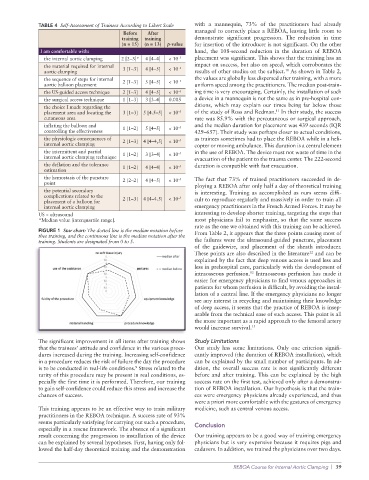
TABLE 4  Self-Assessment of Trainees According to Likert Scale  with a mannequin, 73% of the practitioners had already
                                         Before   After          managed to correctly place a REBOA, leaving little room to
                                         training   training     demonstrate significant progression. The reduction in time
                                         (n = 15)  (n = 13)  p-value  for insertion of the introducer is not significant. On the other
              I am comfortable with:                             hand, the 108-second reduction in the duration of REBOA
               the internal aortic clamping  2 [2–3]*  4 [4–4]  < 10 –3  placement was significant. This shows that the training has an
               the material required for internal          –3    impact on success, but also on speed, which corroborates the
                                                                                              10
               aortic clamping           3 [1–3]  4 [4–5]  < 10  results of other studies on the subject.  As shown in Table 2,

               the sequence of steps for internal          –3    the values  are globally less dispersed after training, with a more
               aortic balloon placement  2 [1–3]  5 [4–5]  < 10  uniform speed among the practitioners. The median post-train-
               the US-guided access technique  2 [1–3]  4 [4–5]  < 10 –3  ing time is very encouraging. Certainly, the installation of such
               the surgical access technique  1 [1–3]  3 [3–4]  0.005  a device in a mannequin is not the same as in pre-hospital con-
               the choice I made regarding the                   ditions, which may explain our times being far below those
                                                                                           11
               placement area and locating the   3 [1–3]  5 [4.5–5]  < 10 –3  of the study of Ross and Redman.  In their study, the success
               cutaneous area                                    rate was 85.9% with the percutaneous or surgical approach,
               inflating the balloon and   1 [1–2]  5 [4–5]  < 10 –3  and the median duration for placement was 439 seconds (IQR
               controlling the effectiveness                     429–657). Their study was perhaps closer to actual conditions,
               the physiologic consequences of             –3    as trainees sometimes had to place the REBOA while in a heli-
               internal aortic clamping  2 [1–3]  4 [4–4,5]  < 10  copter or moving ambulance. This duration is a central element
               the intermittent and partial                –3    in the use of REBOA. The device must not waste of time in the
               internal aortic clamping technique  1 [1–2]  3 [3–4]  < 10  evacuation of the patient to the trauma center. The 222-second
               the deflation and the tolerance             –3    duration is compatible with fast evacuation.
               estimation                1 [1–2]  4 [4–4]  < 10
               the hemostasis of the puncture   2 [2–2]  4 [4–5]  < 10 –3  The fact that 73% of trained practitioners succeeded in de-
               point                                             ploying a REBOA after only half a day of theoretical training
               the potential secondary                           is interesting. Training as accomplished as ours seems diffi-
               complications related to the   2 [1–3]  4 [4–4.5]  < 10 –3
               placement of a balloon for                        cult to reproduce regularly and massively in order to train all
               internal aortic clamping                          emergency practitioners in the French Armed Forces. It may be
              US = ultrasound                                    interesting to develop shorter training, targeting the steps that
              *Median value [interquartile range].               most physicians fail to emphasize, so that the same success
                                                                 rate as the one we obtained with this training can be achieved.
              FIGURE 1  Star chart: The dotted line is the median notation before   From Table 2, it appears that the three points causing most of
              thee training, and the continuous line is the median notation after the
              training. Students are designated from 0 to 5.     the failures were the ultrasound-guided puncture, placement
                                                                 of the guidewire, and placement of the sheath  introducer.
                                                                                                      12
                                                                 These points are also described in the literature  and can be
                                                                 explained by the fact that deep venous access is used less and
                                                                 less in prehospital care, particularly with the development of
                                                                                   12
                                                                 intraosseous perfusion.  Intraosseous perfusion has made it
                                                                 easier for emergency physicians to find venous approaches in
                                                                 patients for whom perfusion is difficult, by avoiding the instal-
                                                                 lation of a central line. If the emergency physicians no longer
                                                                 see any interest in recycling and maintaining their knowledge
                                                                 of deep access, it seems that the practice of REBOA is insep-
                                                                 arable from the technical ease of such access. This point is all
                                                                 the more important as a rapid approach to the femoral artery
                                                                 would increase survival. 13

              The significant improvement in all items after training shows   Study Limitations
              that the trainees’ attitude and confidence in the various proce-  Our study has some limitations. Only one criterion signifi-
              dures increased during the training. Increasing self-confidence   cantly improved (the duration of REBOA installation), which
              in a procedure reduces the risk of failure the day the procedure   can be explained by the small number of participants. In ad-
              is to be conducted in real-life conditions.  Stress related to the   dition, the overall success rate is not significantly different
                                             9
              rarity of this procedure may be present in real conditions, es-  before and after training. This can be explained by the high
              pecially the first time it is performed. Therefore, our training   success rate on the first test, achieved only after a demonstra-
              to gain self-confidence could reduce this stress and increase the   tion of REBOA installation. Our hypothesis is that the train-
              chances of success.                                ees were emergency physicians already experienced, and thus
                                                                 were a priori more comfortable with the gestures of emergency
              This training appears to be an effective way to train military   medicine, such as central venous access.
              practitioners in the REBOA technique. A success rate of 93%
              seems particularly satisfying for carrying out such a procedure,
              especially in a rescue framework. The absence of a significant   Conclusion
              result concerning the progression to installation of the device   Our training appears to be a good way of training emergency
              can be explained by several hypotheses. First, having only fol-  physicians but is very expensive because it requires pigs and
              lowed the half-day theoretical training and the demonstration   cadavers. In addition, we trained the physicians over two days.

                                                                             REBOA Course for Internal Aortic Clamping  |  39

