


Page 44 - JSOM Fall 2021
P. 44
are drawn from the larger body of work (not yet published)   (e.g., radios, extraction harness, flight helmet, and medical
          conducted under the auspices of the aforementioned approvals,   gear) to commence the 720-m walk to the patient. The ICFP
          with consent from the participant.                 was clothed in a two-piece  fire-retardant Nomex flight suit
                                                             (Sisley Clothing,  https://www.sisleyclothing.com.au/), with
                                                                                        2
          Intensive Care Flight Paramedic (ICFP) Characteristics  a jacket fabric weight of 160 g/m  (GSM) and pants fabric
          The ICFP was 44 years of age. He had 23 years of experience   weight of 200 GSM and a cotton undershirt. The ICFP was
          as a paramedic, with 12 years in the HEMS SAR role. De-  wearing a physical activity monitor watch equipped with
          mographics, anthropometric, body composition, and maximal   wrist-based heart rate monitor and global positioning system
          aerobic capacity are shown in Table 1.             (GPS) tracking (https://buy.garmin.com/en-US/US/p/541225).
                                                             Recording was started at the commencement of the walk and
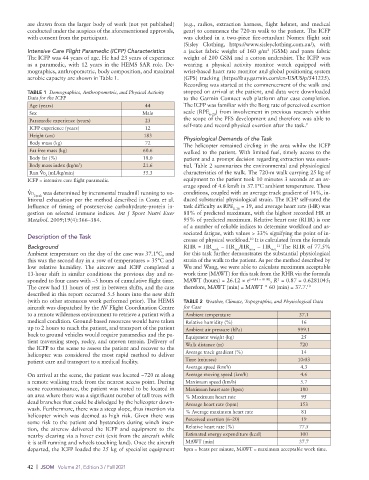
          TABLE 1  Demographics, Anthropometric, and Physical Activity   stopped on arrival at the patient, and data were downloaded
          Data for the ICFP                                  to the Garmin Connect web platform after case completion.
           Age (years)                          44           The ICFP was familiar with the Borg rate of perceived exertion
           Sex                                  Male         scale (RPE 6-20 ) from involvement in previous research within
           Paramedic experience (years)         23           the scope of the PES development and therefore was able to
                                                                                                     9
           ICFP experience (years)              12           self-rate and record physical exertion after the task.
           Height (cm)                          183          Physiological Demands of the Task
           Body mass (kg)                       72           The helicopter remained circling in the area whilw the ICFP
           Fat free mass (kg)                   60.6         walked to the patient. With limited fuel, timely access to the
           Body fat (%)                         18.0         patient and a prompt decision regarding extraction was essen-
           Body mass index (kg/m )              21.6         tial. Table 2 summarizes the environmental and physiological
                           2
              •
           Run Vo (mL/kg/min)                   55.3         characteristics of the walk. The 720-m walk carrying 25 kg of
                2
          ICFP = intensive care flight paramedic.            equipment to the patient took 10 minutes 3 seconds at an av-
                                                             erage speed of 4.6 km/h in 37.1°C ambient temperature. These
          •
          Vo 2peak  was determined by incremental treadmill running to vo-  conditions, coupled with an average track gradient of 14%, in-
          litional exhaustion per the method described in Costa et al.   duced substantial physiological strain. The ICFP self-rated the
          Influence of timing of postexercise carbohydrate-protein in-  task difficulty as RPE 6-20  = 19, and average heart rate (HR) was
          gestion on selected immune indices.  Int J Sport Nutri Exer   81% of predicted maximum, with the highest recorded HR at
          Metabol. 2009;19(4):366–384.                       95% of predicted maximum. Relative heart rate (RHR) is one
                                                             of a number of reliable indices to determine workload and as-
                                                             sociated fatigue, with values > 33% signifying the point of in-
          Description of the Task                                                  10
                                                             crease of physical workload.  It is calculated from the formula
          Background                                         RHR = HR work  – HR /HR max  – HR rest. 11   The RHR of 77.5%
                                                                              rest
          Ambient temperature on the day of the case was 37.1°C, and   for this task further demonstrates the substantial physiological
          this was the second day in a row of temperatures > 35°C and   strain of the walk to the patient. As per the method described by
          low  relative  humidity.  The  aircrew  and  ICFP  completed  a   Wu and Wang, we were able to calculate maximum acceptable
          13-hour shift in similar conditions the previous day and re-  work time (MAWT) for this task from the RHR via the formula
          sponded to four cases with ~5 hours of cumulative flight time.   MAWT (hours) = 26.12 × e (–4.81 × RHR) , R  = 0.87 = 0.6281045;
                                                                                            2
          The crew had 11 hours of rest in between shifts, and the case   therefore, MAWT (min) = MAWT * 60 (min) = 37.7. 10
          described in this report occurred 5.5 hours into the new shift
          (with no other strenuous work performed prior). The HEMS   TABLE 2  Weather, Climate, Topographic, and Physiological Data
          aircraft was dispatched by the AV Flight Coordination Centre   for Case
          to a remote wilderness environment to retrieve a patient with a   Ambient temperature    37.1
          medical condition. Ground-based resources would have taken   Relative humidity (%)       16
          up to 2 hours to reach the patient, and transport of the patient   Ambient air pressure (hPa)  999.1
          back to ground vehicles would require paramedics and the pa-  Equipment weight (kg)      25
          tient traversing steep, rocky, and uneven terrain. Delivery of
          the ICFP to the scene to assess the patient and recover to the   Walk distance (m)       720
          helicopter was considered the most rapid method to deliver   Average track gradient (%)  14
          patient care and transport to a medical facility.   Time (min:sec)                      10:03
                                                              Average speed (km/h)                 4.3
          On arrival at the scene, the patient was located ~720 m along   Average moving speed (km/h)  4.6
          a remote walking track from the nearest access point. During   Maximum speed (km/h)      5.7
          scene reconnaissance, the patient was noted to be located in   Maximum heart rate (bpm)  180
          an area where there was a significant number of tall trees with   % Maximum heart rate   95
          dead branches that could be dislodged by the helicopter down-  Average heart rate (bpm)  153
          wash. Furthermore, there was a steep slope, thus insertion via
          helicopter winch was deemed as high risk. Given there was   % Average maximum heart rate  81
          some risk to the patient and bystanders during winch inser-  Perceived exertion (6–20)   19
          tion, the aircrew delivered the ICFP and equipment to the   Relative heart rate (%)      77.5
          nearby clearing via a hover exit (exit from the aircraft while   Estimated energy expenditure (kcal)  100
          it is still running and wheels touching land). Once the aircraft   MAWT (min)            37.7
          departed, the ICFP loaded the 25 kg of specialist equipment   bpm = beats per minute, MAWT = maximum acceptable work time.


          42  |  JSOM   Volume 21, Edition 3 / Fall 2021

