


Page 91 - JSOM Spring 2021
P. 91
Making Use of Your Assets

                        Clinical Use of EOD Radiography in the Forward-Deployed Setting


                     Caitlin Howard, MD *; Shawn Veach, BSN, RN ; Regan Lyon, MD ; K. Aaron Shaw, DO     4
                                        1
                                                                                    3
                                                                  2


              ABSTRACT
              Ultrasonography  is currently  the  primary  means  of imaging   from the radiographic images proved to be extremely useful in
              for forward surgical teams/forward resuscitative surgical   formulating treatment and evacuation plans for select trauma
              teams (FSTs/FRSTs). As FSTs/FRSTs are pushed farther for-  and sick call patients.
              ward into more austere environments, access to other imaging
              modalities may be limited, potentially affecting resources. On   Radiology Equipment
              a recent deployment, the 126th FRST was able to use radiogra-
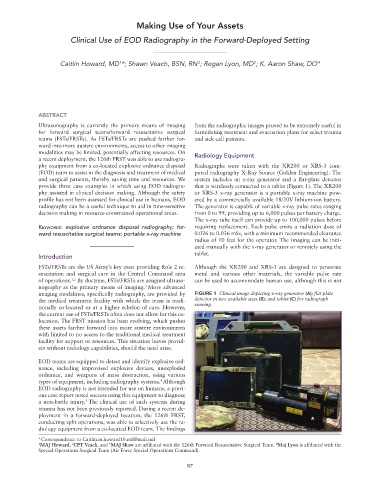
              phy equipment from a co-located explosive ordnance disposal   Radiographs  were  taken  with  the  XR200  or  XRS-3  com-
              (EOD) team to assist in the diagnosis and treatment of medical   puted radiography X-Ray Source (Golden Engineering). The
              and surgical patients, thereby saving time and resources. We   system includes an x-ray generator and a flat-plate detector
              provide three case examples in which using EOD radiogra-  that is wirelessly connected to a tablet (Figure 1). The XR200
              phy assisted in clinical decision making. Although the safety   or XRS-3 x-ray generator is a portable x-ray machine pow-
              profile has not been assessed for clinical use in humans, EOD   ered by a commercially available 18/20V lithium-ion battery.
              radiography can be a useful technique to aid in time-sensitive   The generator is capable of variable x-ray pulse rates ranging
              decision making in resource-constrained operational areas.  from 0 to 99, providing up to 6,000 pulses per battery charge.
                                                                 The x-ray tube itself can provide up to 100,000 pulses before
              Keywords:  explosive ordnance disposal radiography; for-  requiring replacement. Each pulse emits a radiation dose of
              ward resuscitative surgical teams; portable x-ray machine  0.026 to 0.036 mSv, with a minimum recommended clearance
                                                                 radius of 10 feet for the operator. The imaging can be initi-
                                                                 ated manually with the x-ray generator or remotely using the
                                                                 tablet.
              Introduction
              FSTs/FRSTs are the US Army’s key asset providing Role 2 re-  Although the XR200 and XRS-3 are designed to penetrate
              suscitation  and  surgical  care  in  the  Central  Command  area   metal and various other materials, the variable pulse rate
                        1,2
              of operations.  By doctrine, FSTs/FRSTs are assigned ultraso-  can be used to accommodate human use, although this is not
                                                3
              nography as the primary means of imaging. More advanced
              imaging modalities, specifically radiography, are provided by   FIGURE 1  Clinical image depicting x-ray generator (A); flat plate
              the medical treatment facility with which the team is tradi-  detector in two available sizes (B); and tablet (C) for radiograph
              tionally co-located or at a higher echelon of care. However,   viewing.
              the current use of FSTs/FRSTs often does not allow for this co-
              location. The FRST mission has been evolving, which pushes
              these assets farther forward into more austere environments
              with limited to no access to the traditional medical treatment
              facility for support or resources. This situation leaves provid-
              ers without radiology capabilities, should the need arise.

              EOD teams are equipped to detect and identify explosive ord-
              nance, including improvised explosive devices, unexploded
              ordnance, and weapons of mass destruction, using various
                                                     4
              types of equipment, including radiography systems. Although
              EOD radiography is not intended for use on humans, a previ-
              ous case report noted success using this equipment to diagnose
              a non-battle injury. The clinical use of such systems during
                             5
              trauma has not been previously reported. During a recent de-
              ployment  in  a  forward-deployed  location,  the  126th  FRST,
              conducting split operations, was able to selectively use the ra-
              diology equipment from a co-located EOD team. The findings
              *Correspondence to Caitlin.m.howard10.mil@mail.mil
              1 MAJ Howard,  CPT Veach, and  MAJ Shaw are affiliated with the 126th Forward Resuscitative Surgical Team.  Maj Lyon is affiliated with the
                                                                                           4
                         2
                                     3
              Special Operations Surgical Team (Air Force Special Operations Command).
                                                              87

