


Page 86 - JSOM Spring 2021
P. 86
reported in a small group of athletes.  In subjects under du-  The European Food Safety Authority has deemed that intakes
                                       104
          ress, Giles et al. found that anger and confusion remained sta-  of up to 5g/d EPA+DHA are safe and “do not appear to in-
          ble in the FOS group but did not have an effect on fatigue.    crease the risk of spontaneous bleeding episodes or bleeding
                                                        112
          Conversely, Black et al. reported that FOS led to a likely mod-  complications. . . .”  Even in perioperative settings, compel-
                                                                            118
          erate beneficial effect on subjective feelings of fatigue in pro-  ling evidence suggests that FOS does not significantly increase
          fessional athletes.  However, the effect on other mood states   bleeding. A systematic review of 52 studies found that FOS
                        70
          was deemed trivial. Similarly, two previous studies found that   did not increase bleeding during or after surgery.  Similar
                                                                                                     119
          self-reported mental fatigue was significantly less in the FOS   findings were reported after cardiac surgery.  Also, FOS does
                                                                                               120
          groups. 109,110  However, in both studies, other mood states were   not increase bleeding even with concurrent aspirin or warfarin
          not affected.                                      use.  Given the lack of evidence in clinical populations, FOS
                                                                121
                                                             should not pose any bleeding risks to healthy adults, such as
                                                             athletes or SOF personnel.
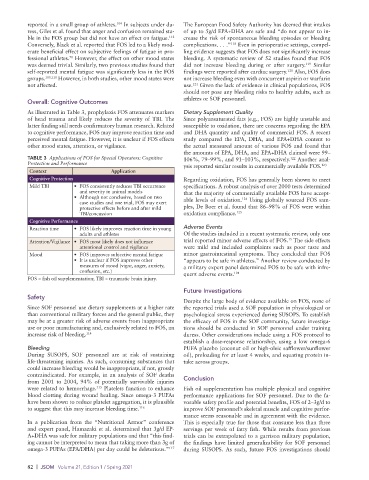
          Overall: Cognitive Outcomes
          As illustrated in Table 3, prophylaxis FOS attenuates markers   Dietary Supplement Quality
          of head trauma and likely reduces the severity of TBI. The   Since polyunsaturated fats (e.g., FOS) are highly unstable and
          latter finding still needs confirmatory human research. Related   susceptible to oxidation, there are concerns regarding the EPA
          to cognitive performance, FOS may improve reaction time and   and DHA quantity and quality of commercial FOS. A recent
          perceived mental fatigue. However, it is unclear if FOS effects   study  compared  the  EPA,  DHA,  and  EPA+DHA  content  to
          other mood states, attention, or vigilance.        the actual measured amount of various FOS and found that
                                                             the amounts of EPA, DHA, and EPA+DHA claimed were 99–
          TABLE 3  Applications of FOS for Special Operators: Cognitive   106%, 79–99%, and 91–103%, respectively.  Another anal-
                                                                                                122
          Protection and Performance                         ysis reported similar results in commercially available FOS. 123
           Context                   Application
           Cognitive Protection                              Regarding oxidation, FOS has generally been shown to meet
           Mild TBI      • FOS consistently reduces TBI occurrence  specifications. A robust analysis of over 2000 tests determined
                           and severity in animal models     that the majority of commercially available FOS have accept-
                         • Although not conclusive, based on two  able levels of oxidation.  Using globally sourced FOS sam-
                                                                                124
                           case studies and one trial, FOS may exert
                           protective effects before and after mild  ples, De Boer et al. found that 86–98% of FOS were within
                           TBI/concussion                    oxidation compliance. 125
           Cognitive Performance
           Reaction time  • FOS likely improves reaction time in young  Adverse Events
                           adults and athletes               Of the studies included in a recent systematic review, only one
                                                                                               15
           Attention/Vigilance • FOS most likely does not influence  trial reported minor adverse effects of FOS.  The side effects
                           attentional control and vigilance  were mild and included complaints such as poor taste and
           Mood          • FOS improves subjective mental fatigue  minor gastrointestinal symptoms. They concluded that FOS
                         • It is unclear if FOS improves other  “appears to be safe in athletes.” Another review conducted by
                           measures of mood (vigor, anger, anxiety,  a military expert panel determined FOS to be safe with infre-
                           confusion, etc.)                  quent adverse events. 101
          FOS = fish oil supplementation; TBI = traumatic brain injury.
                                                             Future Investigations
          Safety
                                                             Despite the large body of evidence available on FOS, none of
          Since SOF personnel use dietary supplements at a higher rate   the reported trials used a SOF population in physiological or
          than conventional military forces and the general public, they   psychological stress experienced during SUSOPS. To establish
          may be at a greater risk of adverse events from inappropriate   the efficacy of FOS in the SOF community, future investiga-
          use or poor manufacturing and, exclusively related to FOS, an   tions  should  be  conducted  in  SOF  personnel  under  training
          increase risk of bleeding. 114                     duress. Other considerations include using a FOS protocol to
                                                             establish a dose-response relationship, using a low omega-6
          Bleeding                                           PUFA placebo (coconut oil or high-oleic safflower/sunflower
          During SUSOPS, SOF personnel are  at risk  of sustaining   oil), preloading for at least 4 weeks, and equating protein in-
          life-threatening injuries. As such, consuming substances that   take across groups.
          could increase bleeding would be inappropriate, if not, grossly
          contraindicated. For example, in an analysis of SOF deaths   Conclusion
          from 2001 to 2004, 94% of potentially survivable injuries
          were related to hemorrhage.  Platelets function to enhance   Fish oil supplementation has multiple physical and cognitive
                                 115
          blood clotting during wound healing. Since omega-3 PUFAs   performance applications for SOF personnel. Due to the fa-
          have been shown to reduce platelet aggregation, it is plausible   vorable safety profile and potential benefits, FOS of 2–3g/d to
          to suggest that this may increase bleeding time. 116  improve SOF personnel’s skeletal muscle and cognitive perfor-
                                                             mance seems reasonable and in agreement with the evidence.
          In a publication from the “Nutritional Armor” conference   This is especially true for those that consume less than three
          and expert panel, Hamazaki et al. determined that 3g/d EP-  servings per week of fatty fish. While results from previous
          A+DHA was safe for military populations and that “this find-  trials can be extrapolated to a garrison military population,
          ing cannot be interpreted to mean that taking more than 3g of   the findings have limited generalizability for SOF personnel
          omega-3 PUFAs (EPA/DHA) per day could be deleterious.”    during SUSOPS. As such, future FOS investigations should
                                                        117

          82  |  JSOM   Volume 21, Edition 1 / Spring 2021

