


Page 83 - JSOM Spring 2021
P. 83
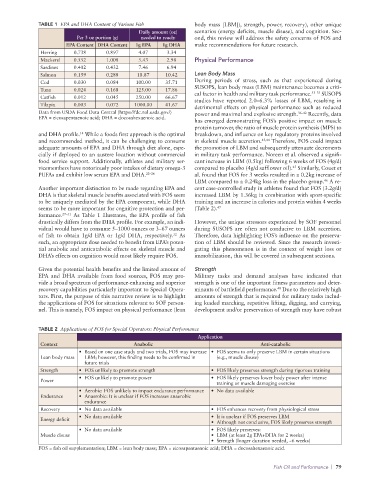
TABLE 1  EPA and DHA Content of Various Fish       body mass [LBM]), strength, power, recovery), other unique
                                              Daily amount (oz)   scenarios (energy deficits, muscle disuse), and cognition. Sec-
                          Per 3 oz portion (g)  needed to reach:  ond, this review will address the safety concerns of FOS and
                       EPA Content DHA Content  1g EPA  1g DHA   make recommendations for future research.
              Herring    0.738      0.897     4.07     3.34
              Mackerel   0.552      1.008     5.43     2.98      Physical Performance
              Sardines   0.402      0.432     7.46     6.94
              Salmon     0.159      0.288     18.87    10.42     Lean Body Mass
              Cod        0.030      0.084    100.00    35.71     During periods of stress, such as that experienced during
              Tuna       0.024      0.168    125.00    17.86       SUSOPS, lean body mass (LBM) maintenance becomes a criti-
                                                                 cal factor in health and military task performance.
                                                                                                            SUSOPS
                                                                                                       33–35
              Catfish    0.012      0.045    250.00    66.67     studies have reported 2.0–6.3% losses of LBM, resulting in
              Tilapia    0.003      0.072    1000.00   41.67     detrimental effects on physical performance such as reduced
              Data from USDA Food Data Central (https://fdc.nal.usda.gov/)  power and maximal and explosive strength. 36–42  Recently, data
              EPA = eicosapentaenoic acid; DHA = docosahexaenoic acid.
                                                                 has emerged demonstrating FOS’s positive impact on muscle
                                                                 protein turnover, the ratio of muscle protein synthesis (MPS) to
              and DHA profile.  While a foods first approach is the optimal   breakdown, and influence on key regulatory proteins involved
                           14
              and recommended method, it can be challenging to consume   in skeletal muscle accretion. 43,44  Therefore, FOS could impact
              adequate amounts of EPA and DHA through diet alone, espe-  the promotion of LBM and subsequently attenuate decrements
              cially if deployed to an austere location without commercial   in military task performance. Noreen et al. observed a signifi-
              food service support. Additionally, athletes and military ser-  cant increase in LBM (0.5kg) following 6 weeks of FOS (4g/d)
              vicemembers have notoriously poor intakes of dietary omega-3   compared to placebo (4g/d safflower oil).  Similarly, Couet et
                                                                                                 45
              PUFAs and exhibit low serum EPA and DHA. 22–26     al. found that FOS for 3 weeks resulted in a 0.2kg increase of
                                                                 LBM compared to a 0.24kg loss in the placebo group.  A re-
                                                                                                           46
              Another important distinction to be made regarding EPA and   cent case-controlled study in athletes found that FOS (3.2g/d)
              DHA is that skeletal muscle benefits associated with FOS seem   increased LBM by 1.36kg in combination with sport-specific
              to be uniquely mediated by the EPA component, while DHA   training and an increase in calories and protein within 4 weeks
              seems to be more important for cognitive protection and per-  (Table 2). 47
              formance. 27 –31  As Table 1 illustrates, the EPA profile of fish
              drastically differs from the DHA profile. For example, an indi-  However, the unique stressors experienced by SOF personnel
              vidual would have to consume 5–1000 ounces or 3 – 67 ounces   during SUSOPS are often not conducive to LBM accretion.
              of fish to obtain 1g/d EPA or 1g/d DHA, respectively.  As   Therefore, data highlighting FOS’s influence on the preserva-
                                                          32
              such, an appropriate dose needed to benefit from EPA’s poten-  tion of LBM should be reviewed. Since the research investi-
              tial anabolic and anticatabolic effects on skeletal muscle and   gating this phenomenon is in the context of weight loss or
              DHA’s effects on cognition would most likely require FOS.  immobilization, this will be covered in subsequent sections.

              Given the potential health benefits and the limited amount of   Strength
              EPA and DHA available from food sources, FOS may pro-  Military tasks and demand analyses have indicated that
              vide a broad spectrum of performance-enhancing and superior   strength is one of the important fitness parameters and deter-
              recovery capabilities particularly important to Special Opera-  minants of battlefield performance.  Due to the relatively high
                                                                                            48
              tors. First, the purpose of this narrative review is to highlight   amounts of strength that is required for military tasks includ-
              the applications of FOS for situations relevant to SOF person-  ing loaded marching, repetitive lifting, digging, and carrying,
              nel. This is namely, FOS impact on physical performance (lean   development and/or preservation of strength may have robust


              TABLE 2  Applications of FOS for Special Operators: Physical Performance
                                                                  Application
              Context                        Anabolic                                 Anti-catabolic
                           • Based on one case study and two trials, FOS may increase • FOS seems to only preserve LBM in certain situations
              Lean body mass   LBM; however, this finding needs to be confirmed in  (e.g., muscle disuse)
                             future trials
              Strength     • FOS unlikely to promote strength         • FOS likely preserves strength during rigorous training
                           • FOS unlikely to promote power            • FOS likely preserves lower body power after intense
              Power
                                                                        training or muscle damaging exercise
                           • Aerobic: FOS unlikely to impact endurance performance  • No data available
              Endurance    • Anaerobic: It is unclear if FOS increases anaerobic
                             endurance
              Recovery     • No data available                        • FOS enhances recovery from physiological stress
                           • No data available                        • It is unclear if FOS preserves LBM
              Energy deficit
                                                                      • Although not conclusive, FOS likely preserves strength
                           • No data available                        • FOS likely preserves:
              Muscle disuse                                           • LBM (at least 2g EPA+DHA for 2 weeks)
                                                                      • Strength (longer duration needed, ~6 weeks)
              FOS = fish oil supplementation; LBM = lean body mass; EPA = eicosapentaenoic acid; DHA = docosahexaenoic acid.

                                                                                          Fish Oil and Performance  |  79

